
No Joe Schmo Featured on Forbes’ Top 75 Websites For Your Career

Big, exciting news for No Joe Schmo this weekend! From a roster of roughly 700 different websites, NoJoeSchmo.com was selected as one of Forbes’ Top 75 Websites For Your Career. From Forbes.com:

No Joe Schmo delves behind the scenes of jobs you wish you had (like the roller coaster engineer), jobs that make you squirm (the alligator wrestler), and jobs you didn’t know existed (the dirty car window artist). The men and women who comprise the fabric of No Joe Schmo hail from local communities to mass markets. And while you probably wouldn’t recognize them on TV, their stories and career paths are just as inspirational, insightful, and worthwhile.

The list, which was assembled by Forbes writers Jacquelyn Smith and Susan Adams, is the first of its kind on Forbes.com; it was inspired by ForbesWoman’s list of Top 100 Websites For Women. The “comprehensive guide to smart and engaging sites” incudes a wide range of sites, including “blogs, job aggregators and boards, personal career coaching pages, and traditional media outlets’ career sites that could be useful to those in traditional 9 to 5 office jobs.”

No Joe Schmo launched about 16 months ago with an inaugural post about a hot, young, and single circus ringmaster. To date, the site has featured more than 90 individuals with cool, crazy jobs, including a Foodie Fridays series and tidbits of career advice.

A big thanks goes out to all No Joe Schmo’s loyal readers, interviewees, and interview coordinators. You can continue your support in several ways:

  • Suggest a No Joe Schmo: either a specific person or a cool job you heard about
  • “Like” the No Joe Schmo Facebook page for inside scoops, photos, and polls
  • Subscribe to No Joe Schmo and receive notifications of new posts right to your email inbox. Click the +Follow button that appears in the toolbar at the top of the site when you’re logged into WordPress.com.

Here’s to lots more #NoJoeSchmo love!

9 Rules For Creative Genius

Photo: uncyclopedia.wikia.com

As an art director at Sideshow Collectibles in Thousand Oaks, Calif., David Igo begins each morning with an inbox stuffed with freelancers’ artwork. Before noon, he sorts through about a dozen sketches from artists vying to work on projects for the retailer that manufactures collectible figures for various movie, film, and television properties, including Lord of the Rings and Star Wars.

The 29-and-a-half-year-old has learned quite a bit about finding success while still being able to laugh at himself. (“That’s how you can gauge my maturity – I add the ½ to my age,” Igo says.) He spews nuggets of wisdom throughout our talk: “If you love something, there’s some way to make it work. You must find joy in your job, not simply use it a means to an end.”

Yet this can be easier said than done. Below, Igo describes 9 ways to get your creative genius on.

1. Don’t be a lemming. In 2004, I went to Comic Con to shoot my portfolio around. There were all these big portfolio review lines, but I skipped them. I went straight up to booths and asked to speak with artists. Sometimes I hit gold and talked to one; other times, I was handed off to a public relations person. I passed out 30 copies of my portfolio that weekend. During the last hour of Comic Con on Sunday, when I’d pretty much given up all hope, one of the guys I had talked to approached me about a job as a concept artist.

2. Find creative balance. A lot of people burn out from being creative on the clock. I’ve worked my way into an art director’s position so that I’m working with amazing artists, but save my personal art energy for my own stuff.

3. Use disadvantages to your advantage. I’m color blind, so I focus more on pose and line art with my mechanical pencil and paper than full-blown paintings.

4. Don’t always feel the need to convey a “deeper meaning” with your product. I’m a huge product of 80s cartoons, like Transformers, G.I. Joe, Dragon Ball Z, and ThunderCats. They are ridiculous, fun, over-the-top stories and visuals. I try to have fun like that when I’m drawing.

5. You can’t make everyone happy. Sometimes, you need to make sacrifices and admit that your idea might not be the best. Don’t sit on your mistakes; find ways to make them better. That said, I try to make as many people as possible happy.

6. Know how and when to assert yourself. If someone screws you over, hold your ground – but not in a malicious way. People will trust and respect you more for it. You just have to put on your daddy pants sometimes.

7. Never say something aloud about someone you wouldn’t say to his or her face. Once, I was venting about one of my bosses, and it turned out he was right around the corner and overheard. But I had that motto in my head, so I wasn’t saying anything I wouldn’t have said to his face. I just wouldn’t have chosen to say those things to his face.

8. Be the guy (or girl) that people want to work with. When you approach someone, don’t make it all about you. Talk with others about what they do and show a genuine interest.

9. Constantly add to your portfolio. Keep improving: working hard and show progress. Then follow up: If there’s a company you really want to work for, you need to stay on its radar. I think there’s a happy medium between a jack-of-all-trades and a master of none. Flexibility and dexterous skills will make you that much more valuable; advance with technology and always be on the lookout for what’s next.

More No Joe Schmo tips and advice: 5 rules for finding a job on Twitter and 7 LinkedIn tips for recent grads

Sample David’s artwork and art direction below. Find more of his on Sideshow Collectibles and his personal art site, Satellite Soda.

This slideshow requires JavaScript.

Foodie Friday: The Cheese Makers

At Edgwick Farm, Talitha Thurau and her business partner Dan Jones sell eight different types of goat’s milk cheeses, plus a few seasonal ones.

Talitha Thurau was raised on one of the first certified organic farms in Massachusetts, where her stepfather tore out the family’s oil heater so they could learn to cook on a wood stove. As a teenager, she milked goats before hauling off to homeroom. After graduating from high school, she couldn’t wait to escape farm life, and traveled far, far away, becoming a lawyer in Brooklyn, N.Y.

About 10 years later, after having children, Talitha rediscovered her roots. She moved upstate to Cornwall, N.Y., where she shares nine acres of land with 50 goats, 60 chickens, 14 ducks, four dogs, and three cats. Last year, the seasoned farmer received a commercial license for Edgwick Farm with partner Dan Jones, and now spends just as many hours making and selling cheese as she did practicing law.

“I took my childhood on the farm for granted,” she says. “Now, so do my kids. People go crazy over our cheese, and my sons say, Mom, what’s wrong with these people? We eat this every day!’”

Age: 48
Graduated from: The New School, B.A. in liberal arts; CUNY School of Law
Based in: Cornwall, N.Y.

What guided your path from law school to cheese? After graduating from CUNY Law, I moved to Park Slope [in Brooklyn, N.Y.] and practiced law for 10 years. Then, I had kids and wanted to go back to my roots. I wanted my kids to eat right and live right, just like I had. My [now] ex-husband and I drew a big line around New York City and settled in Cornwall, about 55 miles away. We got goats and I made cheese when I had too much milk.

“[These girls] are challenging and beautiful,” reads the caption to this photo on Edgwick Farm’s Facebook page. Udderly challenging and beautiful, that is.
The process: We milk 40 of our 50 goats twice each day, pasteurize the milk, and then hang and drain it. Once you get all the whey out, you can make whatever cheese you want. But you can’t just follow a recipe; you need to look at how the milk behaves, based on the weather and the goat’s diet. I use pH strips for milk coagulation tests. Each batch of cheese is different.

That’s a lot of goats. Do you have help? Over the summer, we had a bunch of college students working as milkmaids. But I like getting in there, feeling the milk and curds, seeing what my girls are producing.

How do you differentiate yourselves from dozens of other cheese makers in upstate New York? We have the minerals from the soil and water of the Hudson Valley, which makes a big difference. Our milk is always fresh; it gets made into cheese within 24 to 48 hours. Great milk makes great cheese. Plus, our community is Cornwall is incredibly supportive.

How did you meet Dan Jones, your business partner at Edgwick Farm? He was a family friend in Cornwall, and we both went through divorces. In 2006, we took a training class to figure out whether cheese making was a viable business. It took five years to build the infrastructure of our business.

Dan says: I was Talitha’s backup milker when she went on vacation in 2003, and she kept me on after that. She began serving her cheese at barbecues and parties, and people raved about it, so I suggested going full-time together. We got a $120,000 grant from the U.S. Department of Agriculture, which gave us a leg up.

Talitha and Dan store all the cheese in a “cave,” or make room, which is a 6’ x 6’ walk-in cooler set at a certain humidity.

Your most popular cheese: Chèvre, which is the basic spreadable goat cheese. We marinate it in olive oil, Herbs de Provence, and freshly diced garlic for 10 to 15 days.

At this point in our conversation, Talitha tells me to hold. Chickens cluck in the background. “What are you throwing at the chickens?” she yells to Dan. Then she returns, apologizing.

Your favorite cheese: Sackett Ridge hard cheese. It’s a cheddar recipe that takes a few days of pressing and drying and six months of aging. It’s a sweet, mild golden wheel that sharpens over time.

How do you name your cheeses? Artisan cheese makers name their cheeses after local landmarks. Sackett Ridge is a landmark we can see from our farm.

Best part of your job: When baby goats are born. There’s nothing like it – it’s so joyous.

Most challenging part of your job: Where you have joyous birth, you’ll always have death, which is heartbreaking and difficult. Recently, we had a fox come through the farm and take a mother hen. Her chick has been walking around calling for her. I still cry whenever an animal dies.

Amount of cheese sold this year: About 20,000 pieces, which I hope to be 28,000 by December. I label each one by hand.

What does success look like for you? Feeding our neighbors in the Hudson Valley. Dan and I don’t want to be rich and famous; we just want enough money to feed our goats and make the most fantastic cheese possible.

Best autumn recipe using cheese: Bruschetta. Cover toasted bread with marinated Canterbury cheese and gorgeous heirloom tomatoes, and then marinate it.

On the agenda for this year: We’d like to teach people how to make cheese in their kitchens and how to have backyard goats. You need at least two goats; they’re herd animals that would be miserable alone. We also want to have backyard chicken-raising contests.

Your favorite cooking show: Oh, we don’t have a TV. We do read the New York Times every day, though. And we’re connected to many chefs in the Hudson Valley.

Do your children appreciate farm life in the way you wish you had? Between Dan and I, we have five teenagers. This is something they’ve always known, so they want to have their own lives. We have to give them that opportunity.

LAUNCHING YOUR CAREER>>
1. Connect with those who make cheese or enroll in classes. Take a look at Peter Dixon’s website and the Cheese Forum.

2. To make cheese in your kitchen, put two or three gallons of milk into a double boiler. No animals or bread-making in the kitchen, though. Yeast and other living critters will cross-contaminate it.

3. Most importantly, get good milk; that’s where it all starts. Raw milk is the best milk to make cheese with in your kitchen.

More information about Edgwick Farm is available on its blog and Facebook page. All photos and video courtesy of Edgwick Farm.

NEXT: Meet more Foodie Fridays, like the submarine chef and the food chemist.

Submit Your Questions: The Coney Island Carny

Come one, come all >> This weekend, we’re taking the F train to the southern tip of Brooklyn for an exclusive with a Coney Island Circus Sideshow sensation. Here’s a taste of his acts to whet your palette: juggling swords, eating fire, and walking across beds of nails. Below, submit your questions for the jack-of-all-trades. Don’t hold back.

Accepting questions through Friday, August 31

← Back

Thank you for your response. ✨

Carny-crazy? Last year, No Joe Schmo spoke with the young, hot, and single ringmaster of the Big Apple Circus.

The Dirty Car Artist

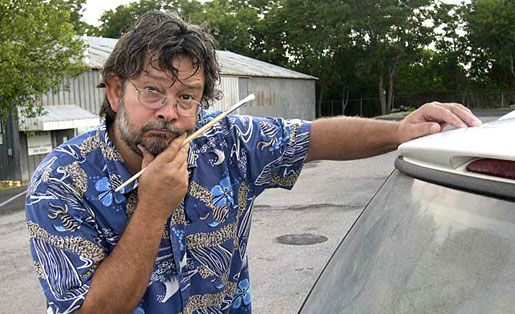
Scott Wade was dubbed “Lord of the Dust” at an event in Istanbul, Turkey, and “the da Vinci of Dust” by the National Enquirer.

Like many others with families to support and mortgages to pay, Scott Wade works full-time in an office cubicle, glued to his computer screen for a majority of daylight hours.

But in his other life, cars are his art and dirt is his palette.

Wade began doodling in filthy car windows as a way to relieve the stresses of his 9-to-5 job as a graphical user interface designer. He discovered a new meaning of “screen time” — one that involved intricate designs on windshields and 10-foot-tall storefront windows. A hobby that began on small-town dirt roads in Texas evolved into the viral phenomenon of Dirty Car Art, bringing Wade to Lisbon, Istanbul, and London. But his toolkit remains simple: brushes and vegetable oil.

“[My artwork] challenges our perceptions of what’s beautiful,” Wade explains in earnest. “It takes what we think of as an eyesore, and flips that on its head.” But like sidewalk chalk art and sand sculptures at the beach, impermanence comes with the territory. His masterpieces only last until the next rain.

Age: 53
Graduated from: Texas State University, BFA in commercial art
In the business for: 9 years
Based in: Wimberley, Texas (about 30 minutes from Austin)
Previous jobs: Arts and crafts instructor; freelance designer; drummer

The dusty roads in Texas must make for ideal dirty car conditions. I used to live on a long dirt road, and the blend of limestone dust and gravel and clay resulted in a fine white dust that coated the rear window. My first 50 or 60 creations were on cars that got naturally dirty just from driving up and down that road, building up successive layers baked on by heat and humidity.

And now? I don’t live on that dirt road anymore, and I’m doing a lot more creations for events. So I had to figure out a way to make a car dirty that wasn’t. I ordered Fuller’s Earth substitute — the same thing that makes dust clouds in the movies — and made it stick to the windows with a thin coat of vegetable oil. But I still love working on real dirty cars; they look much more three-dimensional. I miss those old days.

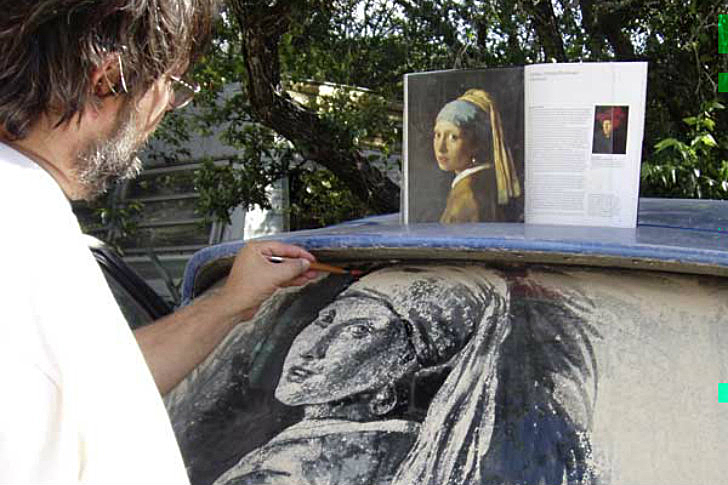
Wade creates original drawings as well as representations of recognizable art, such as Girl with a Pearl Earring.

What sparked your realization that a dirty rear window makes the perfect canvas? If you’re a fairly curious person, you can’t resist playing on a dirty car window, even if it’s just a smiley face or a “wash me.” It’s an impermanent canvas, so you’re free to play with it.

It probably helped that you majored in art. I think I picked up drawing from my dad; he was a really good amateur cartoonist. Living on a mile and a half of dirt roads, we never washed our car, so I’d always doodle in the windows. Then, one day, I used my fingernail and a popsicle stick to do some cross-hatching. And then I went inside to get my brushes, and realized that I’d found a real medium.

Your toolkit: A chisel-point rubber paint shaper tool, which acts like a pencil; different-sized fan brushes; and large brushes for the background. I do lot of work in Adobe Photoshop to figure out my designs, but the dirt is forgiving.

Do you carry the brushes with you for unsuspecting dirty cars? Sometimes, actually. That would be a great candid camera TV show: I could hang out at movie theaters, and when a really dirty car pulls up, draw in their windows. Since they’re at a movie theater, you know they’ll be gone for at least an hour or so.

Your first drawing: A reproduction of the Mona Lisa with van Gogh’s Starry Night in the background. I sent it to some friends via email, and bloggers began linking to it. Then I got a call from the National Enquirer.

And then your work went viral. Did that surprise you? Who would have thought people like looking at dirty pictures on the Internet? [Laughs.] I did receive some serious flack for a portrait of my daughter, which looked like she was being abducted. It was supposed to be funny, but it turned out creepy.

Your dream dirt drawing: I want to do a portrait using someone’s cremated ashes on the windows of a hearse. It would be weird, but also compelling.


Best part of your job: Most artists are isolated in their studios, but I’m creating artwork while people look on and talk to me. It took awhile to get used to, but I really enjoy that aspect.

Most challenging part of your job: Dealing with the business side of things, which I think a lot of artists can relate to. The medium itself is also very challenging. Dirt is not uniform, and the results are never what I totally expect.

What would people be surprised to learn about your job? A dirty car is typically an ugly thing. But when people see that dirt can be turned into beautiful art, it really challenges their perceptions.

Best reaction to telling a stranger about your line of work: I always get a cocked eyebrow. I can tell they’re thinking, Oh, it’s probably just some little doodles. Then I show my representation of the Birth of Venus by Botticelli, and they’re totally floored.

Do you wear protective gear to avoid breathing in dirt and dust? I might wear a paper mask, depending on the wind’s direction. When drawing on storefront windows, I wear goggles and a respirator.

You mentioned the medium’s impermanence. How do you justify putting so much effort into something that the rain will wash off in seconds? It’s a lesson in letting go, in understanding that life is just a series of moments passing by. If you try to hang on to something, it causes grief and heartache. If you can just be happy you had the experience, it frees you up.

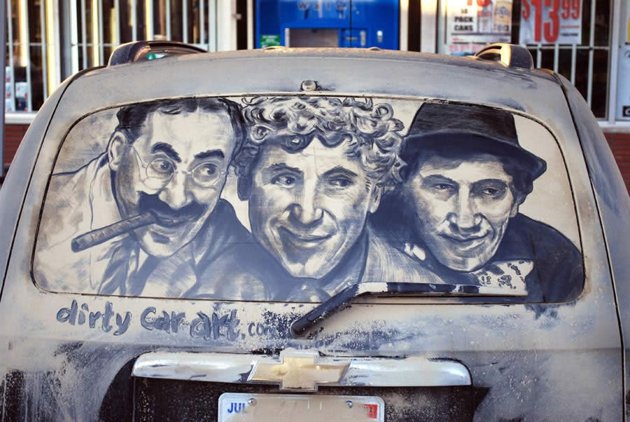
One of Wade’s most recent works: The Marx Brothers. His creations can take anywhere from 30 minutes to 6 hours.

Fee per job: I charge by the day, not by the car. My corporate rate is $3,500/day, especially overseas. My nonprofit rate ranges from $650/day to $1,200/day.

When you tell your daughter to clean her dirty room, does she argue it’s just “art”? I don’t think she’s ever used that argument, and I’m not going to mention it to her.

LAUNCHING YOUR CAREER>>
There are a lot of people who have made careers out of doing something special in their medium, like Julian Beever’s 3D pavement drawings. Be unique in the way you do art: that’s what gets attention. This type of work can be very rewarding and enriching. Click here for a full gallery of Scott Wade’s work.

Impressed by dirty car art? For more artsy No Joe Schmos, meet the glassblower and the pop-up paper engineer.