The Quidditch Olympian

Team USA competed at the Olympic Quidditch Expo Tournament in Oxford, England, this summer. Photo: Bernard Scott Taylor

This is not your wizard’s Quidditch.

Yes, players run with brooms wedged between their legs (wearing Spandex, of course, to prevent “bristle burn”). But in Muggle Quidditch, feet remain rooted firmly on the ground, and the snitch – that pesky winged golden sphere – is just a small ball velcroed to the waistband of the snitch runner.

As chaser for the first United States national Quidditch team, Kedzie Teller has the following bragging rights: he’s one of the top 21 Quidditch players in the country. He competed alongside the Olympic Torch Relay. He’s basically a real-life James Potter, minus that detail about fathering The Boy Who Lived.

Quidditch first manifested as a Muggle sport at Middlebury College in Vermont, the birthplace of the intercollegiate Quidditch World Cup in 2007. Now, 824 teams exist in the U.S. alone.

Although Teller brought home a gold medal from the Olympic Quidditch Expo Tournament in Oxford, England, this summer, he bemoans the reality that many perceive the sport as “a bunch of goofballs with brooms” chucking balls into trash cans. But to Teller and his teammates, the broom compares to a tennis racket on the court or a baseball bat on the diamond. It defines the sport.

Age: 22
Graduated from: Boston University, degree in journalism
Based in: Boston, Mass.
Years playing Quidditch: 4
Position: I’m one of three chasers. We rack up points, which means we manipulate the quaffle – which looks like a volleyball – to score on one of three hoops. It’s a full-contact sport.

Don’t try this at home. Source: harrypottergif.tumblr.com

Did the Harry Potter series spark your interest in the sport? I’ve read all the books and seen all the [Harry Potter] movies, but I can’t call myself a Potterhead. I’ve never been to a midnight release.

So why Quidditch? I was recruited to Boston University for track, but after my first year on the team, decided it wasn’t for me. I’m very competitive, and needed to get involved in another sport. When I saw a Quidditch match at the Boston Commons, my friends and I decided to go to a practice. Then I started playing, and took on a leadership role [as team captain for two years]. People knew me as “the Quidditch kid.”

Ratio of Potterheads to competitive athletes on your college team: The beauty of the sport is that it attracts a spectrum of people. On one side of the gamut, you have Harry Potter-obsessed people living their dream. Then, there’s the really intense athletes. It’s nice to have a chance to see those two types intermingle.

How did you learn to run with a broom between your legs? It’s funny watching it for the first time, and it’s always awkward. In the beginning, I got sidelined a lot because I thought I had more dignity than holding onto the broom. But then it becomes second nature, like riding a bike.
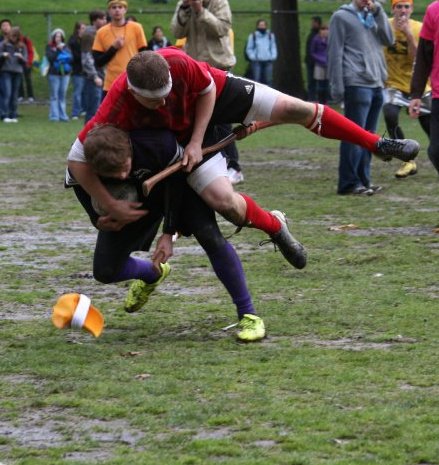
“This photo is definitely of an illegal tackle, but it still looks fun,” Teller says. Pictured: Boston University playing against Emerson College.

Have you sustained any serious injuries from Quidditch? I sprained my ankle at a regional tournament last spring, but that’s about it. There are lots of cuts and bruises among amateurs who don’t know how to use brooms, but the most common injury during games is concussions from people hitting heads.

I imagine you don’t use household brooms. The ones we use are made specially for Quidditch. The most commonly used broom in today’s game is called a Shadow Chaser, though many teams also use Scarlet Falcons. I have one of each, and I don’t differentiate between matches and practice. You’ll see PVC pipe homemade brooms in many tournaments, since they are cheap to make.

Do you play Quidditch daily? After the Olympic tournament this summer, I’ve been in a lull. Sometimes, I help out my college team; I’d love for them to gain club sport status, since it’s still considered a social club. But my main priority is planning for Boston Massacre, a community Quidditch team that I’m launching in May. Right now, I’m building the buzz for that, as well as working with the International Quidditch Association (IQA) to hold an international tournament in April 2013.

How do you pay the bills? I’m an information risk specialist at MassMutual Financial Group. But I’m tapping my fingers, waiting for the day to end so that I can play Quidditch.

Does your health insurance cover Quidditch-related injuries? [Laughs.] I’m on a good program that helps me cover the expense of a few injuries per year. [Mass Mutual] is super supportive; I actually went through the hiring process while I was overseas competing in the Olympics Quidditch tournament.
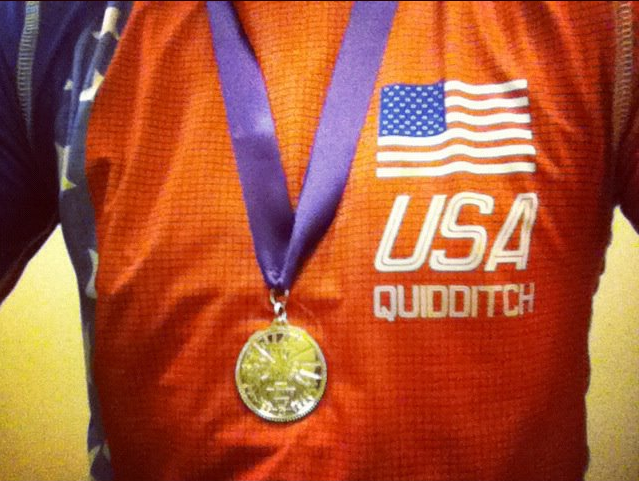
The gold medal that Team USA took home after the Olympic Expo Games this summer in Oxford, England. Photo: Kedzie Teller

Some Quidditch teams wear capes. What does your uniform include? Our team [at Boston University] nixed the capes about four years ago. Now, they look like soccer uniforms – knee-high red socks, black shorts, white jerseys, whatever cleats we can find. Our jerseys for Team USA [see right] are made by Quiyk.

Best part of your position on the U.S. national team: Knowing that we’re building the foundation for something bigger – that we’re building a future generation of Quidditch players. Sports programs are reaching out to local Quidditch teams to run training sessions in elementary schools called Kidditch.

Most challenging part of the position: The reactions from people who don’t understand Quidditch. I’ve been an athlete for as long as I can remember, so to be part of a sport that other athletes look down upon – that’s not great for the ego. It’s also hard not getting the support we need. To many universities, we’re just goofballs with brooms asking for field space. They don’t think we deserve it, so we end up playing on a patch of grass behind a building.

Do your parents understand your passion for the sport? My mom didn’t at first, but she is one of my biggest supporters now. My dad almost broke into tears when he found out I made the national team; he knew how much it meant to me. The second I got picked for the team, I updated my Facebook status, and it got 400-something likes within four days. If I could relive any moment, it would be finding out I made the team.

Your Twitter must-follows: I follow the IQA religiously for Quidditch news; Serena Williams, since tennis is my other great passion in life; and The Boston Globe and The New York Times, since I’m a news junkie.

LAUNCHING YOUR CAREER >> Don’t be shy about reaching out to the IQA. You don’t need to know a lot about Quidditch to get involved. And don’t let people decide things for you. If I had listened to everyone around me, I would not be playing Quidditch right now.

Follow Kedzie Teller on Twitter @Kedz and on his Facebook fan page. PLUS: Find the full rules of Muggle Quidditch at InternationalQuidditch.org.

Next: Odd jobs at the Olympics

The Graveyard Guide

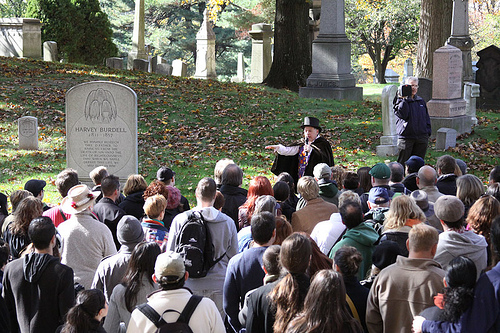
Jeff Richman’s Halloween tours attract many first-time visitors to Green-Wood. “When you love something, you want to share it with people. You want them to appreciate it as much as you do,” he says. Photo: Jeff Richman

Monk parakeets caw on the 106-foot spires of the Gothic-style arch at the entrance of Green-Wood Cemetery in Brooklyn, New York. Purple-grey clouds settle atop weather-worn brownstone mausoleums.

One may mistake it for the opening of a Stephen King novel.

But Green-Wood’s full-time historian, Jeff Richman, spends a lot of time trying to convince people that cemeteries are nothing to be afraid of. Among other responsibilities, he organizes year-round tours across the cemetery’s 478 acres, the most popular of which are the “murder and mayhem” Halloween tours. For those, Richman dons a top hat and kitschy pumpkin-embroidered purple vest.

Richman brags about Green-Wood’s more famous “permanent residents,” like Boss Tweed and Leonard Bernstein, as a proud mother might describe her daughter’s straight-A report card. When asked about his retirement plans, the grey-haired 63-year-old laughs: “We’ll see how this week goes.”

Age: 63
Graduated from: Stony Brook University, political science major; New York University School of Law
Based in: Long Island, New York
Previous jobs: Practiced criminal defense law for 32 years

Years in the business: In 1990, I started giving tours of Green-Wood and researching to write a book about the cemetery. I realized there was a ton of misinformation and incomplete information, and I wanted to clear that up. In 2000, I became a part-time historian here, and went full-time five years ago. 

What initially brought you to Green-Wood? When I was young, I collected stereoscopic views, which are images placed in a stereoscope to create a 3D effect. I kept coming across images of Green-Wood from the 1860s and 1870s, so when I saw an ad in the newspaper for a photography tour of Green-Wood, I wanted to see whether it had changed in 130 years.

Did you have an “aha” moment during that tour? As I walked through Green-Wood, it occurred to me: This was a landscape in the middle of urban Brooklyn that had remained unchanged for over a century. I immediately knew it was the place for me, so I returned again and again, and soon started leading tours while practicing law part-time.

Green-Wood, which was founded in 1838 as one of America’s first rural cemeteries, was designated a National Historic Landmark in 2006. Photo: green-wood.com

Responsibilities as historian: It’s pretty varied. I lead weekly tours, blog for Green-Wood.com, and pick out plants for the gardens. I’m involved with curating exhibitions, writing books, and collecting things pertaining to the cemetery itself or the people buried here. I also work with our cutting-edge restoration team. Using an old photograph, we identified the broken remains of a monument in the cemetery, and then helped restore it.

Is Halloween your busiest time of year? Yes. This year, we had 450 visitors for our Halloween tours, which tend to draw a lot of first-timers.

Your Halloween tour attire: It’s been the same for years: black top hat, cape, Halloween vest, and jeans. I also use props, like a walking hand, spiders, and George Washington’s chattering teeth. I try to entertain the visitors to the extent that I can.

Yearly visitors: Between 200,000 and 300,000. Our trolley allows us to do themed tours throughout the year, like the Women of Green-Wood and the Pioneers in Baseball of Green-Wood tours. We also host a number of book talks followed by custom-prepared trolley tours throughout the cemetery.

Most famous permanent residents: Horace Greeley [founder and editor of the New York Tribune], William Magear (“Boss”) Tweed, and Leonard Bernstein. We also have Wyckoff Van der hoef, who died at sea on the Titanic, and more than 100 people from the Brooklyn Theater Fire of 1876.

Is the cemetery running out of space? It’s 478 acres, but yes, we are running out of space for new graves. In 5 to 10 years, I think we’ll be filled up.

After Green-Wood opened in 1838, the cemetery attracted close to 500,000 visitors on a yearly basis for about 50 years. Its popularity helped inspire the building of Central Park. Photo: flickr.com/ Mambo’Dan

Cemeteries often get a bad rap, not in any small part thanks to scary movies. We spend a lot of time trying to convince people there’s nothing to be afraid of in cemeteries. We held a movie series in our chapel a few years ago to bring in children, in the hopes that they would no longer consider cemeteries a place to stay away from, but instead a great space to learn in.

Do you still show kids’ movies there? We had one vociferous complainer, so we ended that series. But we often bring in classrooms, and we’re pivoting to become a community-oriented historic park, an alternative to Central Park and Prospect Park.

Number of bodies interred at Green-Wood: More than half a million.

Okay, so you’re not scared of dead bodies. What does creep you out? Leading bus tours.

Are you superstitious? Not exactly. But I do believe that there are more than just, you know, coincidences. Sometimes, it’s like certain graves are calling to us: You never noticed me before, but I’m right over here, come take a look.

Best part of your job: The people. I’m currently writing a book for the cemetery’s 175th anniversary, for which I’m collaborating with curators, Pulitzer Prize winners, and other experts in their fields.

Most challenging part of your job: Keeping track of everything that needs to get done. But that’s a good problem to have.

What would people be surprised to learn about you? I’ve always been a collector — baseball cards, duck decoys, nineteenth century primitive tools, photographic paperweights, and architectural details. And I already mentioned stereoscopic views.

If you had one hour of free time, where would you spend it? I love Acadia National Park in Maine, and the American Wing at the Met[ropolitan Museum of Art]. But Green-Wood, with all its levels of interest and discovery, is my favorite place.

Your favorite spots at Green-Wood: The spectacular marble carving of Jane Griffith, the Beard Bear, the Civil War Soldiers’ Lot, and Niblo Mausoleum on Crescent Water. Oh, and the hill above Valley Water where the Tiffanys are interred and my gravestone stands.

The tombstone of Frank Morgan, the title character in the The Wizard of Oz. Spoiler alert: this was not built with emeralds or yellow brick.

Are you dressing up for Halloween this year? No. After the tours, I’m pretty much done with Halloween. But I’ll still give out candy to the neighborhood children.

Do you plan to be buried at Green-Wood? Yes, I have a grave there. There is value in having a place where your loved ones can pay their respects.

LAUNCHING YOUR CAREER>>
Create a position on your own if you see a need for it. Approach the people who have funding and explain what you can do for them. In 174 years, Green-Wood has had only one other historian, and he died more than 100 years ago. Fortunately, I was able to come in and offer something helpful to our society.

Meet another No Joe Schmos bringing history to life: the guy who makes treasures from recycled waste at TerraCycle.

The Horse Healer

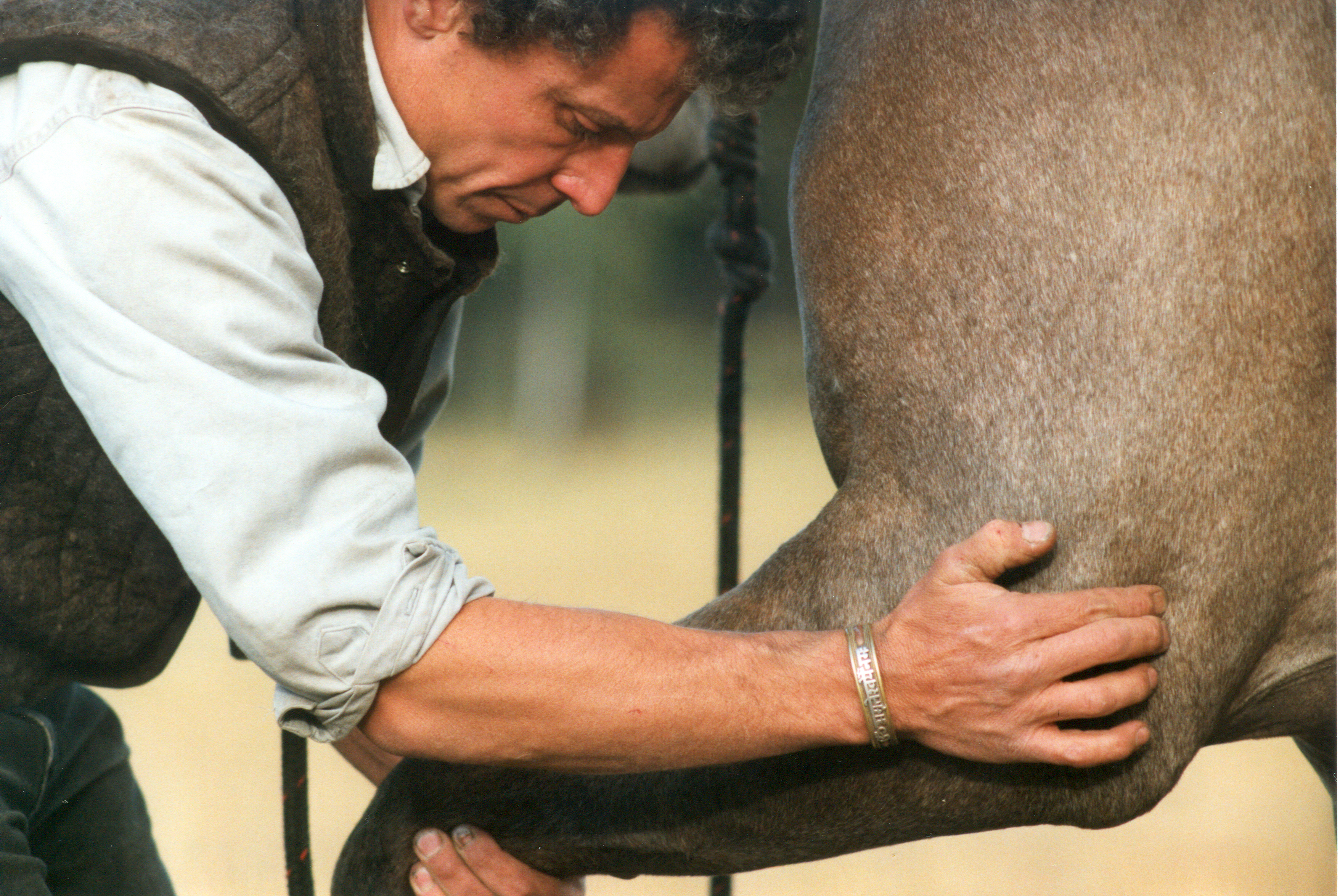
Jeff Moore lives at an equestrian facility with his family. His father influenced his passion for animals at an early age. Photo: Cindy Sloan

One evening in central Washington, Jeff Moore received an urgent call. The man on the line was five hours away, in Canada – a horse trainer on his way to a big race with six horses in tow. He needed Moore’s help, so the two met at a halfway point, a deserted truck stop on the side of a highway. There, Moore cracked open his toolkit, filled with a pulsed electromagnetic blanket, micro-current machines, heat, and ice.

Moore is a certified equine bodyworker. He traverses North America to heal injured and sore horses on family farms using qigong, the Chinese medicinal practice of aligning breath and movement for exercise and meditation purposes.

“Working with horses is a peaceful, meditative job,” says Jeff Moore, as his two-year-old wails in the background. “It’s like I’m in a whole other world. Communicating with [the horses] is not always verbal. The essence is movement and body language.”

Age: 54
Grew up in: The Philippines and California. My father was drafted into the military.
Based in: Oregon
Graduated from: University of Washington, degree in biology
Years in the business: 20 years

Previous jobs: I worked at the Washington Department of Fish & Wildlife, but I didn’t want to work for a state agency. So I bought an outfitting business and took people horseback riding in Hells Canyon between Idaho and Oregon. A client opened my eyes to how chiropracy can help horses move better and make them happier and safer, and I followed that healing path.

Job description in two sentences: I do bodywork, training, saddle fits, and clinics to help horses move correctly again. I’m also a qigong instructor, which has really informed what I do with the horses.

The Robert Redford movie has left Moore with disdain for the term horse whisperer. Photo: bossip.com

How large are the horses you work with? Anywhere from 80-pound miniature horses to 1,800-pound warmbloods. But size doesn’t matter much. Ponies and bullfighting horses in Mexico move relatively similarly.

Most common problem: Riders. A lot of what happens to horses is because of humans, often because they’re sitting incorrectly or forcing something that shouldn’t be forced. 

Your toolkit: Mostly my hands and eyes. I’m not much of a gadget person, but I do use a pulsed electromagnetic blanket that helps increases circulation, micro-current machines, heat, and ice. You need to know horses’ movements well enough to be able to see what’s not right.

In that sense, horse chiropracy seems similar to human chiropracy. Yes. A physical therapist can know biomechanics from the books, but if he’s also a runner, he has an intuitive sense of what’s happening in a runner’s body. So having the experience of being a rider and a trainer helps me with my work.

Trained by: An equine chiropractor. Legally, you have to be a vet to do any type of chiropractic or acupuncture work on a horse. I’m not a vet, but I’m certified as a equine massage therapist.

Best part of your job: I’m making the world a better place, one horse at a time. I’m helping to bridge the understanding gap between humans and horses. Horses are highly emotional animals.

Most challenging part of your job: Horse owners. Usually, when I see that a rider is hurting the horse, it’s not intentional. But my job is to keep out my judgment and help them in any way I can. People own horses for a variety of therapeutic reasons, not simply because they enjoy riding. 

When horses photobomb. Photo: flickr.com / Andreas Müller via buzzfeed.com

What would people be surprised to learn about your job? How sensitive horses are. They just want to get along; they’re incredibly forgiving of humans’ mistakes. The more I approach them from a healing point of view, the more I realize that.

Other animals you work with: I gave a client’s chicken monthly massages for the same fees that I charge for horses. I’ve also worked on cows, pigs, dogs, and cats.

Standard session: About 1.5 hours for $135; clinics for neural re-patterning last for three days. I work with 20 to 25 horses each week on an as-needed basis.

Session rundown:

  1. I typically don’t get too much information about a horse before arriving at the barn, so when I get there, I ask the owner what’s going on. By listening to the owner, I start a diagnosis in my head.
  2. I get my hands on the horse and ask the horse what’s wrong. I watch him move. Sometimes, there’s a big difference between what the owner thinks is going on and what the horse thinks is going on.
  3. I decide what tool(s) will best help that horse: body clinics, physical bodywork, fractural relief, or spinal adjustment. I’ve been doing this long enough that it’s often apparent what’s wrong. For chronic musculoskeletal conditions, Moore integrates traditional vet diagnoses with therapeutic horse shoeing, spinal mobilization, acupressure, and flower essences.

Do you own any horses? We have a thoroughbred mare, an English cob, and a 19-year-old Arabian horse that my 9-year-old daughter rides and jumps. We also have a few cats and dogs.

If you could communicate with horses, what would you say? “I’m sorry for my species.”

Meet more hoof-happy No Joe Schmos: the kiddie ride refurbisher and the bull rider.

The PG-Rated Mermaid

Linden Wolbert, aka “Mermaid Linden,” can hold her breath for five minutes. “When I’m not in the ocean for a long period of time, I get really itchy,” she says. Photo: Ric Frazer

“People don’t realize how hard it is to be a mermaid,” Linden Wolbert explains. Sometimes, when a pool’s chlorine levels or pH balance are out of whack, she can’t see well enough to drive home. Other times, she wakes up covered in bruises from hitting the sides of small pools.

But even with cloudy, stinging eyes, Wolbert has no plans to retire to land. Six years ago, hailing from landlocked Amish Country, she plunged into “mermaiding” full-time, spending months molding a tail using fiberglass, clay, and 35 pounds of silicon, which she likens to a newborn child. A 35-pound, 6-foot-long newborn child.

Unlike other mermaids, Wolbert refuses to work bachelor parties or go topless: “I’m not that mermaid.” Quite the contrary: she feels most comfortable teaching children about ocean conservation and working with nonprofits to increase awareness about water safety.

Age: 32
Based in: Los Angeles, Calif.
Grew up in: Amish Country in Lancaster, Penn.
Graduated from: Emerson University, Bachelor’s degree in film and science
Years in the business: 6 years

Describe what you do in a few sentences. I perform in my mermaid tail, which has a real monofin inside, to spread the message about ocean conservation. I’m a geeky, PG-rated mermaid focused on wholesome entertainment and education, an ambassador of the ocean.

At children’s birthday parties, kids swim with Wolbert at warp speed. “Fins down, it’s an incredible sensation,” she says. “They see someone from Disney movies come to life.” Photo: Reuben E. Reynoso Photography

Regular gigs: I’m gone 4 to 6 months out of the year doing underwater work. When I am home, my time is split among the following: children’s birthday parties and nonprofit events about ocean education; celebrity clientele parties [for audiences including Jessica Alba, Jessica Biel, Christian Audigier, and Justin Timberlake]; and photo shoots for film and TV, with or without my tail.

Mermaid ensemble: My 35-pound silicon tail, a beautiful beaded top, and a paua shell necklace from New Zealand. It’s pointless to wear toenail or fingernail polish, and I only wear makeup when I’m performing on camera.

Where does one buy a silicon tail? I worked with special effects artist Allan Holt in Hollywood  to create a mermaid tail. It took seven months. We made a mold of my body from the waist down and filled it with fiberglass to create a fake pair of legs. Then we used about 35 pounds of clay to sculpt a tail, which I designed myself. We created a fiberglass mold of it, and the mold was then injected with a high-grade silicone. I’m normally 5’4″, but I’m almost 8 feet tall with my tail on.

Dream job as a college student: An underwater wildlife documentary filmmaker. I started scuba diving right after graduation [from Emerson], and immediately became enveloped in the underwater world. After getting open-water scuba certified, the Professional Association of Diving Instructors (PADI) hired me as an underwater model to travel around the world and appear in ad campaigns and educational materials about diving.

Did you dress as a mermaid for those ads? When I saw my first monofin, I could barely contain my excitement. It’s a single bladed fin made from powerful fiberglass with two foot pockets next to each other. Freedivers strap them to their feet to get more depth and distance. After I tried one on, I knew I had to be a mermaid. I knew I had to turn it into a career.

How did your friends and family react to your decision? I’m the luckiest mermaid in the world; they are so supportive, and didn’t laugh when I told them. At parties, others will usually introduce me first: This is Linden, she’s a mermaid.

Wolbert has never visited SeaWorld, and doesn’t plan to. “I won’t put any money toward keeping animals in captivity,” she says. Above, swimming with whale sharks. Photo: Jewels Diver

Benefits of a mermaid tail: The tail creates so much thrust and torque that people have a hard time keeping up with me in the ocean. This month has been epic: I just went freediving with wild dolphins and swimming with whale sharks in Mexico. And I can’t walk with my fin, which means that I get to be carried around by strong, gallant men.

Storage space for your tail: On my bedroom floor, swaddled in towels in a cool place. I treat it like a newborn. I call it my baby.

You molded the tail at age 26. Have you grown since then? Yes, proportions shift. I have to maintain a very healthy lifestyle and stay in great physical shape. I’m currently designing a new tail with a couture designer, which is a top-secret project.

Did you always love water? I know every word to The Little Mermaid. I have been on swim team since I was a tiny tot, and my parents were both swimmers. I lived in our community pool during summers in Pennsylvania.

Breath-holding record: Five minutes. That means I can dive 115 feet – and come back up – in a single breath.

Do you prefer land or water? Definitely water. I’m in the water as often as I can, whether in a bathtub, the ocean, or a swimming pool. It makes me happy and balanced. Plus, the abundance of wildlife in the ocean is amazing.

Best part of your job: Children’s response to a mythical creative coming alive in front of their eyes. I’m really a science geek.

Most challenging part of your job: Being a one-woman show. I built an entire company around my job. A lot of critics ridicule or belittle my job, but that goes for any artist. Sometimes, I wake up after an awesome day in the pool or ocean and feel crippled. I’ll have bruises from the boat, my neck will be stiff, and my eyes will be watering and cloudy and stinging.

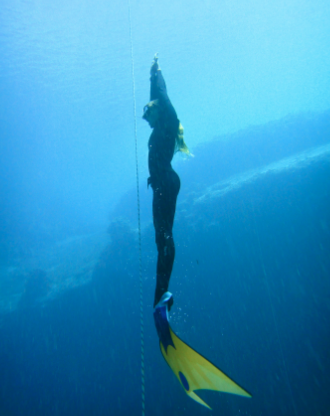
Freediving relies on a diver’s ability to hold his or her breath until resurfacing instead of using external breathing devices. Above, freediving in Bahamas in 2011. Photo: Walter Steyn

Would you consider wearing goggles? No.

What would people be surprised to learn about your job? I say no to a lot of requests for – well, shall we say, less savory events. It’s against my ethics. I’d rather teach swimming safety to people in the Bahamas — about 80% of them don’t know how to swim.

In 10 years, you’ll be: right here. I plan to dive until I can’t walk anymore. Actually, as you age, your metabolism slows, which means you can freedive for a long, long time.

LAUNCHING YOUR CAREER>>
A few words for aspiring merpeople.
1. Follow your heart. Don’t listen to the critics if this is truly what you want to do.
2. Stay honest, stick to your morals, and don’t compromise yourself for opportunities.
3. Get proper safety training, like PADI open water certification. Start with scuba diving, and then pursue freediving. Remember that not all mermaids are freedivers.

PLUS: For more amphibious (or amphibian-loving) No Joe Schmos, meet the alligator wrestler and the oyster farmer.

Follow Mermaid Linden on Twitter at @MermaidsnMotion, on her Facebook page, and in her video series, The Mermaid Minute

Editor’s note: Earlier this year, Discovery Channel aired the documentary Mermaids: The Body Found, which examined whether or not mermaids are real. (h/t @ohquarrie)

The Naked Cowboy Reads Nietzsche

“Everyone in the world knows me, and if they don’t, they will. It’ll be Buddha, Jesus, Naked Cowboy,” Burck says matter-of-factly. Photo: facebook.com/nkdcowboy

In a dimly-lit Times Square parking lot, Robert Burck, a fair-haired man with bulging biceps and tired eyes, lounges in the driver’s seat of his pristine Cadillac Escalade. There, he remains incognito, clad in cargo shorts and a black t-shirt. Most don’t recognize him without his signature underwear and guitar strapped across his chest.

Burck — more commonly known as the Naked Cowboy — has always been one for showy displays of attention. Each morning, he drives the 20 minute commute from his motel in Secaucus, NJ, to the Icon parking lot in Times Square. By noon, he’s working the crowds, serenading tourists and posing in photos for thousands of passers-by wearing nothing but a hat, cowboy boots, briefs, and a strategically placed guitar.

Particularly prone to exaggeration and contradiction, Burck expresses an impatience for people and their faulty cameras; minutes later, he proclaims himself a “social genius.” After reading Tony Robbins’ Unlimited Power, he says, he grew obsessed with writing self-affirmations and personal goals. He reveals a stack of college-ruled papers, perhaps several hundred sheets thick, held together by a large binder clip. The papers are clearly worn: the edges fray and the dark circles and underlines on each page bleed together.

This summer, Burck’s manager sent a cease-and-desist letter to the Naked Indian, who recently started showing up in Times Square. Burck believes he is stealing his act.

The 41-year-old climbs out of his Escalade, takes off his t-shirt and shorts, and slithers into a pair of tighty-whities. They’re a boys’ size 12. “No undies when I’m not working,” he explains. A few swipes of deodorant and a quick guitar tune-up later, he swaggers out of the parking lot into more familiar territory, strumming a tune: I have tons of fun, just shaking my buns, all day long, out here in the sun. Within minutes, a crowd surges around him. Two girls giggle and point: “Oh my God, it’s that guy.” Another couple, struggling with a subway map: “This is so New York.”

Age: 41
Based in:
New York, NY; Secaucus, NJ
Grew up in: Cincinnati, Ohio
Graduated from: University of Cincinnati, Bachelor’s degree; Xavier University, incomplete Master’s degree
Previous jobs: Stripper; waiter at T.G.I. Friday’s; male model
Years in the business: About 13

Where did your identity as the Naked Cowboy originate? In 1998, I was in Venice Beach, California, shooting for Playgirl magazine. I took out my guitar, and the photographer suggested playing in my underwear. I made over $100 that day from tips. I did the same thing a few days later in Cincinnati, got arrested, and made the news. The next morning, I left town in my beat-up BMW and did the same thing driving across the country, getting arrested along the way. I finally landed in New York, and I’ve gotten better at not getting arrested.

How does one get better at not getting arrested? Don’t push the envelope, don’t be a jerk. For two years, before landing in Times Square, I would call the media and the police on myself.

Weather conditions that keep you inside: I don’t go out if it’s pouring rain, because people won’t interact with me. I stand outside during 90% of the winter and wear a full-length mink coat to warm up in between rounds. I don’t get sick; being sick is a state of mind.

A small opening in the top of the guitar collects cash. Burck also glued on a small mirror.

Source of income: I charge $1 for up to 100 photos with me, but most people stop at two. I probably make about $100 an hour, especially in the evenings. Then there’s the money from my three music albums [including an X-rated country album], my endorsement deal with Blue Island oysters, my merchandise, and the Naked Cowboy Bar and Grill that’s opening soon.

Ratio of adults to kids who approach you: Yesterday, I picked up at least 80 people off the ground, 60% of which were old people and grandmas. They’re not scared, because I’m strong as sh*t.

Your driving force: Reading and studying. I read six to seven hours a day, and have for 24 years. I read psychology, philosophy, Spanish. I want to be the smartest motherf*cker on the face of this Earth.

Currently reading: The Art of Seduction, for probably the third or fourth time. I’ve read Robert Greene’s The 48 Laws of Power at least six or seven times. And Emerson’s essays, which are sitting at my hotel – I’ve read those about 100 times.

Your hotel? For the last 13 years, I’ve lived in the Royal Motel in Secaucus, New Jersey, right outside the city. It’s only $50 per night. My mailing address is still my mother’s in Cincinnati.

Burck keeps two pairs of boots in the trunk of his car at all times. He wears each pair for two or three weeks before selling them on his website.

Where do you keep your belongings? I have a suitcase in the backseat with all my underwear, my guitar, my boots, my hat, and a few other things. My hotel room has a spare guitar, my mink coat, and a suit and tie from my high school graduation. That’s all I need.

Brand of underwear: Fruit of the Loom, which is what my mother bought me when I first started. They come in packs of six, but I always keep a seventh just in case. I wear two pairs at a time: one painted with Naked Cowboy, and one unpainted. When they get old or stained, I sell them for $50 on NakedCowboy.com.

They look really tiny. They’re a size 12, which is meant for boys who are about 114 pounds. I weigh 200-something. I haven’t missed a day at the gym since I was 17 years old.

Do you stay this tan year-round? In the winter, I supplement a little bit. Right now, even with all the sun, I have a lighter spot on my leg where my guitar sits.

How do you unwind after a long day? I go to my hotel, have a glass of wine, and write in my journal for a few hours about how great I am, how my expectations are always fulfilled, how I’m a child prodigy.

Can you read me something you wrote recently? I am the most incredibly polished, spontaneous, talented, hilarious performer of all times. [I am] the most fabulously built, ripped, and determined body and mind ever created. […] [I am] an American icon, true badass, no-fear cowboy. The only Naked Cowboy.

That seems a bit arrogant. People don’t understand humility. It’s not about downplaying yourself.

Are you religious? I’m God Almighty. The God you worship is the God you are capable of becoming, in the words of Joseph Campbell. Do you know him? J.C., Jesus Christ.

Guitar go-tos: Mostly just sh*ts and giggles, except when I play full songs and pretend I don’t see people. My guitar is just an unlikely vehicle to get people’s attention. People even tell me I can’t sing very well.

Burck meticulously documents his meals, reading logs, and schedule into black marble notebooks. To date, he estimates he has filled about 400 journals over the past 13 years.

What would people be surprised to learn about your job? Standing in Times Square is hard work. If people come up to me with the wrong attitude, I double their wrong attitude, and they scurry off in fear. I don’t waste time with people who are wasting my time.

Best part of your job: Freedom.

Most challenging part of your job: Nobody’s camera is ready. Nobody knows how to shoot a picture. After a few hours, I’m kind of like, I’m never coming here again. When it’s raining, it feels like it’s never going to shine again.

Are you dating anyone? I have a girlfriend who I see once every few days. She works at the Cranberry Café, where I’ve eaten lunch every single day for the past 10 years. When my last relationship ended, I ended up with her, because she was the only girl I knew.

Do you walk naked into the café? I’ve been in many places naked, but I don’t do that anymore. I have a key to the executive bathroom here in the Icon parking lot, where I’ve parked for free for 10 years. These guys are the best.

You mention that you’re the only Naked Cowboy, but now it’s a franchise. That happened about two years ago. There are four Naked Cowboys, myself included, and four Naked Cowgirls, all part of Naked Cowboy Enterprises at different spots throughout Times Square. They just came out of the woodwork and approached me about it. The black Naked Cowboy was selling comedy tickets in Times Square.

You ran for mayor in 2009 and announced a run for the 2012 presidency as a Tea Party candidate. Those both fizzled. Any future plans to run for office? When they knock on my door and beg me to run because I’m the best man for the job.

Dream job as a kid: I wanted to be the most celebrated entertainer of all time. I did whatever I could to have all eyes on me. Everyone was always telling me what I couldn’t do.

The tattoo on Burck’s right arm depicts a devil, and the one his left depicts Jesus. “It shows I can be as evil or as good as I want,” he says.

Like getting that tattoo on your arm? When I was 16, I was on house arrest, so I got this tattoo of the devil’s head. It was the coolest picture I could get for $60. Later, I got Jesus on my other arm to balance it out.

How do you spend your time when you’re not reading or in Times Square? That’s really it. I can be the life of any party, but why spend all that enthusiasm on a few people in a room when I can spend it on thousands of people walking through Times Square?

Does your family visit you here? I send them envelopes filled with money every week. I stamp each dollar with my Naked Cowboy stamper and sign each dollar coin.

Do you want kids? Nope, not for as long as I live. And I don’t plan on dying. Ever.

Visit the No Joe Schmo Facebook page for more behind the scenes with the Naked Cowboy (and to find out how he signs his text messages).

Follow the Naked Cowboy on Twitter at @TheNakedCowboy and on his Facebook page. All photos courtesy of Megan Hess unless otherwise specified.