The Sculptor With a Palette of Butter, Chocolate, and Cheese

Jim Victor and Marie Pelton created a life-size chocolate replica of the No. 18 Toyota Camry M&Ms car. Photo: designboom.com

When it comes to chiseling 1,000 pounds of butter into life-size manatees or molding a Santa from cream cheese and mascarpone, no one does it better than Jim Victor. Just don’t ask him to use meat. That’s gross.

The food sculptures can take Victor and his wife, Marie Pelton, up to a month in their Philadelphia studio, using heavy-duty cutting tools, whittling implements, and cheese graters.

Age: 68
Graduated from: Pennsylvania Academy of the Fine Arts
Based in: Philadelphia, Pa.
Years in the business: 30 or so. I made my first chocolate sculpture in 1982, but didn’t do any again until 1995.

Did you attend art school with the intention of sculpting food?  No. I started out with wood, and did my first chocolate sculptures in the 80s. But didn’t grow serious about food sculpting until the 90s, when I realized a real demand for it. I actually got my first butter-sculpting job through a wanted ad that my brother saw in a local Harrisburg, Pa. newspaper. As a sculptor, your opportunities are few and far between.

Andy Warhol's "Marilyn Monroe" using marshmallows for the Orange County Fair in 2010.
Andy Warhol’s “Marilyn Monroe” using marshmallows for the Orange County Fair in 2010.

You work with quite a range of materials, from steel and wood to cheese and vegetables. A lot of the same sensibilities come into play; I have to think about textures and colors. But there’s an added concern with perishables, like fruits and vegetables. You have to create them the day before a show.

Your workspace: We have a regular studio and two temperature-controlled trailers for sculpting on the road. The sides of the trailers are windowed so that people can watch. Many fairs also have butter booth facilities.

How do you prevent the butter and chocolate from melting as you handle it? For butter, temperatures must be below 60 degrees Fahrenheit. Chocolate is a little more forgiving — it just needs to be away from the sun and moisture, and below 80 degrees. For cheese, we work with harder ones, like hard cheddar.

Favorite edible medium: Parmesan cheese.

Your toolkit: Lots of clay modeling tools, or wooden tools that I carve myself. For something slippery, like butter, I need a big handle.

This butter manatee appears to be floating, but the seaweed supports the mammal's hefty body mass, explains Victor's wife, Marie.
This butter manatee appears to be floating, but the seaweed supports the mammal’s hefty body mass, explains Victor’s wife, Marie. Victor works mostly with unsalted butter, but salted butter is softer and easier to shape.

Which comes first, the subject or the medium? They’re usually commissions from corporate sponsors that want specific materials. After planning, we make armatures from wood, wire, or steel. That’s the skeletal frame around which the sculpture is built. People think we’re cheating, but you need an understructure to hold up the cheese, or chocolate, or whatever.

Your strangest commission: It was for a politically incorrect-themed party in California. We made Fidel Castro out of fruits and veggies, and Hitler out of cheese.

I didn’t see those on your website. It shocked me so much that I left those off.

Is there any food you won’t use for sculpting? For a long time, I said I wouldn’t work with meat. Then I did, but just a little. I don’t want to work with big quantities of meat — I think that could be really gross.

You’re not grossed out by 1,000 pounds of butter? Not really.

The nature of your job involves a sizable waste of food, considering your sculptures are not for human consumption. We use waste butter from dairy plants that would be thrown away anyway. A lot of our butter is turned into biofuel using digesters on farms or at university campuses to run cars.

Does the same go for cheese? No. We give some of [our cheese sculptures] to a food bank in Texas after a job. But for the most part, our sculptures can’t be eaten because we handle the material too much. We’re not chefs.

Best part of your job: Getting commissions to do work you love.

Mark Ingram, Jr., a running back for the New Orleans Saints, recreated in bread, raisins, cranberries, and chicken salad.

Most challenging part of your job: The technical challenges and demands that people and corporations throw at us. For Subway, we recreate heads of NFL stars using sandwich materials. It’s like, how do you make [Washington Redskins quarterback] Robert Griffin III out of chicken salad?

What would people be surprised to learn about your job? How difficult it is, both physically and technically. It involves a great deal of engineering and is very physically demanding. We’re lifting hundreds of pounds of butter. It’s also very long hours. For the past month, in preparation for a chocolate show in New Orleans, we’ve been working 10-hour days, seven days per week.

President Jimmy Carter, plaster, 1974.

Your work in non-perishables is quite popular as well. Your plaster bust of Jimmy Carter currently resides in the Jimmy Carter Presidential Library. That’s a funny story. New York magazine commissioned that bust — they wanted to smash it to pieces and then photograph it for their cover, to symbolize [what everyone thought would be] Carter’s failed negotiations for peace in the Middle East. But it turned out that his deal pulled through. So I wrote a letter to Carter, offering him the head for the museum. He accepted.

Average rate: We charge anywhere from $1,000 to $2,000 per day, depending on our work. But we don’t always make that much, once you factor in design, shipping, and hiring people to help.

How do you unwind after a long day carving butter? With a stiff drink.

LAUNCHING YOUR CAREER>>
There are only so many jobs you’ll find in the wanted ads. The most successful people figure out what they want to do and make their own jobs. Opportunities are very fleeting; don’t ignore any of them.

Meet more artists with creative palettes: the dirty car artist, the soap maker, and the pop-up paper engineer.

Unless credited otherwise, all photos courtesy of JimVictor.com. Find more of his sculptures below:

This slideshow requires JavaScript.


The Top 5 No Joe Schmos of 2012

New years hat2012 has been an exciting year for No Joe Schmo. Most notably, we were featured on Forbes‘ first-ever list of Top 75 Websites For Your Career, and we hit our 100th post here on NoJoeSchmo.com. We’re planning even more exciting things for 2013.

This year-end list does not include viral videos, cats, or fiscal cliff jokes. Rather, it’s a handful of the some of the most cool-and-crazy No Joe Schmos featured this year. From the Naked Cowboy to Santa Claus, these are the stories of individuals that have made a living by finding — or making — work for themselves in unusual places. Happy reading, happy sharing, and happy New Year!

5. The Miniature Food Artist | Shay Aaron began creating miniaturized food sculptures at 1:12 scale that look almost completely edible, and used the hobby to curb his appetite.

4. The Magician Who Lives in the Waldorf Astoria | Steve Cohen brings in about 300 viewers each weekend – including high-profile guests like Martha Stewart, Barry Diller, and David Rockefeller  – and a seven-figure annual income.

3. The Naked Cowboy Reads Nietzsche | Every morning, despite sleet and snow, 41-year-old Robert Burck climbs out of his Escalade, takes off his t-shirt and shorts, and slithers into a pair of tighty-whities. They’re a boys’ size 12.

2. The Mall Santa Who Wears Birkenstocks and Kneepads | Santa “Sid,” who has been working at the Mall of America every holiday season for 16 years, doesn’t wear a coat or hat. “The fur makes kids cry,” he says.

1. The SNL Cue Cards Guy | Wally Feresten was once almost fired for his sloppy handwriting. Now, 22 years later, he owns a successful cue card company that handles Saturday Night Live and Late Night with Conan O’Brien.

Have an idea for a No Joe Schmo? Suggest one here.

The Mall Santa Who Wears Birkenstocks and Kneepads

"I can put a smile on anyone’s face – young, old," says
“A lot of people think I’m a therapist or a teacher. I’m not,” says Santa Sid. “I’m also not a stuffy old man with a beard. I’m a kid.” (Above: during one of two pet nights at the mall.)

The hardest part about being Santa Claus is making two-year-olds smile for photographs. But after 42 years in the business, one of the most experienced Santas in the United States has it down to a science. No coat or hat – the fur makes kids cry. He doesn’t scream at kids to sit still – he crawls onto the padded floor surrounding his chair to make eye contact.

And it works. He’s only had a handful of criers. “I thrive on winning kids,” says Santa “Sid,” which stands for “Santa in disguise.”

Santa Sid headlines The Santa Experience at the Mall of America in Bloomington, Minnesota. It’s not your average shopping mall: Seven Yankee Stadiums could fit into the complex’s 4.2 million square feet. But then again, Santa Sid isn’t your average Santa. The license plate on his red Hyundai reads Santa S; his spare bedroom is filled with Christmas knickknacks, including a tree that stays up year-round; and kids frequent the pool in his backyard (duh, it’s Santa’s summer home).

Age: Santa is 1,500 years old. But I’m 58.
Graduated from: Santa Claus University, with a Master’s degree in Santa Claus.
Based in: I admit to having a summer home in Eden Prairie, Minn. Otherwise, Santa lives in the North Pole. I’ll retire somewhere warmer, but I wouldn’t know how to act in a place that never snows.
Years as Santa: 42. I’ve been in the Mall of America for 16 years now.

How do you spend time on your off months, from January through October? I work at a company that makes aircraft parts called Hitchcock Industries in Bloomington, Minn. I just tell people that I make “big people toys.”

Previous jobs: I’ve always been in the kid business. I lost my 3-and-a-half-year-old brother to leukemia, so I started visiting cancer patients at hospitals dressed up as Santa. I spent two years as the Santa at a mall in Kalamazoo, Mich., before getting this job [at the Mall of America].

TK
Although his hair and beard are 100% natural, Santa admits to bleaching his facial hair for “the workshop look.”

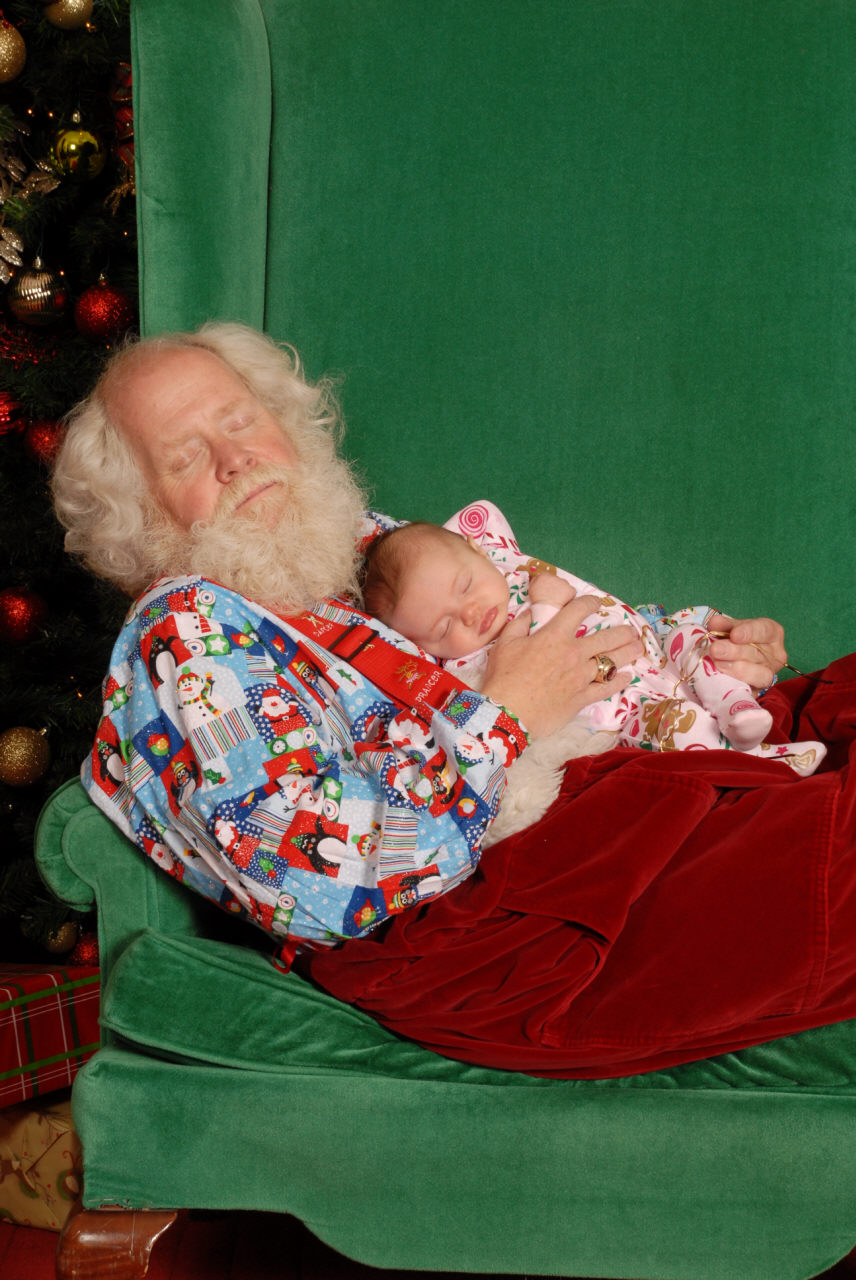
Was it a tough job interview? You needed a background check – local and federal. I showed them photos from my past, like one of me taking a nap with a baby on my chest. [See right for a similar photo from this year.]

I read that visits are by appointment only. My line used to be three or four hours long every day. Then someone came up with the idea to put me in a private room and book appointments. This year, before even opening for the season, I had 400 appointments. By December 1, I had 5,800 appointments.

Number of kids on your lap per day: I see 15,000 to 17,000 kids each season, which consists of 45 days.

Walk me through a typical workday. I work from 9 a.m. to 1 p.m., take a one-hour break, work from 2 p.m. to 5 p.m., take a one-hour break, and work from 6 p.m. to 9 p.m. I sit on the floor 99.9% of the day to get on eye level with the kids; I give them high-fives to get communication going. Then I go home, eat dinner, and go to sleep.

Do you use any props? I have a really cool kid rocking chair that’s all cushioned up, and I have a stool behind it. That way, kids don’t know I’m there, and we get lots of great pictures. I also have a floor built with kid padding for playing on the floor, and a stethoscope for taking photos with pregnant moms.

Where do you suit up? At home, before driving to the mall at 7:30 a.m. I own 80 different shirts, so I never wear the same one twice. I wear pants, suspenders, slip-on Birkenstocks, and knitted green, white, and red socks. I don’t wear a jacket; the fur makes kids scream. But I do wear kneepads, since I’m constantly on my knees with the kids.

A hat? Nope. I get my hair done at the hair salon at the mall, so I have hot rollers in my hair every day. Then I go to Starbucks [at the mall] to get my coffee.

Funniest “kids say the darndest things” moment: Maybe, “I want bacon.” Kids are simple – they usually want electronics and remote-controlled toys, or dolls. Sometimes they come with lists that are three to four pages long, though. I take the lists and say, “I’ll see what I can do.” I never promise anything.

Photo: activerain.com

Kids ask for different toys each year. What larger shifts have you seen in gift requests throughout your years as Santa? Things have gone very digital. I hear hundreds of requests for cell phones, iPads, tablets, Nooks. Once, a 3-year-old asked me for an iPhone 5. I tell kids that I have a toy factory – I want to talk about toys. Parents give me a thumbs-up for that one.

Best part of your job: I truly see the magic. I sit on the floor and look into children’s eyes – I see the sparkle, the smiles on their faces. I’m helping to be a part of that. 

Most challenging part of your job: Too many 2-year-olds.

What would people be surprised to learn about you? I organized a Santa Club in Minnesota with 115 Santas. I help out a lot of guys.

I envision you guys swapping stories about bratty kids. We have three get-togethers a year: A pool party at my house in July, for Santas and Mrs. Clauses; a Christmas kickoff in early November; and a Blues Party when it’s all over, in February, at a hotel. All the Mrs. Clauses are great at making food – your Santas are plump for a reason.

At what age do you think children stop believing in Santa Claus? The magical age for believing starts around 3 – the 2-year-olds are more fearsome – and can go to around 10 or 11. When kids ask whether I am the real Santa, I tell them to pull on my beard and my hair. That way, I’m not really answering, but they walk away saying, he’s the one.

Do you hate Christmas music yet? No. I have it on all the time in my car, and in my back room during breaks. I especially love Bruce Springsteen’s “Santa Claus Is Coming to Town.”

Have kids ever recognized you as Santa during the off-season? All the time. My wife and I go out to dinner, and kids pass me notes, telling me they’ve been good or what they want for Christmas. On vacation in Mexico, kids wanted pictures. When you look like this, you live it.

Any children of your own? One, and he’s 30. He’s my No. 1 elf, out of my 860 elves. I also have three dogs, named Dasher, Blitzen, and Allof. That stands for “all of” the other reindeer.

Retirement plans: I’ll be doing this ‘til I’m dead. Right now, I’m working on a five-year contract.

Salary for the season: Many Santas start out at around $10,000 for the season. Salaries can reach $45,000 for the season, but that’s very rare.

Umpteen years ago, a psychic told me that I was going to do something wonderful with kids," Santa Sid recalls. "[This job] might be draining...but I can put a smile on anyone's face."
Umpteen years ago, a psychic told me that I was going to do something wonderful with kids,” Santa Sid recalls. “[This job] might be draining…but I can put a smile on anyone’s face.”
If you could put one celebrity on your naughty list, who would it be? I don’t look at the bad in people.

Even Kim Kardashian? I don’t know [the Kardashians] or watch their show. That’s their lifestyle.

LAUNCHING YOUR CAREER>>
1. Become a child and learn to play. People sometimes tell me, You’re silly, Santa. That’s the biggest compliment in the world.

2. Learn to answer things as quickly as you can. Once, a little girl asked me Mrs. Claus’ first name. I told her I’d have to get out the marriage certificate to check.

3. An important part of the job is clean living. It’s an honor to be Santa. I don’t drink, smoke, or eat garlic. There’s never onion on my breath.

Unless otherwise specified, all photos are courtesy of Professor Bellows.

The Magician Who Lives in the Waldorf Astoria

Steve Cohen, also known as the Millionaire's Magician, has performed his show at the Waldorf 3,000 times — for 250,000 people.
Steve Cohen, also known as the Millionaires’ Magician, has performed his show at the Waldorf Towers 3,000 times — for 250,000 people.

A cluster of of well-to-do couples huddle in the lobby of the Waldorf Towers in New York City, buzzing with anticipation. At the stroke of 8:45 p.m. on Saturday evening, a tall man in a tailored suit ushers everyone into a gold-plated elevator – the same one that the President of the United States rides when he stays in New York. Primping and fidgeting, the group lines up at a suite at the end of a hallway on the 35th floor. 58 people file in for tonight’s magic show in Steve Cohen’s living room, run solely by word-of-mouth.

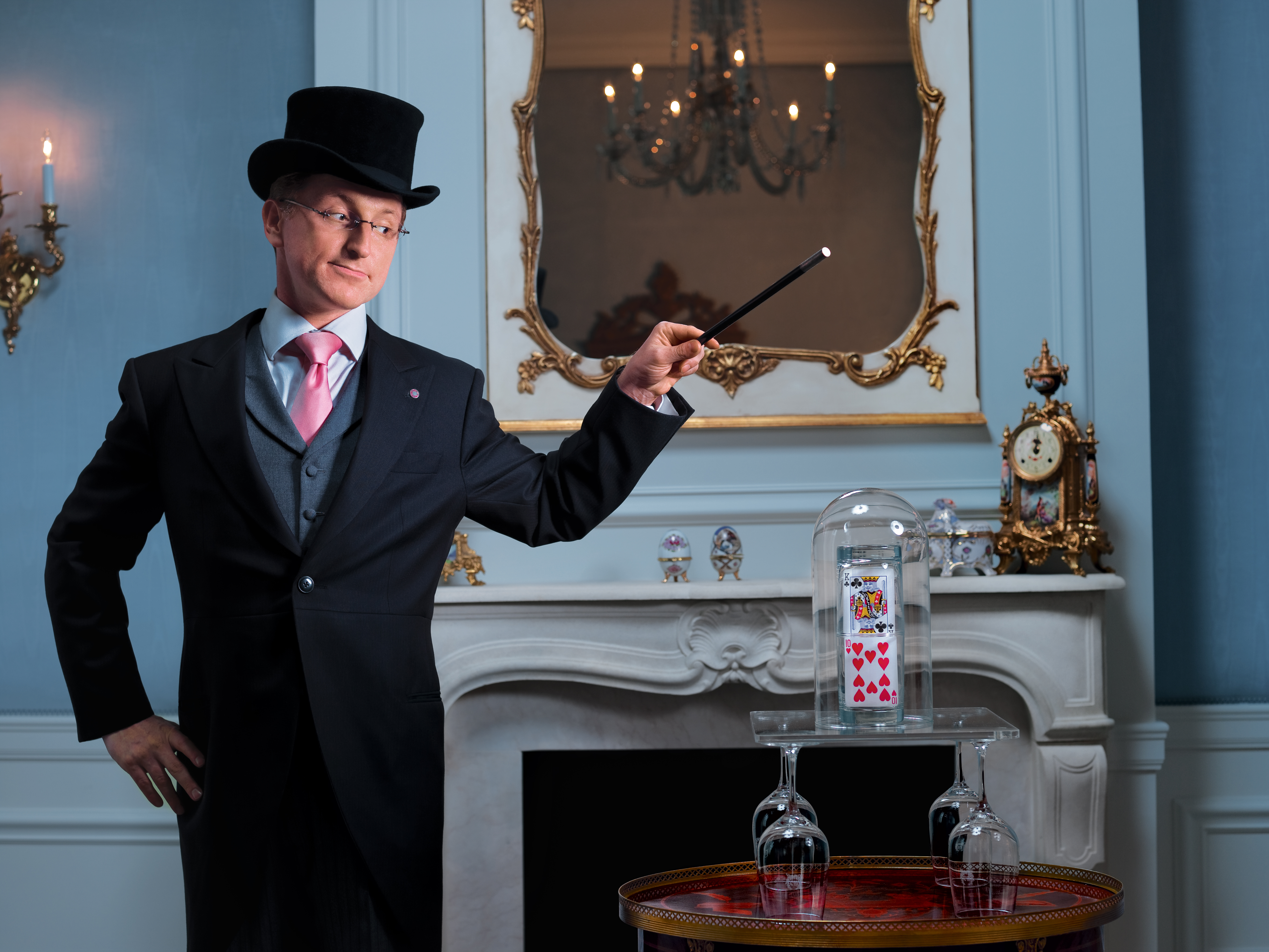
Cohen’s “Chamber Magic” shows inspire an intimate, old-timey parlor feel. Attendees, many of whom have purchased tickets months in advance, are expected to dress well. He doesn’t bother with hats, rabbits, or sleight-of-hand tricks; instead, he uses one gleaming tea kettle to produce five different drinks at the audience’s request.

At age 10, Cohen worked the elementary school circuit, appearing at kids’ birthday parties and Cub Scout meetings. Now, he brings in about 300 viewers each weekend – including high-profile guests like Martha Stewart, Barry Diller, and David Rockefeller  – and a seven-figure annual income. “I put people in an environment where anything can happen,” Cohen says, pausing to sip Kombucha tea (the ginger helps his throat). “People start thinking, Maybe there’s another force in the world, and this guy has control over it.

Age: 41
Graduated from: Cornell University, psychology major; Waseda University in Tokyo, Japan
Based in: New York, N.Y.
Years as a full-time magician:
17
Previous jobs: After graduating from Cornell, I stayed in Tokyo for five years as an English translator. It involved sitting at a desk with lots of legal work and patents.

That seems like a pretty far stretch from your current line of work. The translation work was terribly boring, but lucrative. I was eager to do magic, so I got some part-time jobs performing in hotels, and those got more and more lucrative. I came back to New York and started from scratch as a consultant for other magicians. Then, I started doing my own shows.

Who – or what – brought you into the world of magic? My uncle. He was very talented with cards, and taught me the fundamentals of card magic that you need to become a good magician. I spent all my times at family parties with him. He gave me a book called Magic With Cards, a book from the 1890s that is very hard to find.

How did you turn a childhood hobby into a multimillion-dollar business? For two years, after moving back to America from Japan, I lied to my wife and told her we were breaking even. But we were losing money every show; I lost about $200,000 of my own money. I was about to throw in the towel when an editor from DailyCandy.com came to review the show. Overnight, the show sold out for a year in advance. Then CBS Sunday Morning did a segment on me, and by the end of the week, I had sold $1 million worth of tickets. I had to add more shows.

Is the Waldorf your permanent home? I stay here on weekends. I have another apartment on the Upper West Side with my family – my wife and two kids, ages 12 and 8 – during the week.

Do your kids love magic? They each practice one trick each year, and on Father’s Day, they perform it at my show. But my daughter is more into it than my son. She’s a ham. But there’s not that many women in magic, if you think about it.

Why do you think more men than women are into magic? I’m not sure. But I don’t really recommend becoming a magician to anyone. People are constantly making gags about it. Imagine going into your child’s school for a parent-teacher conference, and the teacher says, “Your child seems to think you’re a magician of some sort.” You always have to explain what you do.

In your grand finale, two audience members shuffle two separate decks of cards. Then, you reveal that each card in the first deck falls in the exact same order as each card in the second deck. The audience really goes wild for that one. People seriously go bananas – they have heart palpitations. They can’t sleep that night. And I’m jumping up and down like Willy Wonka.

It’s funny you mention Willy Wonka. You remind me of him — Gene Wilder’s version, at least. The character of Willy Wonka has been a role model for me. I like his transition from mysterious man to crazed maniac – peeling away layers and seeing more and more about this nutty guy.

Did he inspire your three-piece suit, too? In London, I saw Prince William wearing this exact outfit – a morning coat, a vest with a little lapel, and striped trousers. So I went to the store where the princes shop, and bought that exact outfit. I think it’s so appropriate in this environment.

Think a Drink description
Cohen uses as few props as possible in his shows; he believes they create barriers and cheapen the experience. The kettle is an exception.

It plays into the magician archetype. People want the character of a wizard or a magician to come into their lives and give them hope and possibility. Why do you think Harry Potter is so popular? I’m not doing wizardry here, but I feel like Harry Potter or Dumbledore. People squeal in delight. During my “Think a Drink” trick, a woman in the front row actually cried. [For this trick, five audience members wrote down their favorite drinks, from vodka to banana smoothie. Cohen then produced these drinks from a small kettle.]

Best part of your job: Immediate feedback. I can tell by looking at audience members’ eyes whether I have them under my thumb. When people’s eyes are glowing, I know I’ve done my job. I’ve learned what captures people’s imaginations.

Most challenging part of your job: Nobody else in the world is doing this type of performance, so I don’t have a support team. I’ve lost the camaraderie of fellow magicians; a lot of them are jealous.

Resources for new material: The Conjuring Arts Research Center in New York has a database with every secret that has ever been published in magic, from the 1500s to present-day. You have to be a member or have special access.

Any pre-show traditions? David Copperfield once told me that he brushes his teeth with a certain toothbrush before every show. I joke around and say that I floss before every show. But the fact is, no. I’m very relaxed. Everything in my show is meticulously planned. Without fail, I know the precise minute that I’ll be saying a certain line.

The last time you got nervous: When Woody Allen came in and sat in the front row. I had cotton balls in my mouth, but he was the greatest audience. He laughed at all the right times.

On the Late Show with David Letterman, Steve Cohen performed his favorite trick, involving a lemon, an egg, a walnut, and a ring.

What would people be surprised to learn about your job? You can buy and sell secrets. I once licensed a trick from another magician for my show, but after the terms of the legal contract expired, he wanted the trick back. So I had to create my own version of the trick.

Your most expensive trick: I spent $10,000 for a trick that only lasts two or three minutes, but it’s a really good trick. I fill a flower vase with all different flowers and cover them with a handkerchief. Then, I ask an audience member to name her favorite flower. Say she responds with yellow tulip. I take the handkerchief away, and all the flowers have transformed into yellow tulips.

How do you deal with uncooperative audience members? People have predispositions toward magic shows. Those who give me problems – maybe they got embarrassed at a magic show when they were little. I handle them the same way I would handle kids, and try to diffuse the challenge by making my show lively and interactive.

In addition to performing for Warren Buffet (pictured above), Cohen's star audience members include the Crown Prince of Saudi Arabia and the Queen of Morocco.
One weekend, Warren Buffet paid Cohen to cancel all his shows and fly to Omaha (pictured above).

Your website boasts some of your more famous clients, like Warren Buffet. I still get people coming in here all the time, like, Warren sent me. I always carry with me a card that he signed.

Physical parameters of your show: I need to be inside of a room with no other distractions. People must be completely riveted on just me. I can’t have people thinking about what they’re going to make for dinner. 

Your required reading: Influence: The Psychology of Persuasion by Robert Cialdini. It’s about how and why to persuade people to see things your way.

You never leave home without: My deck of cards. I rarely do magic outside of a venue, but it makes me feel good that I could, if I needed to.

Have you ever pulled a rabbit out of a hat? Yes, and it’s wonderful. I don’t do it regularly, though, because then you have to keep a rabbit as a pet.

LAUNCHING YOUR CAREER>>
Find a venue that is appropriate to your vision of magic, and become the person best suited for that venue. If you’re really good at performing at Bar Mitzvah parties, for example, become the very best Bar Mitzvah magician out there, and work tons of them.


Tickets for Chamber Magic range from $75 to $100; priced separately for private company events. Follow Steve on Twitter and on his Facebook page. All photos courtesy of Steve Cohen. 

The Man Behind the Macy’s Thanksgiving Day Parade

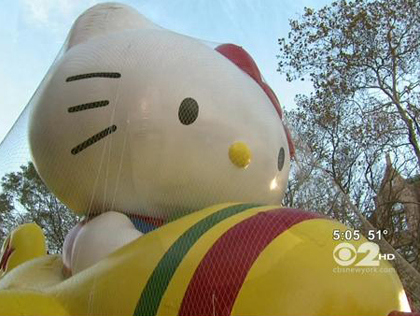
The Hello Kitty balloon is one of three new character balloons and six new floats this year. Photo: CBS 2

As Kermit, Hello Kitty, and Carly Rae Jepsen meander down 6th Avenue in New York City, thousands of onlookers ooh and aah. The annual Macy’s Thanksgiving Day Parade — celebrating its 86th anniversary this year — is as much a Turkey Day tradition as the turkey itself. For most Americans, the spectacle is all over in a few hours.

But for scores of designers and volunteers behind the scenes, the parade has meant months of plans and preparation. Yahoo! News recently interviewed John Piper, the creative director of Macy’s Studio, a “nondescript New Jersey warehouse about 30 minutes outside of New York City” where the float magic happens. He lives 364 days for one.

In the interview, the 30-year parade veteran discusses the worldwide helium shortage, challenges brought on by Superstorm Sandy, and fitting ballons through the Lincoln Tunnel (certain balloons must be disassembled). Watch it on Yahoo! News here.

See also: The Woman Behind the Macy’s Thanksgiving Day Parade, h/t @shelleytibbetts