The Dog Colorist

TK
Pet groomer Dawn Omboy owns two standard poodles, one toy poodle, and one Pomeranian.

If you ever wished for a poodle with a hot pink Mohawk or leopard-print nails, you’re in luck. At Klippers, a full-service spa of sorts for cats and dogs based in Columbus, Georgia, Dawn Omboy specializes in creative pet styling – dyeing fur, attaching feather extensions, and painting nails with water-based Pawdicure Polish Pens, marker-like pens that fill up with paint when shaken and pressed.

In her creative styling classes, Omboy teaches colorists-to-be the importance of sharp color lines, elegance, and a “wow” factor. She has dyed dogs’ fur to resemble pandas, dragons, and jesters. Once, she painted pirate features onto one of her own pups. “One of her legs is a lot shorter than the others,” Omboy explained. “So I colored it to look like a [pirate’s] wooden leg.”

Age: I’ll be 54 this year.
Graduate from: I didn’t attend college. As far as grooming goes, I’m self-taught.
Based in:
Columbus, Georgia
Years in the business:
I’ve known for about 39 years – since age 15 – that I wanted to be a pet groomer.
Previous jobs:
I did some restaurant work in my younger days.

Growing up, did you tend to your family’s pets? We had a cocker spaniel and a couple of schnauzers, and I groomed them all. I wanted to do hair, and I liked animals better than people.

Daily responsibilities: We come into the salon and make sure that the shampoos are fresh and the towels are fluffy and folded. Then, we receive the clients, one by one, and discuss their wishes for their pets: bathing and brushing, shaving their hair, painting their nails (sometimes with art, like little flowers or stripes), and dyeing their fur.

The animals sit still long enough for you to paint their nails? The nontoxic paint dries in less than 40 seconds. But not every dog is a candidate for it. Most dogs really appreciate the grooming aspect – they love the attention – but not all of them want you to touch their feet or nails. We have to train them to accept grooming – the buzzing of the razor, the rubbing of their heads, the water on their fur. [Each pedicure with nail art costs about $20.]  

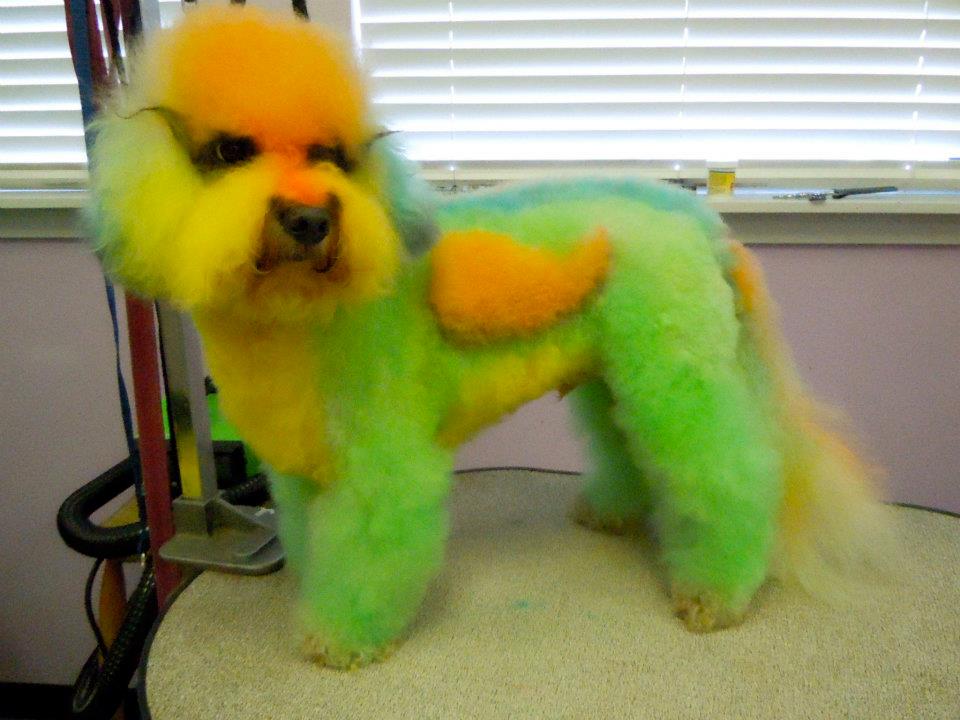
Dog that looks like fox
An all-white coat underwent this foxy transformation.

A few years ago, pet owners in China received a lot of press for dyeing pets to resemble other animals. Do you provide that service at Klippers? Yes. We don’t charge a lot for it, since it’s not a high-market area – a panda trim on a small dog would probably be around $75. We use an applicator brush to set in the dye, and then rinse the fur so the dye doesn’t bleed.

Your craziest trim: For a Looney Tunes-themed competition, I painted Tweety Bird on one side of a dog’s fur and Bugs Bunny on the other side. I called her Looney Grooms.

What’s the appeal of your work? For a special occasion, or to put a smile on their face. The color lines should be nice and sharp and conform to the dog’s body. Maybe someone wants to paint their dog with school colors for a big football game, or with pastel colors for Easter.

Your website also boasts feather extensions and hair tinsel. You don’t think that’s a bit excessive? I don’t, but I know that some people do. Once, I was walking with my pink poodle, and a girl hollered at me that dogs aren’t supposed to be that color. But she had purple hair! A companion dog’s job is just that: to be one’s companion.
Fur.
Omboy uses dyes made with beeswax and cosmetic grade pigments, which often last about six to eight weeks.

Some even consider painting pets a form of animal cruelty. In fact, prior to July 2012, dyeing pets was illegal in Florida. I can show you pictures of things that are cruel. Neglect is cruel. Creative grooming is far from cruel. That law in Florida was meant to prevent people from dyeing Easter bunnies and chicks, but it blanketed all animals. In July 2012, they removed the law completely – after all, there are products made for animals.

Did you work in Florida while the law was in effect? I competed in creative styling competitions there for a few years, until some officers from animal control came in and made a stink about it. No charges were pressed against me.

Number of regular customers: More than 1,000 cats and dogs. Some are weekly, some are monthly, and some are yearly clients.

Only cats and dogs? Mostly. I’ve had some freaky animals come in, like guinea pigs, ferrets, and sheep. Once, a lady brought in a miniature horse for us to shave down.

How steep is the learning curve to become a pet groomer? I started off attending trade show competitions and seminars to further my education in the field. Then, I studied with the Nash Academy in Lexington, Kentucky, and now I’m a National Certified Master Groomer with the National Dog Groomers Association of America.
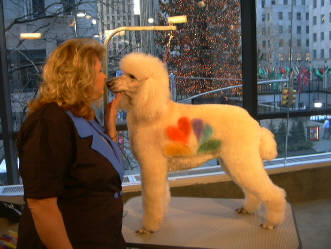
One of Dawn's poodles sported the NBC signature peacock for an appearance on The Today Show in 2007.
One of Dawn’s poodles sported the NBC signature peacock for an appearance on The Today Show in 2007.

Best part of your job: Playing with my dogs and taking them to work.

Most challenging part of your job: Watching dogs grow old and die.

What would people be surprised to learn about your job? It’s very physically demanding, and you’re on your toes all the time. I probably work on about 12 to 16 dogs each day.

Your email signature: “Making the world more colorful, one dog at a time.”

LAUNCHING YOUR CAREER>>
Make sure the [animal] is comfortable with what you’re doing. This line of work is a labor of love. Learn different coat types; for example, soft, curly hair is easier to color than a coarser coat.

For more No Joe Schmos accompanied by furry friends, meet the airport canine ambassador and the pet detective.

All photos courtesy of Dawn Omboy and Klippers’ Facebook page.

This slideshow requires JavaScript.

The Cardstacker (Who Doesn’t Watch House of Cards)

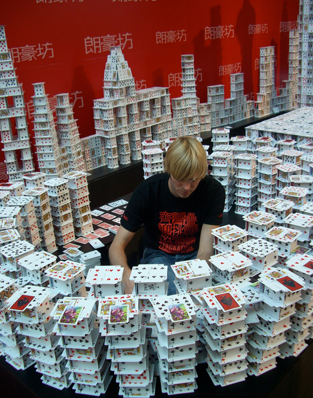
Bryan Berg's recreation of the Dallas skyline used 1,060 decks of cards.
Bryan Berg’s recreation of the Dallas skyline used 1,060 decks of cards. That’s more than 55,000 playing cards.

“There’s this notion that a house of cards is fragile,” says Bryan Berg, who has perfected the art of stacking cards over some 20 years. In fact, he explains, intricate houses can weigh in at hundreds and hundreds of pounds, and often require leaf blowers to take down. “Fragility is relative, right? I can put a brick building up to a tornado, and then you realize that it’s fragile, too.”

Berg, a Guinness World Record Holder at age 38, maneuvers around his freestanding constructions using ladders or scaffolding. His tallest creation, the Dallas skyline, is more than four times his height, towering at 26 feet – the holder of the Guinness World Record for Tallest House of Cards.

Hotels, television networks, and city governments approach Berg with requests for replicas of existing buildings or objects, like creating the largest casino in the world – the Venetian Macao Resort-Hotel in China – during the Chinese New Year in 2010. It took almost two months and 4,000 decks of cards to construct.

Below, Berg describes his 7- or 8-hour workdays, which he mostly spends in silence (except for crunch time, when he cues up electronica on his iPod) and wearing socks.

Age: 38
Graduated from: Bachelor of Architecture from Iowa State University; Master of Design Studies from Harvard
Based in: New Mexico
Years in the business: About 19
Previous jobs: I worked at my dad’s construction company throughout high school, college, and even after. That was part of what allowed me to get my footing with cardstacking.

I captured my [first] Guinness World Record in 1992 when I was a senior in high school. It was 14 feet and 6 inches tall, much higher than anything I had ever built before. But my first paid project didn’t happen until two years later.

Berg built the Beijing Olympic Village at Langham Place Kowloon, Hong Kong's largest shopping center, in celebration of the Beijing Olympics.
Berg built the Beijing Olympic Village at Langham Place Kowloon, Hong Kong’s largest shopping center, in celebration of the Beijing Olympics.

Did a passion for architecture segue into cardstacking, or vice versa? My interests in the built environment led me to cardstacking, and cardstacking led me into the pursuit of architecture.

When did you realize you could make a living by stacking cards? Well through college – if not, after. I considered every project to be an anomaly. Over time, I realized it was more than a fluke, and I took it more seriously.

Do you use novelty cards? Initially, I used whatever I could get my hands on – the cheap decks from the local grocery store. But that created a problem, since [each card] varied in quality and characteristics. So I partnered with this Belgian company Cartamundi to create cards with the ideal height-to-width ratio. I also worked with them to create a special buildable set, with a patent-pending gadget – it’s essentially a training wheel to learn how to stack cards.

Do you use any gadgets? No. But I’m not placing cards in a random or haphazard way – I design every single arrangement in a geometric and orderly method. But there’s no bending or manipulation of cards.

By nature, your art is impermanent – you can’t exactly transport a house of cards. I’ve only used glue with two projects, and I’m very upfront about them: Once, for the Holiday Inn, I glued together key cards for a life-size hotel recreation. Another time, for the World Series of Poker, I glued together poker chips for a full-scale “Welcome to Las Vegas” sign that hung in the air. Watch the time lapse below:

Your technique: There are two principal ways to stack cards: horizontally and vertically. I use both. I also produce a computer-generated rendering for my clients, but the finer points take a lot of improvisation. The musical analogy is that you’re given the time frame and key signature, but you have to fill in the notes.

The deconstruction process: I don’t get upset about knocking [a project] down, as long as I’ve got some good pictures. It’s part of the process; it doesn’t feel complete until I’ve knocked it down. I usually use a leaf blower.

It really requires that much force? A common question I get is, What if you sneeze while you’re working? People don’t realize that a house of cards is very heavy – hundreds and hundreds of pounds. A sneeze won’t do anything. Any damage while I’m building is isolated; it doesn’t spread because of all the partitions.

Best part of your job: Being able to be artistic and to do what I like.

Most challenging part of your job: When people come to us without a clear vision of what they want, or too hardened of an idea.

What would people be surprised to learn about your job? Actually stacking the cards takes a pretty small amount of time compared to planning and coordinating with everyone involved. My wife, Kristin, holds up the business end of things.

Berg was commissioned to break his own record at The Venetian Macao Resort Hotel, the largest casino in the world. The project took 44 days, 219,000 cards, and set a new Guinness World Record.
Replicating the Venetian Macao Resort Hotel, the largest casino in the world, took 44 days, 219,000 cards, and set a new Guinness World Record for Largest House of Cards.

How do you navigate around structures that are taller than you are? With ladders or scaffolding. You don’t want to stack yourself into a corner.

Have you dabbled in real bricks and mortar? I’m actually building a real house for myself right now. I’m the general contractor, so I have a crew.

Any interest in Netflix’s House of Cards? I’ve heard about it, but haven’t seen it.

Some structures must be impossible to recreate using cards. Yes, like the Statue of Liberty’s arm or the Golden Gate Bridge or an airliner’s wings. There’s nothing to support it.

Your required reading: Screw It, Let’s Do It by Richard Branson. It’s about how he made his life fortune by going against the advice of his financial advisors.

Your favorite architectural work: The temples at Angkor in Cambodia and the wooden architecture in Japan.

How do you calculate your rates? It’s a day rate that includes any travel costs. A big part of this is learning to suggest a reasonable price that isn’t a rip-off for [the client] or for me. Over time, you learn what something is worth.

LAUNCHING YOUR CAREER>>
Look at the work of others, but realize that sometimes the best ideas might not come from the human element. They might be outside in nature or in some totally unrelated realm of data or experience.

Follow Bryan Berg on Cardstacker.com, his Facebook page, and at @cardstacker on Twitter.

Next: Meet the SNL cue cards guy, who makes a living with a very different type of cards.

The World-Class Juggler

“I turn regular juggling into a living organism," says Mark Nizer, whose show is in "4-D." Photo: twitter.com
“I turn regular juggling into a living organism,” says Mark Nizer, whose juggling show fuses standup comedy, music, and technology. Photo: twitter.com

Forty years ago, during Mark Nizer‘s first juggling lesson, something inextricable sparked in his brain. He likens the rush to that of drug addicts.

When he began his juggling and standup comedy routine in college, Nizer collected about $15 per street show. But as he replaced ping pong balls for bowling balls and bowling pins for torches and machetes, he began raking in $1,200 in a single weekend.

Now, at 52, Nizer has left his street performing days behind. His shows at performing arts venues are spectacles laden with fog, motion-sensor lasers, and propane tanks whizzing through the air. Audience members don depth-perception glasses, and Siri – the iPhone personal assistant – narrates his stream of consciousness.

Age: 52
Graduated from: University of New Hampshire and San Diego State University; degrees in psychology and zoology; minor in dance
Based in: Charlottesville, Virginia
Years in the business:  30
Previous jobs: I’ve never really had a job besides this, except for working at a lumberyard in high school. In college, I was a street performer. It was awesome; I was performing outside in a free space, with no rules or regulations.

Do you miss that setting, compared with the limitations of performing on stage? I’m basically a street performer cleaned up for the stage.

Your mentors: I watched Michael Davis a lot, the first juggler ever on Saturday Night Live. I also toured with Bob Hope and opened for Ray Charles and George Burns.

What catapulted you from performing on streets to opening for Ray Charles? Somebody videotaped my performance at a college talent show and sent it into the American Collegiate Talent Showcase. I then won first place in the International Juggling Championships, and was named the Comedy Entertainer of the Year in 1998.

When traveling for a show, you don’t leave home without: My iPad and laptop. I plug into the light plot and sound system with my laptop and run everything remotely from stage.

You’re fueled by: Sitting and playing. Mega playtime is critical to coming up with stuff. That’s what we don’t do enough in our lives. That’s how I came up with using Siri’s voice to narrate my show.

Most dangerous items you toss around: I juggle an electric carving knife, bowling balls, propane gas tanks, and lasers. None of that stuff is difficult for me – it happens in slow motion. But fire marshals require that my clothes be treated with a flame retardant.

Who taught you to juggle? When I was in seventh grade, my mom was sick of three teenagers lying around the house, so she signed us all up for juggling class. As soon as I started, something turned on in my brain. I started practicing 10 to 12 hours every day.

Best part of your job: Seeing the world and playing with it, figuring out what works, what doesn’t. Forced creativity can be painful, but it forces you to stumble upon things you otherwise wouldn’t have.

Most challenging part of your job: It’s exhausting having to say Look at me! all the time, trying to get hired for shows. It’s also hard to come up with brand new ways to play with balls and bowling pins. Every day, some kid in Denmark or Africa is thinking of new ways to play with them, and it spreads around the Internet like wildfire.

What would people be surprised to learn about your job? Some tricks take years to develop. And some are disasters. I once built a laser harp with fake laser beams that plays music when it senses your fingers. But it was impractical, and weighed hundreds of pounds. So now I have a bunch of lasers, worth thousands of dollars, sitting in my basement.

Number of shows per year: About 120.

Your most impressive trick: There’s one I call the Impossible Trick. You spin a ball on your right index finger, and another ball on your right foot. You throw the ball [the one spinning on your foot] to your forehead, let it roll down your neck and back, and kick it with your heel so it goes over your head and lands on top of the other ball spinning on your finger. I worked on that trick for seven years before I could get it to work one time. It took another three years before I started performing it.

“There’s a bit of society pressure that says, You’re a homeless street performer,” Nizer explains. That claim isn't unfounded; most performers only collect a few dollars per show by passing around a hat or guitar case. Photo: dwfestivals.aristotle.net
“There’s a bit of society pressure that says, You’re a homeless street performer,” Nizer explains. That claim isn’t unfounded; most performers only collect a few dollars per show by passing around a hat or guitar case. Photo: dwfestivals.aristotle.net

Where do you practice? Any open space indoors with a high ceiling. For shows, I need a space with a 12′ ceiling or higher. Blackout capability is nice for the lasers and other special effects, but not required.

What are you working on now? I’m into hang gliding right now, and I’m messing with metal tubes a lot. I also want to use my two big air circulators to make things fly.

One trick you can’t seem to master: I’ve been trying forever to use a new camera that can sense body position. There’s also this dimension beam that uses infrared light to sense body position, which I’ve been trying to use without much success.

Salary: Per show, I charge anywhere from $1,000 to $15,000.

LAUNCHING YOUR CAREER>>
People say that you don’t need to a college degree to do what I do. I disagree. Economics, marketing, and advertising classes will all help with positioning yourself as a performer.

NEXT: Meet the millionaire’s magician, another No Joe Schmo who will make you question your eyes.

By the way, in case you were wondering: Mark Nizer wasn’t totally crazy during his first juggling lesson, when he felt something “turn on in his mind.” It’s true: learning to juggle stimulates an unused part of one’s brain.

The Hand Model Who Doubled For David Beckham

Furino describes his work as vacillating between "excruciatingly simple" and "brutally high-pressure."
Furino describes his work as vacillating between “excruciatingly simple” and “brutally high-pressure.”

The dirty little secret of hand modeling is that it’s not as glamorous as it looks.

30 or 40 stressed-out food stylists, crew, and advertising and client executives crowd around a table, waiting for James Furino to release a muffin from his grasp for a Dunkin’ Donuts commercial. If he’s off by one second, or the muffin lands at the wrong angle, it could mean another few hours for everyone in the room.

Furino entered the hand modeling business when a friend from his songwriting class, also a hand model, commented on his “beautiful hands.” His background in music serves him well, as rhythm and dexterity come in handy.

If you watch television or read magazines, you’ve seen Furino’s handiwork. On his iPhone, he pulls up a list of various celebrities he’s played hand doubles for: David Beckham, for a Sharpie commercial; Daniel Craig, for a Smirnoff ad; Jackie Chan, for a V8 ad; and Tom Ford, for a cologne promotion (photo editors later added hair to his knuckles in Photoshop).

Age: Let’s just say that my hands look a lot younger than I am.
Graduated from: New York University, degrees in music and business
Based in: New York, N.Y.
Years in the business: I’ve been in the thick of it for 15 years.

Previous jobs: I was a child prodigy drummer. After college, I became a bartender and played drums at cabaret shows. I ran a club called Paulson’s on the Upper West Side; I wrote pop songs and jingles, including one for Snickers; I taught drums at NYU and performed standup at Carolines. Then I was trying to make it as a solo singer/ songwriter/ pianist.

So, nothing handsy. I met a woman in my songwriting class who was a hand model. I ended up at her apartment one day, and she told me I had beautiful hands. She said I had to get pictures done and see an agent. So I did.

Furino's first foray into parts modeling.
Furino’s first foray into parts modeling.

Tell me about your first casting call. My pictures were nothing special; I was holding a calculator (see right.) Every big hand guy in the city was there, but they booked me for $250 an hour. It was a job for a medical magazine, cutting something with scissors.

How would you describe your hands? Not too big, not too small. Not too feminine – they’re manly enough. But, look. Nobody is really selling hands. You need a certain personality. As Mel Brooks would say, you either got it or you ain’t.

Gigs per year: Between 60 and 100. Lately, it’s been closer to 60.

Your greatest achievement: There are two sides to parts modeling. There’s the print world – from billboards to magazine ads to pharmacy pamphlets – and then there’s live action on television. I do a lot of both. I’ve done everything from the Staples “Easy” button to the iPod nano to Pizza Hut to DeBeer’s diamonds. There are really only three or four people who do this really well, and I’m one of them.

Weirdest job you took to make money: Well, before hand modeling, I cleaned bathrooms in college. That’s honorable work.

Weirdest modeling job you took to make money: Once, for a jewelry ad, I got paid $400 per hour to hold my hand on a naked woman’s shoulder. Another time, I was hired to model for a secret product – I didn’t even know what it was for. Turns out, it was for a Michael Jackson video, but I think they just ended up using Michael’s hands.

Your skincare regimen: Stay out of toaster ovens. [Laughs.] I use a regular moisturizer at night, and I’ve learned not bite my nails. I use chapstick on my cuticles to make them clean. I do a few things with gloves, like working out at the gym, waterskiing, and scuba diving. My kids are 5 years old, and they’re very rambunctious, so I’ve started putting gloves on when I roughhouse with them in the pool.

Must female hand models be more careful? It’s more important for a woman to have pristine hands. They can’t come in with callouses or cuts the way that I can. When it comes to print, like cosmetics and magazines, women dominate. TV is another world, and that’s generally men.

Best part of your job: Executing a shot that everyone imagines to be very difficult, and satisfying everybody in the room.

Just look at those cuticles. Photo: James Furino
Just look at those cuticles.

Most challenging part of your job: People think this is a get-rich-quick scheme, but it’s really hard to make a living from it. Everybody wants everyone else’s job. It’s a very small, niche market, and it vacillates between being the easiest job on the planet and crazy-high pressure.

A high-pressure job can still be glamorous. Ugh. Everyone who does this is like, I’m so fabulous. You’re not that fabulous, and you’re not making that much money. You’re just an average person doing something kind of fun, and you’re really lucky.

What would people be surprised to learn about your job? You never see the hands in about 80% or 90% of the stuff I do for television. I’ll be dropping a burger onto a plate for a commercial for Burger King, but if my hand is in the shot, they can’t use it.

So why the elaborate auditions process? They need someone with certain dexterity. For me, I think it comes from my music background. And of course [aesthetics] matter for print ads.

Do you model other body parts? My feet, sometimes. But the most money is made from hands, since they’re used most often. Jobs for modeling an ear or calf or nose are more infrequent, like once a year. Leg models and models who aren’t afraid to model nude can command up to $10,000 or $20,000 for the day.

How do you feel about the depictions of hand modeling in that episode of Seinfeld, or in ZoolanderIt’s silly, but some take it too far. Everyone wants to meet the hand model and ask if they have nice enough hands to be a model. “Can I see your hands? Did you see the Seinfeld episode when George is a hand model?” Not that anyone means harm, but because of the novelty of the work, I become kind of a circus act.

Your hands won’t look young forever. Does your job have an expiration date? It’s a young person’s business, but if you take care of your hands, they can defy your age. Right now, modeling is just a vehicle to get me to the next place. I want to write and direct movies.

Average salary: For TV work, it’s in the range of $1,000 per day, which is regulated by the Screen Actors Guild. For print, it really varies by job.

Are your hands insured? No.

LAUNCHING YOUR CAREER>>
1. Visit a website or look in a magazine, find other hand models, and duplicate their stuff. If they’re holding a paintbrush, for example, hold some magic markers.
2. Get an agent and have some nice photos taken.
3. Don’t quit your day job.

And now, for something completely different: the artificial limb maker.

Unless credited otherwise, all photos courtesy of James Furino.

Foodie Friday: The Dog Food Tester

Food fit for a king (Charles Spaniel). Photo: Nancy Rica Schiff 2006 from her book, Odder Jobs, More Portraits of Unusual Occupations
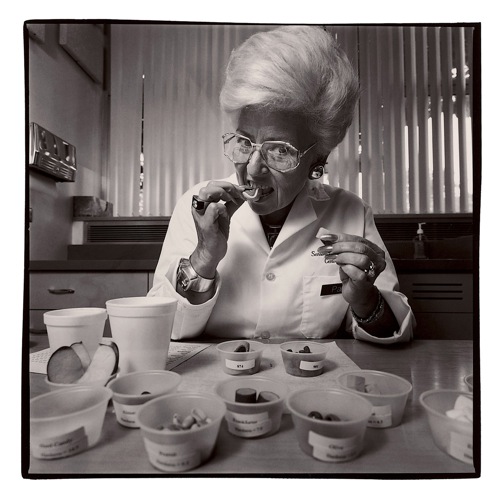
Patricia Patterson samples food fit for a king (Charles Spaniel). Photo: Nancy Rica Schiff 2006 from her book, Odder Jobs, More Portraits of Unusual Occupations

“It really wasn’t as bad as I thought it was going to be,” Patricia Patterson remarks thoughtfully. She remembers its porous surface – it resembled lava rock. She inserted a chunk into her mouth, moved it around for a few seconds. Spit and repeat. Spit and repeat.

At the Sensory Analysis Center at Kansas State University, Patterson, a former restaurateur, analyzes a slew of products for flavor, texture, and color – fragrances, fruit, gelato, coffee, air fresheners, and fabrics. But dog food is the product that makes people raise eyebrows and cock heads.

“I admit, there’s a certain stigmatism to eating dog food,” Patterson said. “But I don’t eat it. I taste it and analyze it.” In fact, its distinct flavor is harder to identify than many might imagine.

Age: 65
Graduated from: Business school in Salina, Kansas
Based in: Manhattan, Kansas
Years in the business: 12
Previous jobs: I started out as a secretary, but I got bored sitting behind a desk. I wanted something more people-oriented, so I went into the bar and restaurant business. I did that for a good many years, but I got burned out.

You left one food job for a very different food job. I basically retired from my restaurant job, and I was looking for something part-time. I saw this newspaper ad for the job at Kansas State University, which appealed to me because it said something like, “If you like to work with food, people, and products.”

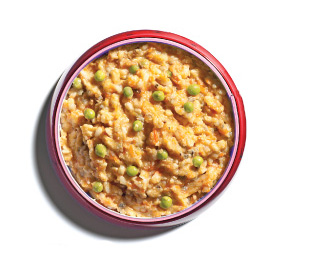
Human vs. canine food: a sometimes-blurry line. Photo: businessweek.com

No mention of dog food. No.

Tell me about your first day on the job. Well, before you’re accepted and trained, you have to pass a test. You have to describe and differentiate between different products. Take cinnamon, for example. They want you to say brown, sweet, woody. But an individual who hasn’t been trained doesn’t think about those things. They might just say that it smells good. 

So developing a lexicon filled with rich adjectives is part of the training. Yes. We’re always coming up with descriptive terms and definitions. It comes with time and experience.

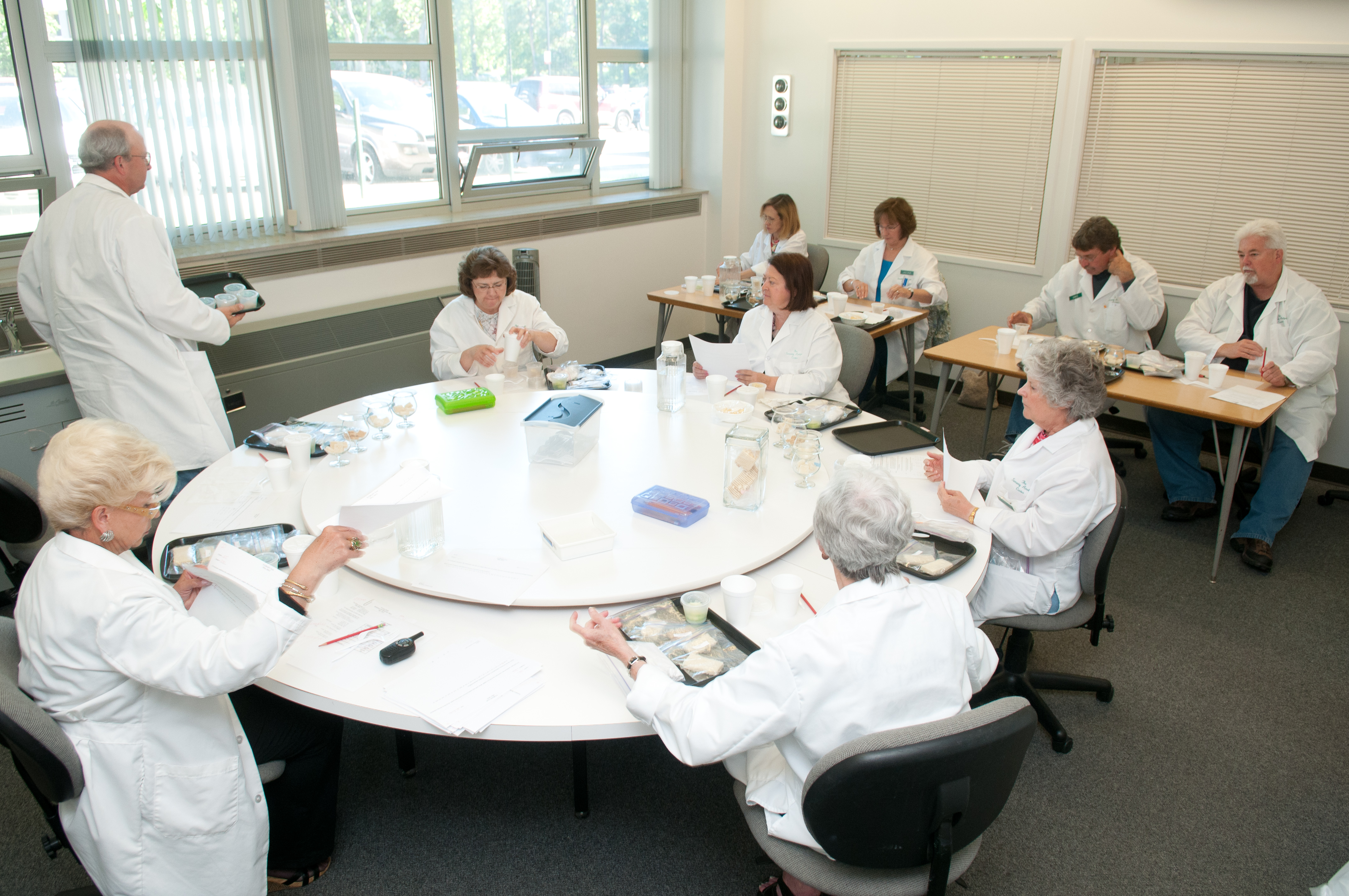
Preparation and special tactics: We don’t prepare the products, so we don’t need gloves or hairnets. But we wear white lab coats [when testing], and stay away from perfume or anything scented. No flavored lipstick, no hand lotion or hairspray, no detergent. We work in a clean conference room, with a table, chairs, blackboard, and sink to wash your hands.

How did you react the first time that dog food appeared on the table in front of you? I was like, yuck, nasty! Animal food was a totally new area we hadn’t approached before.

Have you ever dined at a restaurant and thought, Wow, this kind of tastes like dog food? Yes. Sometimes, you’d like to shut it off, but you can’t.

Your objective in taste testing: We’re not told specifically what we’re looking for; others extract the information they need. We just examine the aroma, flavor, and texture. We determine attributes using references.

Do you mean points of reference? Yes. We have about 40 references for dog food, for attributes ranging from smokiness to mustiness to fishiness. We have references for its appearance, too: color, shape, size, and surface texture.

Testing dog food wasn't half bad, says Patterson. Her worst memories stem from testing cat litter. Photo: Sensory Analysis Center
Patterson has also tested cat litter (for aroma, not taste). “It’s one of my least favorite products,” she says. Photo: Sensory Analysis Center

Your beef with dog food: We had one that tasted like sponge rubber. But we also had one that was very, very good. I’m sorry, but it was. It was meaty and had vegetables.

Did you swallow it? No – you don’t want to mix the flavors. You leave it in your mouth for a certain amount of time, maybe moving it around, maybe chewing it. Then you expectorate it.

Skills required for the job: Patience. A testing can take one day, or it can take weeks, months, or years. It depends on the project. You also need to be unbiased; it doesn’t matter whether or not you like the product.

Best part of your job: Seeing so many different products. I also like the international travel. I’ve been to Germany to work on cheese; Thailand to work on soy sauce and a variety of miniature fruits; and Italy to work on gelato.

Most challenging part of your job: Coming up with new terms and attributes. But it’s a group effort; that’s why we have panels of sensory analysts.

What would people be surprised to learn about your job? It’s not an eating job. We taste, over and over and over. It’s very repetitive.

Woof. Source: 4gifs.tumblr.com

You mentioned that you own a dog yourself. He must benefit from your sophisticated palette. He’s spoiled rotten. I cook for him a lot – chicken, beef, potatoes, rice, carrots, and pork. But if I’m traveling, he does get dried dog food.

Recently, the radio show This American Life investigated a story about meat plants selling pig intestines as fake calamari. It suggested that consumers couldn’t differentiate between the two. Do you think the same goes for dog food and certain “human foods,” like chopped liver? I have to say, some of the dog food we had was better than people food.

Salary: $10 to $16 per hour.

LAUNCHING YOUR CAREER>>
There’s a certain satisfaction in improving and developing products that eventually end up on shelves. It’s very rewarding. It’s also interesting to be exposed to products that consumers may never see – the things that don’t make it to the shelves.

Like Patricia Patterson, many No Joe Schmos started out in more ordinary professions. Meet the tech entrepreneur turned pooper scooper and the real estate agent turned hot air ballon pilotThen, check out more of the cutest dog GIFs of all time.