King of the Jungle: CEO of Lincoln Park Zoo

When Kevin Bell first became director of the zoo, he had no managerial or administrative experience.

Growing up in the Bronx, the first sounds Kevin Bell heard in the morning were not honking cars and alarms, but rather the Tarzan-like screeches of white-cheeked gibbons and barks of sea lions.

To be fair, he didn’t live in the Bronx as most of us imagine it. At age 5, his family moved into a home behind the Reptile House at the Bronx Zoo, where he was surrounded by 252 acres of animals. He helped out his dad, who worked as zoo’s bird curator, and spoke to the giraffes and hippos at night until it was time for bed. He knew immediately that it was his calling.

After completing his Master’s studying the Atlantic Puffin off the coast of Maine, Bell was hired at the Lincoln Park Zoo in Chicago, Ill., one of the nation’s oldest zoos housing 1,200 animals representing 230 species. Now, 35 years later – as the zoo’s president and CEO – he reveals the challenges of running a nonprofit, why he’s not worried about a Bronx Zoo cobra situation, and how he gauges potential new hires (hint: it’s not resumes).

Title: President and CEO, Lincoln Park Zoo
Age: 58
Graduated from: Syracuse University, degree in biology; State University of New York, Master’s degree
Has worked at the zoo for: 35 years, and 18 years as president/CEO
Previous jobs: Curator of birds at the Lincoln Park Zoo
Visitors per year: 3 to 4 million

Bell is particularly fascinated by hornbills, which are indigenous to Africa and Asia. To lay eggs, the female seals herself in tree cavity with a tiny opening for the male to feed her through.

You’ve worked at the Lincoln Park Zoo your entire post-college life. I was hired there directly after graduate school. After working as the bird curator for 18 years, I became assistant director of the zoo for six months, and then director. After we privatized the zoo in 1995, my title became president/CEO.

What do you do all day? I oversee the overall direction of the zoo and concentrate a lot on fundraising. This is a free zoo, and doing something good for the public adds a feel-good part to the job. But you need an incredible amount of resources to operate a nonprofit organization.

What background did you have with animals? My father was the bird curator at the Bronx Zoo, and we moved to the zoo grounds – behind the reptile house – when I was 5 years old. Surrounded by 252 acres of animals, I had the zoo to myself in the evenings and early mornings. I spent all my time there until I left for Syracuse.

Bell describes his management style as relaxed: "People call me by my first name."

Did you help out your dad? Yes – I had chores. In the birdhouse, I carefully turned hundreds of eggs a quarter-inch in the incubator. I took care of some of the hatchlings since I was there 24 hours a day – even after the keeper staff went home.

Living at the zoo is many a little kid’s dream. I’d feed the giraffes and hippos and talked to all the animals. I was convinced they knew me; many animals develop relationships with their keepers and recognize familiar faces.

Something people don’t know about your job: That I started out as an animal person, and that I had no administrative or fundraising experience when I took over as president and CEO. I learned on the job.

Most important lesson learned: The impact zoos have, especially in urban areas like New York City, Chicago, and Los Angeles. So many kids don’t get outside the city – not to mention to Asia or Africa – so their only bond with wildlife is coming to the zoo. Elementary school kids are amazed when they come here and realize where milk comes from, where the food on their tables comes from. It’s a great way for them to see that science can be fun.

Best part of your job: When I get frustrated with personnel issues, I go over and see a giraffe or feed a rhino; they don’t get in bad moods. I also love walking around as a visitor and experiencing the zoo from that side of the equation. I’ll walk up to other visitors and tell them a fun fact that I think they may not know.

WATCH:

Most challenging part of the job: Balancing the budget in a tough economy. Attendance is free, but right now, revenue is way down since people aren’t spending a lot of money inside the zoo.

Responsibilities as bird curator: I traveled a lot as bird curator, doing fieldwork on birds in Central America, Iceland, and Indonesia. It was the best job in the world.

Favorite animal: You might expect it to be a bird, but I love tigers – they’re absolutely magnificent creatures. Unlike lions, tigers are very secretive and elusive; to see one in the wild is an amazing event. I also love great apes and the Himalayan takin, which is kind of like a sheep-goat.

Do you worry about escapes, like the Bronx Zoo’s cobra? You worry more about the visitors that don’t respect fences. With 50,000 visitors in a day, there are bound to be a few unstable people walking through who have had a few beers. That said, if a dangerous snake got out at Lincoln Park, it would be almost impossible for it get into a public space.

How would you describe your management style? Relaxed and informal – people call me by my first name. I’m a bit of a micromanager, but that’s because I’ve gone through the system and understand most of the jobs really well.

Gibbons are born with blonde fur, but by age 2, their color turns to black. As adults, males remain black and females change back to blonde.

Coolest animal at the Lincoln Park Zoo: I try to stay away from favoritism, but the white-cheeked gibbon is pretty cool. It has long arms and fingers and swings between trees, Tarzan-style. They also communicate with a Tarzan holler that carries through the jungle.

Do you live on the grounds of the zoo now? No; I live a few blocks away.

LAUNCHING YOUR CAREER>>
1. A liberal arts education, including some business management and economics classes, is great for people interested in nonprofit management. The key to fundraising is building relationships with people, so that they get to know and trust you – and at the basis of that is being to talk to people about everything from arts to politics. You need that broad background to relate to people.

2. Volunteer for every possible job at a company. As bird curator, I volunteered to do things like budgets and inventory, and not because I had the skills. It ultimately made me a better manager.

3. Get comfortable communicating with others on a large scale. Now, I give speeches to 2,000 people, but when I first took the job as director of the zoo, I was terrified to talk in front of 25 people.

Follow the Lincoln Park Zoo on Twitter at @LincolnParkZoo and check out its YouTube channel. Unless stated otherwise, all photos courtesy of the Lincoln Park Zoo.

PLUS: Other No Joe Schmos love animals, too. Jenny Litz is saving the Ecuadorian rainforest in $8 rubber rain boots!

Foodie Friday: The Food Chemist

"It's so gratifying to go into a grocery store and see something you’ve been working on for the last year," says Supriya Varma, a senior scientist at Frito-Lay.

Traditionally, food and science and technology don’t exactly go hand-in-hand. But the combination comes naturally for Supriya Varma, the senior scientist at Frito-Lay. Varma uses science and technology on a daily basis to help develop processed food products like southwest enchilada black bean dip.

Many people think the job is “like home ec,” Varma says, which is a misconception. In addition to seeing products through from conception to execution, food scientists are responsible for ensuring that astronauts get the required amount of nutrition in the most compact way possible. (Every gram sent into space costs $10,000!)

After moving to the U.S. from India to complete her Ph.D., Varma pursued a career in food chemistry, a field offering much growth. As she points out, people love to eat – so the industry is very stable. Here, Varma discusses reducing enzyme activity to preserve a product’s shelf life, her views on genetically modified munchies, and her love of plain old Lay’s potato chips.

Age: 33
Graduated from: Rutgers University with a Ph.D.
Has held the position for: 3 years
Previous jobs: Formulated health drinks at GlaxoSmithKline Pharmaceuticals Limited in India

In a sentence or two, what do you do all day? I generate ideas for new products, build prototypes, and work with consumer insights to get a sense of what customers want. I’m involved from design to execution of new products.

Frito-Lay Southwest Enchilada Black Bean Dip. Photo: fritolay.com

What products? All different dips. We launched a Southwest Enchilada Black Bean Dip a few years ago, and recently launched a spicy nacho cheese one. We also do single-serve dips to go.

Emerging trends in the food industry: Ethnic flavors and hot, spicy products – like Mexican and Latin flavors. Lots of consumers nowadays like those flavors in the form of snacks and drinks, which is a change from what we’ve seen in the past. Consumers used to be very intimidated by new flavors.

Advances you hope to see in the field: While consumers are experimenting with new flavors, it’s still not in a big way. For example, they want to see all different kinds of ice cream, but in the end, they still lean toward the vanilla or strawberry.

So creating innovative new products is a big risk for sizeable companies like Frito-Lay. Yes. Sometimes, we’ll see products come and go, and it took a huge amount of time and effort to have it hit the market in the first place. But there’s hope; many years ago, people barely knew about sushi, and now you see tons of sushi places across all cities, and even in grocery stores.

True, but much of that sushi is not true to form. That’s another thing that concerns me about the food industry: it’s important that products stick to their true roots and are not diluted too far away. You want to give an authentic experience to consumers.

Misconception you’d like to change: People think all processed food is unhealthy, but it’s not.

How do people respond when you tell them what you do? Some say, “Oh, I was never sure how we were getting tomato ketchup on the shelves.” People in my field are the ones making sure astronauts get the required amount of nutrition in a compact way, since every gram you send to space costs $10,000.

Best part of your job: I get to eat all day, but that’s good and bad. [Laughs.] You’re ahead of trends and get to see products in their entirety, ideas coming to life. It’s very gratifying to go to a store and see something you’ve been working on for the last year.

Photo: accessexcellence.org

Something people don’t know about your job: A lot of people think being a food scientist is home ec[onomics] or learning how to cook, but it’s not. It’s looking at food in a scientific way, and making sure the eating experience is the same whether you buy a product at a 7-Eleven on the road or at a large grocery store.

How to you apply science in your job? It helps us understand how the products are impacted over time – in other words, its shelf life. If ingredients have lots of enzymes that can degrade the product, we figure out how to limit the activity of those enzymes. We work very closely with engineers and packaging folks.

Your required reading: Food Chemistry by Owen Fennema. It’s the bible for food chemistry.

Views on genetically modified food: It’s tricky. You want to make sure that the good attributes of food products are maintained and that they don’t have harmful effects. You see things like onions that don’t make you cry and huge cloves of garlic, but it’s important that the overall attributes – flavor, texture, and appearance – remain the same.

Do you have any weird eating habits? I enjoy new cuisines and lots of quick, easy cooking – like frozen veggies, meats, and instant meals. I use them as building blocks and then customize those frozen products. I don’t have time to make elaborate meals.

How have advancements in technology changed your job? We’re now able to store perishable crops without them getting damaged, which in turn makes raw material more readily available. Ingredients that were previously just seasonal are now available throughout the whole year.

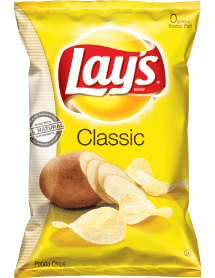
Lay's classic potato chips. Photo: fritolay.com

Favorite Frito-Lay product: Traditional Lay’s chips.

Dream job in college: I love animals, so probably working as a vet or at a shelter.

Foodie idol: I don’t really have one. I do like The Food Network’s Alton Brown, though. He demystifies our industry and bridges the gap between culinary and food science.

LAUNCHING YOUR CAREER>>
Supriya Varma offers advice for aspiring food chemists: Put in the time to understand the basic science behind the job; you need to like getting your hands dirty. A science background is highly recommended, if not required, since the job ultimately boils down to chemistry and what’s happening to products as they’re getting processed.

Hungry for more? Click here for more Foodie Fridays on No Joe Schmo, including a pizza chef and kimchi taco truck worker.