
Foodie Friday: Mrs. Willy Wonka

Mayumi (left) directing a photo shoot for Dylan's Candy Bar. Photo credit: Renata Yagolnitzer

As summer approaches, the shelves at supermarkets teem with ripe strawberries, blueberries, and watermelon. But candy is always in season.

No place knows that better than Dylan’s Candy Bar, the supersize candy store on Manhattan’s Upper East Side (other locations include East Hampton, NY; Garden City, NY; Houston, TX; and Orlando, FL). Mayumi Ando, the company’s creative director, oversees all graphic needs. People buy sweets at Dylan’s Candy Bar in no small part because of its unique packaging; the company’s trademark bold, rainbow style is part of the experience.

Mayumi’s theatrical background gives her a unique approach to design – most notably, as a cast member of the Broadway show RENT. And despite her nickname as “The Gobstopper” (because she’s sweet but tough), she lacks a sweet tooth. In fact, she’d prefer Latin American arepas over chocolate-covered almonds any day.

Title: Creative Director, Dylan’s Candy Bar
Age: 32
Has held the position for: 2 years
Graduated from: Columbia University, Bachelor’s degree in sociology
Number of cavities: Many. I’d like to blame that on genetics rather than eating too much candy.
Previous jobs: Hostess at The Russian Tea Room; tap dance substitute teacher; cast member in the Broadway musical RENT; freelance designer
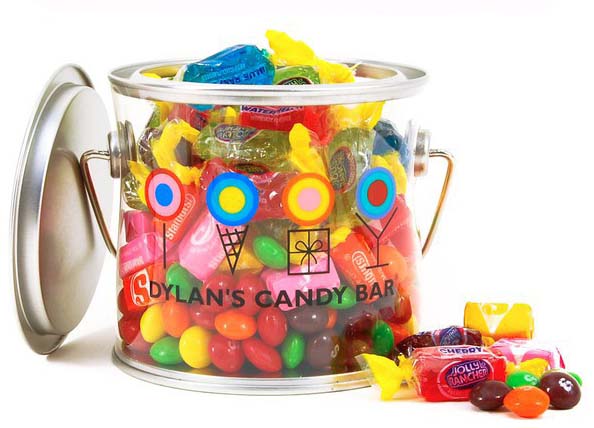
The Everything Under the Sun Mix, an online exclusive, includes Jolly Ranchers, Starbursts, and Skittles. Photo credit: dylanscandybar.com

Job description in one sentence: Everyone at Dylan’s Candy Bar wears many hats, but my responsibility is to oversee all creative aspects of the company – everything from internal graphic needs to product development/packaging, window displays, and website design.

How she got the job: I began freelance designing for Dylan’s three Christmases ago, when they were really swamped and only had one person in their creative department. A few months later, the creative director was leaving, so I filled in for her while [the company] searched for a replacement. In that time, they realized I was very capable of the job, and one thing led to another…

Something people don’t know about your job: Many don’t realize how involved Dylan [CEO and founder of Dylan’s Candy Bar] is in the company. Nothing goes out without her final approval; she is available via Blackberry 24/7, and is in my office three to four times a week. Also, a lot of people also don’t know that Dylan is Ralph Lauren’s daughter. In a way, that’s a testament to Dylan’s branding and business savvy!

Tell me a little more about Dylan. She’s an extremely creative person, which everyone is very surprised by. She loves bright colors, and dresses the way she’s created her brand – the other day, she came in wearing extremely bright green jeans.

How would you describe the brand? Very bold and colorful. Sophisticated but fun. There’s nothing shy about it.

From where do you draw inspiration? New York City is the perfect place. I’ll get on the subway and look at shopping bags people are holding, what they’re wearing, the conversations they’re having, the books they’re reading. I also love the idea of combining aesthetics from other countries into the Dylan’s Candy Bar brand. I just came back from a trip to Japan.
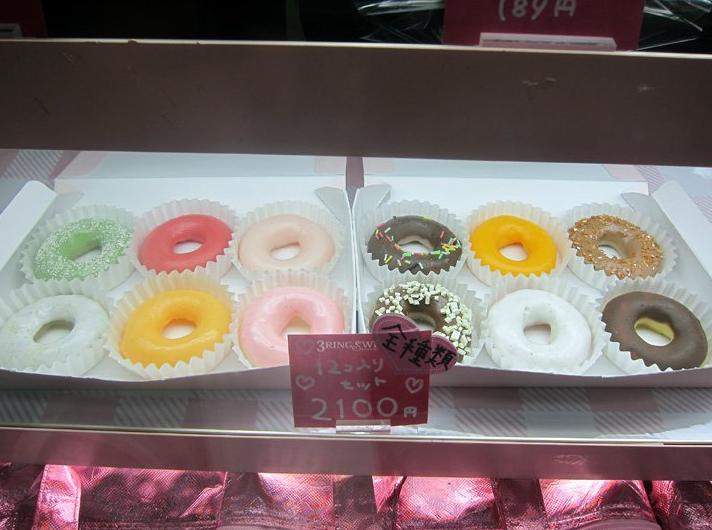
Donut-shaped mochi in Japan. Photo credit: Mayumi Ando

Any good finds there? Donut-shaped mochi! They look like colorful donuts, but are actually mochi filled with cream and drenched in a candy coating, then frozen. They taste similar to mochi ice cream – which is a ball of ice cream covered in mochi – but are filled with frozen cream, not ice cream.

Best part of the job: Seeing a final product come in after many months of development and thinking, “That initially came from my brain, and now everyone can see it, touch it, and enjoy it.”

Hardest part of the job: I have a large volume of work and responsibilities, and many short deadlines. There are “fire drills” on a daily basis, and in a way, they keep me challenged and excited. But it can also wear me down. Sometimes, I have to give myself a break and say, I just can’t get that done in an hour.

Guilty pleasure: Hulu.com – I don’t have a TV. I’ll put on Iron Chef and stare at all the beautiful food. I’m more of a savory person than a sweet one; I love Caracas Arepa Bar in the East Village.

What are the creative meetings at Dylan’s like? We’ll sit on the floor, sifting through magazines, throwing out scenes and branching off one another. It’s more talking than drawing.

Dylan’s Candy Bar was featured in the movie Arthur, starring Russell Brand. Catch it in this trailer at 1:45!

Best lesson learned: At RENT, I not only got to do what I loved and trained so hard to do — dance, sing, and act — but I also believed in the all-encompassing message of acceptance behind the show. Knowing that I touched the audience and changed teens’ lives … that just meant the world to me. From then on, I knew that it was possible to have a career doing what I loved and to inspire people. Having both parts fulfilled is a must for me now, in any job I choose.
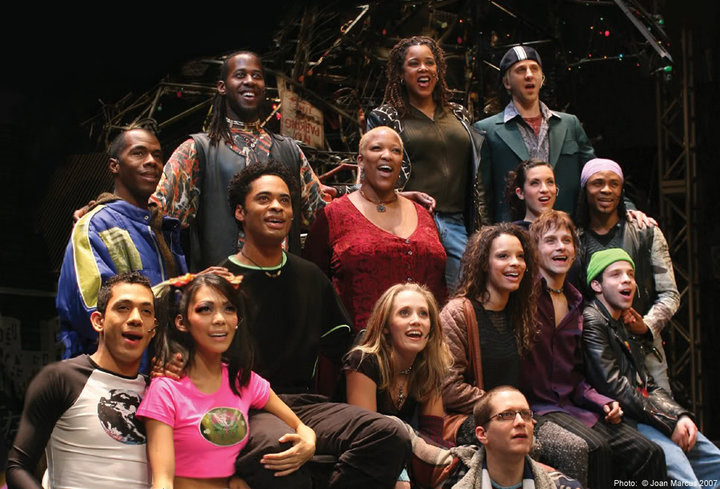
Bottom left, wearing pink: Mayumi Ando, with the cast of RENT in 2007. Center, wearing red: Frenchie Davis from "The Voice." Photo credit: Joan Marcus

How did you make the transition from musical theater to graphic design? I love to dance and perform, but after four years in RENT, I started feeling creatively stunted. I started experimenting with the video camera, teaching myself Final Cut Pro, and drawing a lot. My castmates noticed, and I quickly became the artist-in-residence at our theater. At one point, a castmate showed me preliminary layouts for her website and asked for my advice. Mid advice-giving, we paused, looked at each other, and she said, “You know, you could really do this as a career.” I was thinking the same thing. It was a lightbulb moment.

So you decided to leave Broadway? The next day, I started researching art schools in New York. For a semester and a half, I attended classes at Pratt Institute [for digital media and interactive design] during the day and performed in shows at night. I saw a future for myself in design, so I quit RENT to develop those skills – and became so much better when I could devote 100% of my efforts to it.

How did you build up your portfolio? I got it going pretty quickly, since my castmates were still coming to me to take their headshots, lay out their websites, and design posters for their shows. I was the go-to girl, and my name spread within the Broadway community. I kept putting myself out there, and nailed lots of jobs through recommendations and replying to posts for freelancers. I did in-house design at firms and learned how to work in corporate settings.

Favorite candy growing up: Mini Snickers and Reese’s peanut butter cups.
Favorite candy now: Sour straws. I like chewy, sour stuff.
Least favorite candy: Jellybeans. But I love their colorfulness.
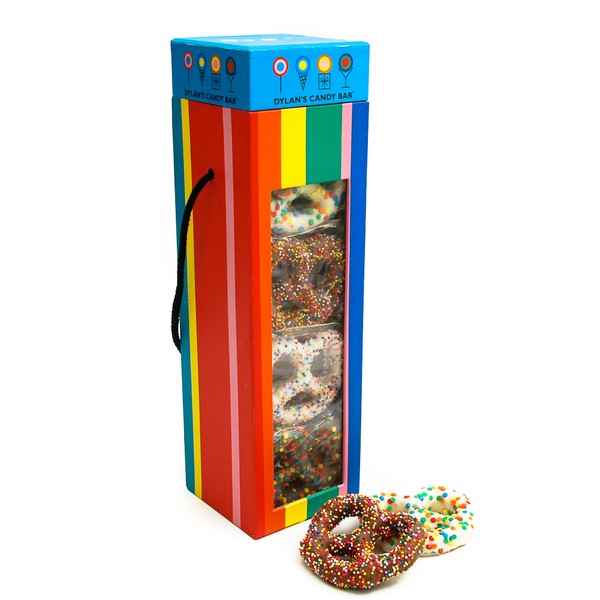
The striped pretzel tower is filled with 3.25” x 2.5” white and milk chocolate covered pretzels. Photo credit: dylanscandybar.com

How many times a day do you eat candy? Maybe twice a week – but if I get cravings, I clearly have access. In my mind, people buy our products for the packaging. You can get chocolate covered pretzels anywhere — though I can vouch for our chocolate-covered pretzels being of premium quality — but most people choose to buy them at Dylan’s Candy Bar because the packaging is so unique.

What are you working on right now? Although it’s summer, it’s very much Christmas time right now for us. We’re also collaborating with Hello Kitty to help support the earthquake and tsunami relief effort in Japan. I am proud to be designing two chocolate bar wrappers specifically for this project.

LAUNCHING YOUR CAREER>>
Mayumi Ando divulges three key steps for aspiring graphic designers.

1. Craigslist doesn’t make any sense for designers, in my experience. When I was applying to jobs and replied to postings on Craigslist, it wore on me to get only one response for every 20 portfolios I sent out. Now that I’m on the other side, I see that posting a job opening on Craigslist means receiving hundreds of portfolios a day. I recommend using your school’s network and alumni database; it increases your chances of being seen because of the fewer number of applicants, and alumni are often willing to help and trust the quality of training by fellow alumni.
Photo credit: yourmis.com

2. The only way to keep the creative juices flowing is to continually design, even if just for yourself. Design is like dance – if you don’t dance every day, your muscles atrophy. Your brain can’t remember how to pick up new choreography quickly. It’s all about upkeep.

3. I’m more impressed with solid student work than so-so real-world work. Once, an applicant showed me her work from a gig at Bed Bath & Beyond, but it was clear that her job was to just lay out existing artwork onto postcards and flyers. It didn’t show me what she was truly capable of. If your real-world work isn’t as impressive or doesn’t portray who you are, it’s not worth showing – just list it on your resume.

Click here for more Foodie Fridays! Follow Dylan’s Candy Bar on Twitter at @DylansCandyBar, and check out Mayumi’s website for some of her work.

PLUS: Trying to cut back on sweets for bikini season? Indulge in some of Dylan’s “skinny sweets,” like gluten-free cookies and sugar-free gummy bears.

The Brand Namer

Jay Jurisich at his desk at Igor International.

What’s in a name?

According to Jay Jurisich, quite a lot. An emotional connection, separation from the competition, a unique positioning platform, a positive engagement with the audience. For starters.

Jurisich is the creative director at San Francisco-based naming and branding agency Igor International, which has worked with clients ranging from TV networks to oil and chemical companies. The most important factor in choosing great name is demonstrating your brand and values, Jurisich says. Bad ones resort to advertising to explain what they actually do.

Over the past five years, Jay Jurisich has filled 4,050 pages of Moleskine notebooks with ideas for names. In the Igor Naming Guide, he explains the company’s six-step process and four categories of names, from the super-boring (think: The Naming Company) to the metaphoric (think: Apple).

Position: Creative director and co-founder (2002)
Age: 48
Salary: Project-based, with up to six projects per month.
Typical naming cost: $20,000 to $35,000 for products; $35,000 to $50,000 for companies.
Graduated from: College of Creative Studies at UC Santa Barbara, Bachelor’s degrees in literature and art studio; UCLA, Master’s degree in fine arts
Based out of: San Francisco, Calif.
Previous jobs: Founder of Wordlab.com, a free naming and branding website with community discussion forums; editorial director at A Hundred Monkeys, a brand naming company based in Mill Valley, Calif.

How he got the job: Before landing at A Hundred Monkeys, I was out of work for five months, completely broke, with a wife and two small kids. But I was working on Wordlab every day, putting out over 25,000 names and taglines for free, constantly writing and creating a community. A Hundred Monkeys noticed and hired me. Then, we created Igor. We had no clients and no portfolio to speak of, and it took us three months to get our first client. But then it really took off.

Photo credit: articles.sfgate.com

Igor’s role in the market: We name the brand positioning, not the direct product or service. That is, we’re naming the brand’s unique tone, spirit, and personality. Apple’s positioning was creating user-friendly computers in a world of giant IBMs that filled up the room. They could have named themselves “Simplicity Computing,” which is direct, but it’s over the top and obvious. It’s like saying, Trust me, I’m honest. Only dishonest people say that. The concept of an apple has thousands of years of rich shared cultural history.

Do you have a specific brainstorming process? You can’t confine it to an hour or a day; it’s ongoing. Don’t approach naming like sitting down in front of a thesaurus or glossary. The best people are always thinking about it, and it’s part of who they are. There’s no punching the clock.

Weirdest place you’ve found inspiration? I’m constantly writing stuff down as I walk around. I’ve filled up 51 80-page Moleskine journals over the last five years.

When you find something, is it just…ta-da? A brand is born? We typically present 15 to 20 pre-screened names to the client in the first of three rounds, and then discuss them one by one.

Length of each naming process: 4 to 5 weeks. If we worked all day and night, we could do an entire project in a week, but that’s really shortchanging the process. You need time to live with the names, think about them at night, in the shower, at dinner with your wife.

Photo credit: examiner.com

A great name has: A naturally creative response. You’ll start imagining everything you can do with it. It should make you sit up and pay attention, stop in your tracks and say, what is this? Like Snapple, or Oreo. If you don’t hook a person with a great name off the bat, you’ve lost them.

Name you’re proudest of: Gogo, a wi-fi broadband service on airlines. It’s short, energetic, and all about travel, in a fun, sexy, and distinct package.

The key to good branding: Demonstration. What you fail to demonstrate with a name and brand, you have to make up for by spending a lot of money explaining it with advertising. Every company that hires us says their product is new and innovative. So we say, you need to have a name that demonstrates you’re new and thinking outside the box.

What drew you to the industry? I’ve always wanted to elevate the conversation and quality of names out there. There are so many horribly mish-mashed or boring brand names, when they should be fun and joyful.

How would you qualify a “bad” name? If it’s easily forgotton. There are basically four types of names:

  • Functional/descriptive: rarely successful; usually just explain what company does. Ex: Name Generator, The Naming Company.
  • Invented: memorable and fun to say. Ex: Google, Oreo.
  • Experiential: only describes experience of using a company or product. Ex: Safari, Internet Explorer.
  • Evocative: usually most successful; hardest to get right. Ex: Virgin Atlantic, Yahoo!, Apple

What’s a great name you’ve come across recently? An Australian company, Crumpler, sells a camera strap called Industry Disgrace. Only a brand that is very good and secure in what they’re doing can call their product something like that.

How did you arrive at the name “Igor”? A naming company having to name itself is scary and self-referential. It’s kind of like the movie Being John Malkovich, when John Malkovich goes inside his own head. There’s a big irony that naming companies can’t think of good names for themselves, exemplified by agencies with names like Namestormers, Name Razor, and Brand DNA. Igor, on the other hand, refers to the hunchback idiot in Young Frankenstein, the idiot who screwed up the whole project. We purposefully wanted a name with strong negative connotations, to prove to potential clients that even very edgy names, if they support the brand positioning, can be very successful. And our positioning is more along the lines of, the ultimate assistant, or we’ll do whatever it takes to bring your brand to life.

Best part of the job: Thinking of a great name and having a client sign off on it. The first is the joy of conception, the latter is like giving birth. Neither happens without the other.

Worst part of the job: When clients don’t “get it” and require lots of extra meetings to go over the same ground. The downside of owning your own company is being on call all the time.

Your biggest flaw? Being too nit-picky. I wish I could just crank out work and not care about typos.

Best career advice? Don’t wait for others to give you permission to do something.  If you can’t get a job, go out and create the job you want, and then take down the companies that refused to hire you.

LAUNCHING YOUR CAREER>>
Jay Jurisich suggests three ways to hone your skills for the branding industry.

Photo credit: masterfile.com

1. Start creating names, even if it’s just for your friend’s band or startup company, and begin assembling a portfolio. In the meantime, learn web development, coding, and programming skills. These are all extremely useful ways to make money as a side or temporary job; many small companies can’t afford to hire expensive web developers.

2. Create a web presence for yourself. If you have something to say about naming, start a blog or build a website. We get resumes all the time, and it’s much more interesting to see a project a candidate is working on – like a website – than items on their resume. I can tell a lot from someone’s website: design sense, writing skills, work ethic. Building a site isn’t the only thing you can do, but it’s a handy, visible tool that can be shared anywhere.

3. Create social networks with people in the industry. Hunt down branding companies on Twitter and retweet their tweets, mention them, get on their radar. You can even communicate directly through Twitter with specific people at companies you’d like to work for.

You can follow Jay on Twitter at @Jurisich, check out his artwork on Jurisich.com, and find out more about the industry on Igor’s naming blog.

Update: In the time since this interview, Jay Jurisich has left Igor and opened Zinzin, a new naming and branding agency. 


6 Ways to Maximize Your Resume For a Job

Photo credit: mflmigration.com

Using effective keywords and specific numbers can capture potential employers’ attention as soon as they open your resume. In fact, simply changing a verb or two can draw viewers. Here are six simple ways to make the most out of your skill sets:

1. Plant the right keywords. Certain buzzwords identify an industry or a profession, showing you know the lingo – and potentially separating your resume from the rest of the stack. Visit the websites of companies and associations related to your target industry, and check out the terminology used on their “about us” page. Also search for LinkedIn profiles of users who have similar jobs to the one you’re seeking, and take note of the keywords they’re using. Remember: Add these keywords and specialties to the “summary” section in your LinkedIn profile. Search engines add more weight to keywords in bold, italics, and in title/header tags.

2. Instead of listing your knowledge of Microsoft Office Suite, tout social expertise in areas such as SEO, HTML, CSS, WordPress, Tumblr, YouTube, Flickr, Twitter, Facebook, Flash, and Dreamweaver. At this point, it’s pretty much universally assumed that you know how to use Word, Excel, and PowerPoint.

Photo credit: enforen.com

3. Highlight specific numbers. If you manage your company’s Twitter account, how many times do you tweet per day? Do you use applications like HootSuite and TweetDeck? Did you increase the number of followers?

4. Use descriptive, action-packed verbs. Verbs on your resume should be concise and firm — and, most importantly, action-first. Change have demonstrated to I demonstrate. Also delete static terms like completed and made. A resume is your opportunity to make a killer first impression on potential employers! To start, here are 10 resume power words: formulate, design, produce, manage, develop, present, master, execute, build, and collaborate.

5. Include impressive stats or analytics, such as total page views and absolute unique visitors to your website. Even if you simply wrote an article for another website or blog, note the number of visits or re-tweets your post received.

6. Social media links should dominate the visual hierarchy. If you’re active on Twitter (which you should be), list your Twitter handle at the top of your resume – near your address, email, and phone number – so it’s easily identifiable. Also include your personal website and/or blog, but ensure it has been recently updated. Including a blog URL on your resume can work against you if you haven’t posted in more than a month.

What other ways do you maximize the skills on your resume? Comment below!

Check out other tips & advice from No Joe Schmo, such as questions to ask at the end of interviews and ways to make your business card stand out.

10 Cool Jobs You Wanted as a Kid

For some reason, little kids are expected to answer the question, “What do you want to be when you grow up?” In response, the bright, optimistic youngsters profess their dreams of becoming rock stars, princesses, and secret agents. Good for them. Their dreams have not yet been crushed by the economy. But despite the coolness that comes with those lofty careers, each also has a lameness factorial.

Today’s post is a collaboration with List Planet, an awesome blog featuring countdowns, rankings, and lists. The first five childhood dream jobs are here on No Joe Schmo, and then head over to List Planet for the remaining five.

5 MORE COOL JOBS >> Check out the rest on List Planet!
What was your dream job as a kid? Comment below.

Vote for No Joe Schmo for BlogHer ’11 Voices of the Year!

TODAY’S NEWS>> No Joe Schmo has been nominated for the BlogHer ’11 Voices of the Year contest, and we need your help to rock the vote! You can only vote for any single post once, but you can vote for as many posts as you like. You must be logged in to vote on a post, so make sure you create a BlogHer account before voting — it takes literally 30 seconds. Just create a username and password.

VOTE HERE for the Q&A with The Hot, Young, & Single Circus Ringmaster
VOTE HERE for the Q&A with The Fortune Cookie Writer

Thanks for all your support, and we’ll keep you posted with results. Make sure you’re following BlogHer on Twitter at @BlogHer!