King of the Jungle: CEO of Lincoln Park Zoo

When Kevin Bell first became director of the zoo, he had no managerial or administrative experience.

Growing up in the Bronx, the first sounds Kevin Bell heard in the morning were not honking cars and alarms, but rather the Tarzan-like screeches of white-cheeked gibbons and barks of sea lions.

To be fair, he didn’t live in the Bronx as most of us imagine it. At age 5, his family moved into a home behind the Reptile House at the Bronx Zoo, where he was surrounded by 252 acres of animals. He helped out his dad, who worked as zoo’s bird curator, and spoke to the giraffes and hippos at night until it was time for bed. He knew immediately that it was his calling.

After completing his Master’s studying the Atlantic Puffin off the coast of Maine, Bell was hired at the Lincoln Park Zoo in Chicago, Ill., one of the nation’s oldest zoos housing 1,200 animals representing 230 species. Now, 35 years later – as the zoo’s president and CEO – he reveals the challenges of running a nonprofit, why he’s not worried about a Bronx Zoo cobra situation, and how he gauges potential new hires (hint: it’s not resumes).

Title: President and CEO, Lincoln Park Zoo
Age: 58
Graduated from: Syracuse University, degree in biology; State University of New York, Master’s degree
Has worked at the zoo for: 35 years, and 18 years as president/CEO
Previous jobs: Curator of birds at the Lincoln Park Zoo
Visitors per year: 3 to 4 million

Bell is particularly fascinated by hornbills, which are indigenous to Africa and Asia. To lay eggs, the female seals herself in tree cavity with a tiny opening for the male to feed her through.

You’ve worked at the Lincoln Park Zoo your entire post-college life. I was hired there directly after graduate school. After working as the bird curator for 18 years, I became assistant director of the zoo for six months, and then director. After we privatized the zoo in 1995, my title became president/CEO.

What do you do all day? I oversee the overall direction of the zoo and concentrate a lot on fundraising. This is a free zoo, and doing something good for the public adds a feel-good part to the job. But you need an incredible amount of resources to operate a nonprofit organization.

What background did you have with animals? My father was the bird curator at the Bronx Zoo, and we moved to the zoo grounds – behind the reptile house – when I was 5 years old. Surrounded by 252 acres of animals, I had the zoo to myself in the evenings and early mornings. I spent all my time there until I left for Syracuse.

Bell describes his management style as relaxed: "People call me by my first name."

Did you help out your dad? Yes – I had chores. In the birdhouse, I carefully turned hundreds of eggs a quarter-inch in the incubator. I took care of some of the hatchlings since I was there 24 hours a day – even after the keeper staff went home.

Living at the zoo is many a little kid’s dream. I’d feed the giraffes and hippos and talked to all the animals. I was convinced they knew me; many animals develop relationships with their keepers and recognize familiar faces.

Something people don’t know about your job: That I started out as an animal person, and that I had no administrative or fundraising experience when I took over as president and CEO. I learned on the job.

Most important lesson learned: The impact zoos have, especially in urban areas like New York City, Chicago, and Los Angeles. So many kids don’t get outside the city – not to mention to Asia or Africa – so their only bond with wildlife is coming to the zoo. Elementary school kids are amazed when they come here and realize where milk comes from, where the food on their tables comes from. It’s a great way for them to see that science can be fun.

Best part of your job: When I get frustrated with personnel issues, I go over and see a giraffe or feed a rhino; they don’t get in bad moods. I also love walking around as a visitor and experiencing the zoo from that side of the equation. I’ll walk up to other visitors and tell them a fun fact that I think they may not know.

WATCH:

Most challenging part of the job: Balancing the budget in a tough economy. Attendance is free, but right now, revenue is way down since people aren’t spending a lot of money inside the zoo.

Responsibilities as bird curator: I traveled a lot as bird curator, doing fieldwork on birds in Central America, Iceland, and Indonesia. It was the best job in the world.

Favorite animal: You might expect it to be a bird, but I love tigers – they’re absolutely magnificent creatures. Unlike lions, tigers are very secretive and elusive; to see one in the wild is an amazing event. I also love great apes and the Himalayan takin, which is kind of like a sheep-goat.

Do you worry about escapes, like the Bronx Zoo’s cobra? You worry more about the visitors that don’t respect fences. With 50,000 visitors in a day, there are bound to be a few unstable people walking through who have had a few beers. That said, if a dangerous snake got out at Lincoln Park, it would be almost impossible for it get into a public space.

How would you describe your management style? Relaxed and informal – people call me by my first name. I’m a bit of a micromanager, but that’s because I’ve gone through the system and understand most of the jobs really well.

Gibbons are born with blonde fur, but by age 2, their color turns to black. As adults, males remain black and females change back to blonde.

Coolest animal at the Lincoln Park Zoo: I try to stay away from favoritism, but the white-cheeked gibbon is pretty cool. It has long arms and fingers and swings between trees, Tarzan-style. They also communicate with a Tarzan holler that carries through the jungle.

Do you live on the grounds of the zoo now? No; I live a few blocks away.

LAUNCHING YOUR CAREER>>
1. A liberal arts education, including some business management and economics classes, is great for people interested in nonprofit management. The key to fundraising is building relationships with people, so that they get to know and trust you – and at the basis of that is being to talk to people about everything from arts to politics. You need that broad background to relate to people.

2. Volunteer for every possible job at a company. As bird curator, I volunteered to do things like budgets and inventory, and not because I had the skills. It ultimately made me a better manager.

3. Get comfortable communicating with others on a large scale. Now, I give speeches to 2,000 people, but when I first took the job as director of the zoo, I was terrified to talk in front of 25 people.

Follow the Lincoln Park Zoo on Twitter at @LincolnParkZoo and check out its YouTube channel. Unless stated otherwise, all photos courtesy of the Lincoln Park Zoo.

PLUS: Other No Joe Schmos love animals, too. Jenny Litz is saving the Ecuadorian rainforest in $8 rubber rain boots!

Foodie Friday: The Food Chemist

"It's so gratifying to go into a grocery store and see something you’ve been working on for the last year," says Supriya Varma, a senior scientist at Frito-Lay.

Traditionally, food and science and technology don’t exactly go hand-in-hand. But the combination comes naturally for Supriya Varma, the senior scientist at Frito-Lay. Varma uses science and technology on a daily basis to help develop processed food products like southwest enchilada black bean dip.

Many people think the job is “like home ec,” Varma says, which is a misconception. In addition to seeing products through from conception to execution, food scientists are responsible for ensuring that astronauts get the required amount of nutrition in the most compact way possible. (Every gram sent into space costs $10,000!)

After moving to the U.S. from India to complete her Ph.D., Varma pursued a career in food chemistry, a field offering much growth. As she points out, people love to eat – so the industry is very stable. Here, Varma discusses reducing enzyme activity to preserve a product’s shelf life, her views on genetically modified munchies, and her love of plain old Lay’s potato chips.

Age: 33
Graduated from: Rutgers University with a Ph.D.
Has held the position for: 3 years
Previous jobs: Formulated health drinks at GlaxoSmithKline Pharmaceuticals Limited in India

In a sentence or two, what do you do all day? I generate ideas for new products, build prototypes, and work with consumer insights to get a sense of what customers want. I’m involved from design to execution of new products.

Frito-Lay Southwest Enchilada Black Bean Dip. Photo: fritolay.com

What products? All different dips. We launched a Southwest Enchilada Black Bean Dip a few years ago, and recently launched a spicy nacho cheese one. We also do single-serve dips to go.

Emerging trends in the food industry: Ethnic flavors and hot, spicy products – like Mexican and Latin flavors. Lots of consumers nowadays like those flavors in the form of snacks and drinks, which is a change from what we’ve seen in the past. Consumers used to be very intimidated by new flavors.

Advances you hope to see in the field: While consumers are experimenting with new flavors, it’s still not in a big way. For example, they want to see all different kinds of ice cream, but in the end, they still lean toward the vanilla or strawberry.

So creating innovative new products is a big risk for sizeable companies like Frito-Lay. Yes. Sometimes, we’ll see products come and go, and it took a huge amount of time and effort to have it hit the market in the first place. But there’s hope; many years ago, people barely knew about sushi, and now you see tons of sushi places across all cities, and even in grocery stores.

True, but much of that sushi is not true to form. That’s another thing that concerns me about the food industry: it’s important that products stick to their true roots and are not diluted too far away. You want to give an authentic experience to consumers.

Misconception you’d like to change: People think all processed food is unhealthy, but it’s not.

How do people respond when you tell them what you do? Some say, “Oh, I was never sure how we were getting tomato ketchup on the shelves.” People in my field are the ones making sure astronauts get the required amount of nutrition in a compact way, since every gram you send to space costs $10,000.

Best part of your job: I get to eat all day, but that’s good and bad. [Laughs.] You’re ahead of trends and get to see products in their entirety, ideas coming to life. It’s very gratifying to go to a store and see something you’ve been working on for the last year.

Photo: accessexcellence.org

Something people don’t know about your job: A lot of people think being a food scientist is home ec[onomics] or learning how to cook, but it’s not. It’s looking at food in a scientific way, and making sure the eating experience is the same whether you buy a product at a 7-Eleven on the road or at a large grocery store.

How to you apply science in your job? It helps us understand how the products are impacted over time – in other words, its shelf life. If ingredients have lots of enzymes that can degrade the product, we figure out how to limit the activity of those enzymes. We work very closely with engineers and packaging folks.

Your required reading: Food Chemistry by Owen Fennema. It’s the bible for food chemistry.

Views on genetically modified food: It’s tricky. You want to make sure that the good attributes of food products are maintained and that they don’t have harmful effects. You see things like onions that don’t make you cry and huge cloves of garlic, but it’s important that the overall attributes – flavor, texture, and appearance – remain the same.

Do you have any weird eating habits? I enjoy new cuisines and lots of quick, easy cooking – like frozen veggies, meats, and instant meals. I use them as building blocks and then customize those frozen products. I don’t have time to make elaborate meals.

How have advancements in technology changed your job? We’re now able to store perishable crops without them getting damaged, which in turn makes raw material more readily available. Ingredients that were previously just seasonal are now available throughout the whole year.

Lay's classic potato chips. Photo: fritolay.com

Favorite Frito-Lay product: Traditional Lay’s chips.

Dream job in college: I love animals, so probably working as a vet or at a shelter.

Foodie idol: I don’t really have one. I do like The Food Network’s Alton Brown, though. He demystifies our industry and bridges the gap between culinary and food science.

LAUNCHING YOUR CAREER>>
Supriya Varma offers advice for aspiring food chemists: Put in the time to understand the basic science behind the job; you need to like getting your hands dirty. A science background is highly recommended, if not required, since the job ultimately boils down to chemistry and what’s happening to products as they’re getting processed.

Hungry for more? Click here for more Foodie Fridays on No Joe Schmo, including a pizza chef and kimchi taco truck worker.

The Hot Air Balloon Pilot

Mike England has been flying hot air balloons with Hot Air Expeditions for 16 years.

Imagine drifting smoothly and quietly through a clear blue sky, the cool breeze blowing wisps of hair across your face, gazing at the Earth from a wicker basket.

That fantasy is a reality – every day, in fact – for hot air balloon pilot Mike England. England loves seeing thrilled, awe-struck passengers, whether it’s those who are afraid of heights or couples renewing their vows at a 7,000-foot elevation.

What began as a hobby developed into a career when England moved to Arizona. Now, working for Phoenix-based Hot Air Expeditions, the largest hot-air balloon tour operation in the country, England has spent some 5,000 hours cruising through the air in balloons that can typically fit 250,000 basketballs.

Age: 64
Graduated from: University of Illinois, Bachelor’s degree in agriculture
Flying balloons for: 32 years; as a living for 16 years
Previous jobs: Farm business analyst at University of Illinois; real estate agent
Price per balloon ride: $195 per person; varies for different parts of the country

How does one “pick up” hot air ballooning? It started rather impulsively as a hobby. I had a friend whose brother-in-law flew hot air balloons, and he needed some land to take off from. I had the land, so I asked to go along for the ride. I bought his balloon when he sold it for a bigger one.

Where did you store it? In my garage. It was just about the size of a small pickup truck, and the wicker basket was about 40×40 inches. Back then, I thought that was big.

Size of balloons you’re flying now: Four times that size. The basket is 10 feet long and five feet wide, and holds 10 to 14 people. The balloon itself [called the envelope] is 250,000 cubic feet – meaning it can fit 250,000 basketballs.

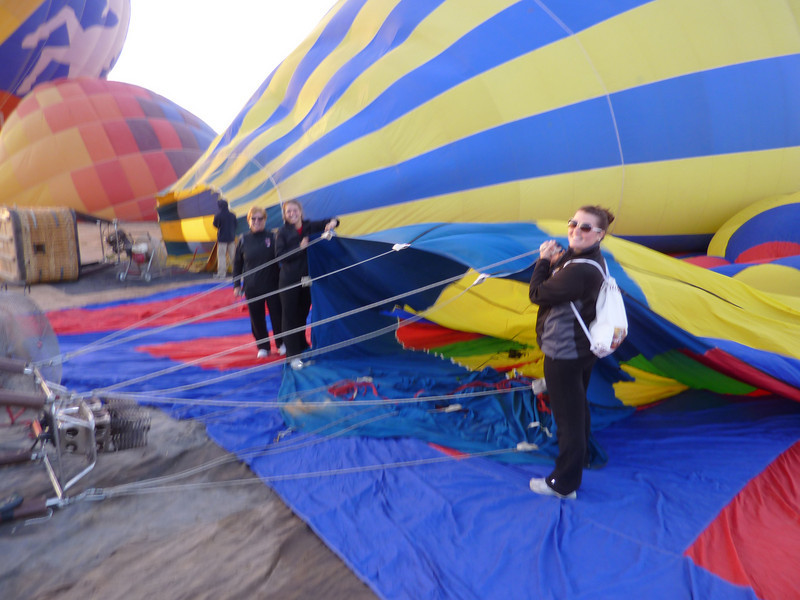
Inflating the hot air balloon.

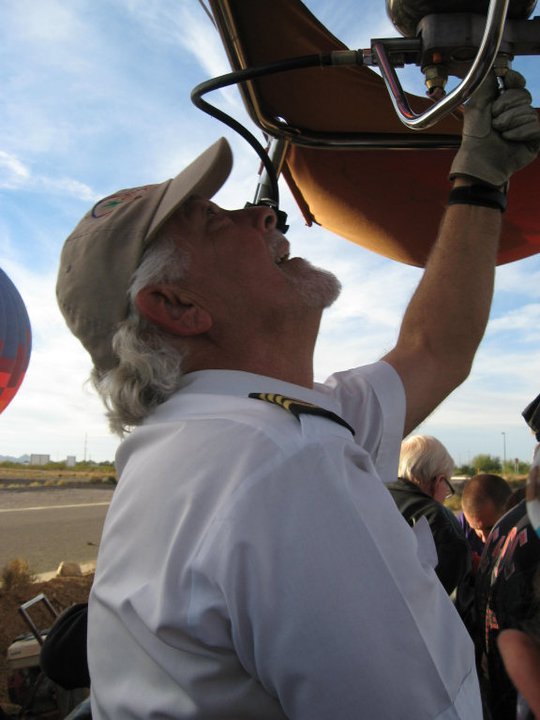
What does your job entail? I inflate the balloon with two other people using inflator bands and heat it with large propane burners. That brings the envelope up, and we fly through the air for an hour or so before landing and packing up the balloon.

You deflate and re-inflate the balloons every day? Yes. Heat and sunlight deteriorate the fabric faster than anything else, so they’re stored inside. It takes about 10 to 15 minutes to inflate them again.

On my first (and only) hot air balloon ride, we landed with the basket on its side, and crawled out. Is that normal? Usually, we land with the basket upright and climb out over the side. If it’s windy, we’ll drag on the ground a little. If it’s very windy, we’ll land so the basket is on its side and then crawl out.

What makes Hot Air Expeditions unique? At the landing site, we have a full breakfast [with the passengers on the balloon ride] with linens, china, and traditional champagne. We also have a ceremony at the landing site, where we present certificates as mementos and do the balloonist’s prayer.

The balloonist’s prayer? It was supposedly started by an Irish priest years ago, when he found out how beautiful it was.

The balloonist’s prayer, via BalloonFiesta.com: May the winds welcome you with softness. May the sun bless you with its warm hands. May you fly so high and so well that God joins you in laughter and sets you gently back into the loving arms of Mother Earth.

WATCH:

How many flights have you piloted? About 5,000.

What time of year is ideal for flights? Year-round, we do sunrise flights in the early morning. In addition, from the end of October until the end of March, we also do sunset flights.

Something people don’t know about your job: We get quite a few people who say they’re scared of heights, but when in the balloon, they have no idea how high up they are. It’s like floating on air, something you’ve never experienced before.

How high up do you go? It varies from several feet to 7,000 feet. The altitude is our steering wheel; we utilize the winds available to us to decide what’s a suitable landing site.

What do you use to gauge winds? Weather forecasts. We also physically go outside in the morning and launch a helium balloon to see what happens. Typically, though, we have good weather in Arizona, so we don’t have to cancel many flights.

Smooth sailing.

Best part of your job: Seeing the happiness on passengers’ faces. We’ve done engagements and weddings flying over the most beautiful part of the Sonoran Desert.

Most challenging part of your job: Mother Nature’s winds.

Has anyone fallen out of the balloon while you’ve been piloting? No.

Items you bring on each flight: An altimeter, a radio that communicates with a crew on the ground, a hat, and gloves for handling deflation ropes.

Most memorable flight: A couple came out for their anniversary and was hoping to have someone who could renew their vows in the air. The qualified people they had found didn’t want to go in the balloon. Then, as we were getting into the balloon, another passenger volunteered to do it – he was an ordained minister. That’s never happened before.

Thoughts on Balloon Boy: That was a ridiculous situation. There was no chance that there was ever a person in that thing. If you actually saw the size of it, you knew it was clearly a hoax.

What’s still on your bucket list? I haven’t skydived yet.

Ready for takeoff!

LAUNCHING YOUR CAREER>>
Mike England discusses the highs and lows of flying.

1. It’s a very unique job, and only a handful of people fly large balloons throughout the country. Experience is key; fly with another qualified pilot who will give you the opportunity to learn.

2. The job is not one for the meek and unadventurous. It’s a challenging experience, and you must be willing to learn and want to give a great experience to other people.

3. Flying balloons is also physically challenging. You’re launching and deflating with a rope that you’re pulling in.

Check out Hot Air Expeditions on Twitter at @BalloonsAZ, its Facebook page, and its YouTube channel. All photos courtesy of Hot Air Expeditions.

PLUS: For more in-the-air No Joe Schmos, check out the roller coaster engineer and the bull rider!

Foodie Friday: The Pizza Chef

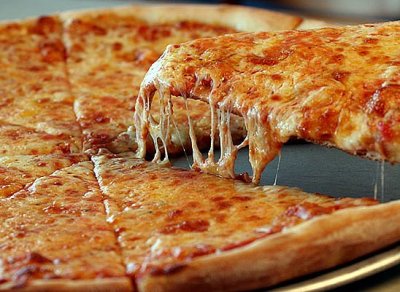
New York-style pizza has a thin, crackery crust with ingredients spread across the top. Photo: ecryptical.blogspot.com

As the general manager at Santullo’s Eatery in Chicago, Ill., Jeremy Kniola tosses pizza pies, schmoozes with customers, and figures out how to rake in more dough (we don’t mean the flour-y kind).

Santullo’s serves up slices of New York-style thin-crust pizza to set itself apart from the crowd of deep-dish eateries that line the streets of Chicago’s Wicker Park. And if customers complain about that, the staff simply recommends they go elsewhere. Below, Kniola talks about the mystery behind the pizzeria’s name, his scarring experience with Domino’s, and his unabiding love for omelettes and Arrested Development.

Age: 34
Graduated from: Didn’t attend college
In the pizza business for: 2 ½ years; many years in the restaurant business
Previous jobs: Table waiter; coffee shop manager

Growing up in the restaurant business, did you feel as though a career in the food industry was inevitable? As a kid, I wanted to be a rock star; I played bass. But my dad ran a restaurant in the early 60s, and I worked there through high school, waiting tables and cooking. Then I got into the management side of things and stepped my way up, which I really enjoyed.

What do you do all day at Santullo’s? I take care of finances, inventories, and marketing – but I don’t just sit in my office. I’m also on the floor, talking to customers to see what they want, and working shifts and making pizzas. I’m also working on a new menu to attract more customers while still keeping the musical, artsy feel of the place.

The Santullo's storefront. Photo: santullos.com

What will the new menu include? Vegan and vegetarian pizza options and a pasta menu, which our regulars have been asking for.

How would you describe a slice from Santullo’s? It’s New York-style instead of the traditional Chicago deep-dish. Our thin crust has a cracker feel, so it can’t hold a lot of weight, but we’re always trying new things that make us different from our competitors.

Like what? Our Hawaiian pizza isn’t just pineapple and ham – we also mix in barbecue sauce and bacon. A lot of our creations are generated by customer feedback.

Do you get backlash for serving New York-style slices in Chicago? On occasion, but in those cases, we suggest [other pizzerias] to those people. You can’t satisfy everyone.

Besides the crust thickness factor, how does New York-style differ from Chicago-style pizza? With New York-style, the ingredients are spread evenly across the top. With Chicago-style, the ingredients are in the middle of the pizza, and it has a lot more bread.

Something people don’t know about your job: Making pizza doesn’t take long to learn, but it does take a long time to perfect. People think we just toss out pizzas, but we need to make sure the weight is distributed equally on the dough with a nice circular edge. It can get thin and tear very easily.

Photo: recipes.howstuffworks.com

Do you spin the dough on your fingertips? That would rip it. It should land on your knuckles after tossing it in the air.

Best part of your job: Working with my friends. We’re all musicians or artists who also enjoy food – and we don’t dread coming to work. I actually come in on my days off.

Most challenging part of your job: With food prices rising, we have to figure out where to spend money that will be most effective for bringing in customers.

Do you ever get sick of pizza? No. I don’t eat it every day – I also try different things on our menu, like sandwiches and salads.

Most popular pizza: Margherita, which includes fresh mozzarella, tomato, and basil.
Your favorite pizza: Great White, which includes provolone and mozzarella cheese, red onions, sun-dried tomatoes, roasted garlic, and olive oil.
Type of oven used: Two older-model electric stoves.

Where does the name “Santullo” come from? It’s a mystery! It’s supposed to be a family thing, but there’s nobody named Santullo here. We have more fun coming up with concepts and telling people stories than knowing where it really came from.

Are you Italian? No. There are Italian people here, but not me.

Most despised corporate pizza chain: Domino’s. I had a bad childhood experience – let’s just say [the pizza] came back up.

What is it about pizza that unites all Americans? It’s traditional, like the cheeseburger or hot dog. You can have it as a quick lunch, a snack at a game, or over a movie with your family on a Friday night.

Your comfort food: Omelettes. I was raised to eat something right away in the morning.

Breakfast pizza. Photo: thekitchn.com

Have you tried making a breakfast pizza? We’ve done a few as specials, with eggs and tomato sauce.

Where do you see yourself in five years? Opening more Santullo’s locations in the Chicago area and beyond.

If you could star in any TV show, it would be: Arrested Development.

LAUNCHING YOUR CAREER>>
1. Start from the bottom: take a job waiting tables or shadowing a chef. I washed dishes and waited tables to understand as much as possible about the business.

2. Look to see what your competitors are doing to get ideas, but be as original as possible. Do things your own way to separate yourself from the crowd.

3. Keep an open mind and find people you can work with. The last thing you want to do is fight at work.

Follow Santullo’s Eatery on Twitter at @SantullosPizza.

Hungry for more? Click here for more Foodie Fridays on No Joe Schmo, including a master fudge maker and professional competitive eater.

Great Balls of Fire: The Glass Blower

Rene Steinke is fascinated by how much glass has changed the world, from telescopes and microscopes to Intel chips.

“I have ADD bad, and glass blowing is the only thing that makes me focus,” Rene Steinke says between breaths. He’s working on a masterpiece as we speak. “It really channels all my energy.”

Steinke, a self-described 30-year-old child, spends his days teaching classes at Rainbow Glass and working in his dream factory in downtown Sacramento, Calif. (it’s half glass blowing studio, half skateboarding rink).

Growing up, Steinke worked at a pizzeria, where he burned himself more on the pizza oven than he does now on balls of molten glass. But pursuing his passion comes at a cost: his financial struggles force him to build all his equipment from junkyard scraps.

Age: 30
Based in: Sacramento, Calif.
Graduated from: Nowhere; I’m a high school dropout who found something I loved
In the business for: 15 years
Previous jobs: Pizza delivery man; construction worker

How did you transition from remodeling roofs to blowing glass? At age 15, someone at the construction site I was working at offered me an opportunity to help out at a glass blowing studio after work. The studio’s owners noticed I picked up [glass blowing] quickly and wasn’t afraid, and they offered me a job on the spot. I quit my construction job and started working there instead.

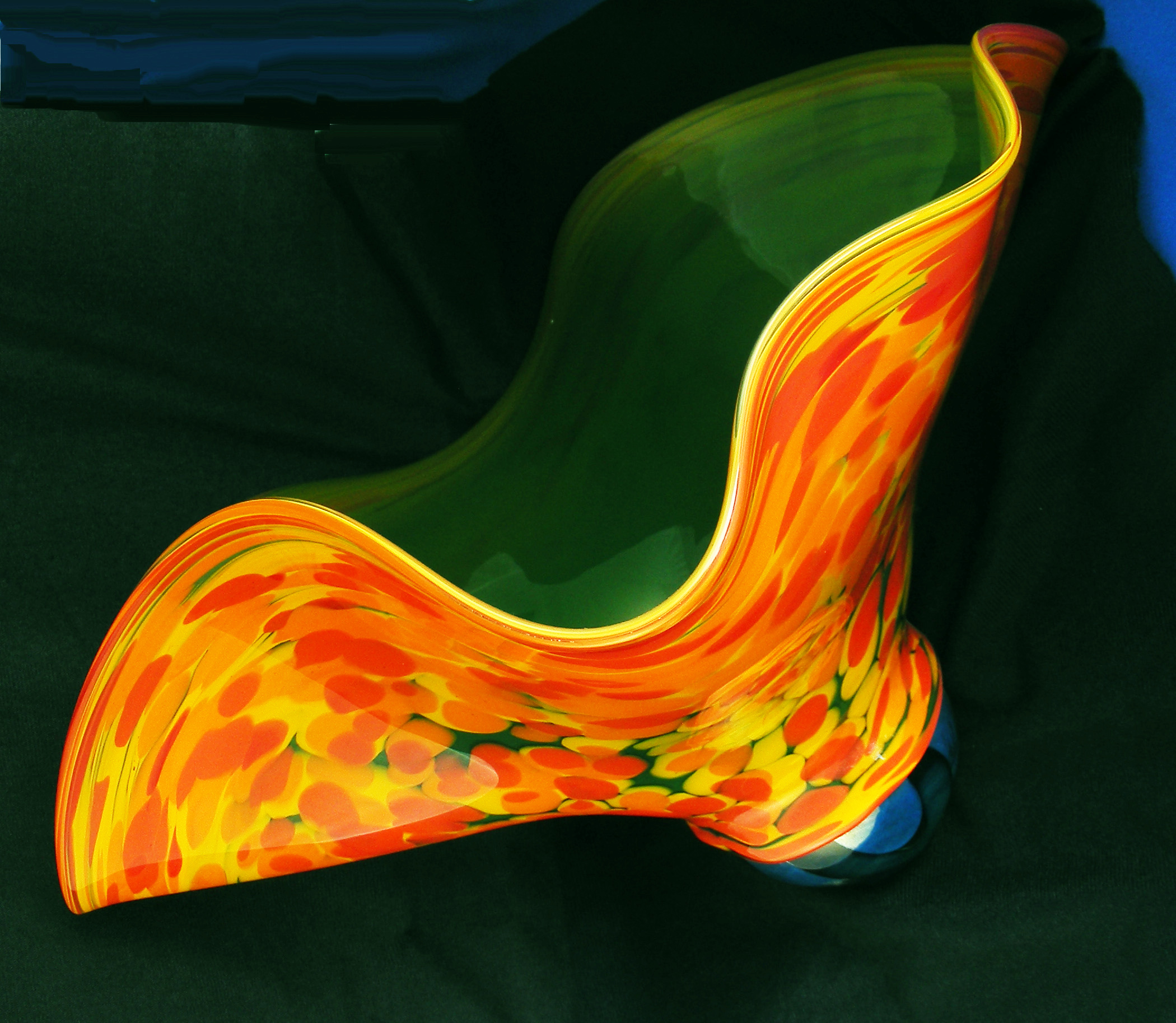
This multi-colored vessel features a large hand-blown marble in the center.

Without a formal education, what sort of training did you receive for blowing glass? I studied at the Corning Center for the Fine Arts in Corning, NY, under a famous Venetian glass blower. That opened my eyes to how glass blowing works.

Briefly explain the process of glass blowing. A ceramic crucible inside the 70-lb. kiln heats up to 2100 degrees Fahrenheit, melting the glass inside it. I take a steel pipe – a hollow blowpipe – and gather a ball of molten glass on the end. I blow into the pipe to shape the glass, let it cool, and dip it back into the furnace. Then I break the glass off the blowpipe and leave it in the oven to cool until the end of the day.

Do you coax the glass into certain shapes only using your breath? With the help of metal tools, like tweezers, and cherry wood blocks.

How close can you get to the glass without burning yourself? You never actually touch the glass, but you can use wet newspaper to shape it. Working on a large piece might require someone else to hold up a paddle or piece of wood as a heat shield.

Did you love fire as a little kid? Yes. I think fire is a wonderful thing. [Editor’s note: via email, Steinke’s mother stated that he wanted to be an arsonist or firefighter as a child.]

Steinke teaches student Gabriel Dart, 15, how to start the shape of a piece.

Most kids grow out of the pyro phase. I’ve always done extreme activities, like skateboarding and snowboarding – and I’ve always loved art. So I found this extreme art form, where I had an instant love for the process and the medium. I have bad ADD [attention deficit disorder], and this is the only thing that makes me focus.

Do you still find time to skate and snowboard? I have a warehouse in downtown Sacramento with a half-pipe and a glass blowing studio.

Best part of the job: Making something beautiful without touching it with your hands.

Most challenging part of the job: It’s very physically demanding work and difficult to learn. You keep stumbling over yourself until you figure it out, but that’s why I enjoy it so much.

It must be tough to keep the hot glass intact. If you let a piece go below 1,000 degrees, you risk breaking what you’re working on. The glass is moving all the time; you’re constantly chasing this weird, morphing piece, trying to control something that doesn’t want to be controlled.

Any serious injuries? Only cuts from the glass, not burns. When I worked at a pizzeria, I burnt myself more on the damn pizza oven than I have ever burned myself on glass. And now, I’m working with three to four times the amount of heat.

Steinke created this glass bicycle for the annual Amgen Tour of California. It features working parts, complete with rolling wheels.

How would you describe your style? I’m really into using nature, particularly sea life. I’m working on a product line of functional sea life art that’s half sculpted and half blown, like seahorse flower vases.

Your favorite project: I was the lead glass blower for a project in the Davis Public Library in Davis, Calif., which consisted of 32 pieces of glass suspended from the skylight in a reverse pyramid.

Common myths about the profession: People ask whether sucking inward will burn my lungs out. The answer: no, it won’t.

Biggest setback: Figuring out how to make money and survive. But I overcame that by scrounging – I built all my equipment from junkyard pieces. If I see metal in an alley, I’ll pull over and pick it up.

Pricing for your work: They range for $50 to $10,000, based on the time it took me, amount of glass used, and how much I love the piece.

If you could be reincarnated into someone dead or alive, who would it be? Let’s go with Tony Hawk.

Learn more about the process:

LAUNCHING YOUR CAREER>>
Interested in blowing glass? Rene Steinke offers some advice.
1. Remember that you fail your way to success.

2. Attend a reputable training program. Two schools that offer great ones are the Corning Center for the Fine Arts and the Pilchuck Glass School.

3. Travel abroad and learn from as many mentors as you can. There are a million ways to blow glass – don’t get stuck in just one.

PLUS: For more artsy No Joe Schmos, check out the tattoo artist, the filmmaker and film editor couple, and the permanent makeup artist.

All photos courtesy of Darby Patterson.