The Las Vegas Hypnotist

Photo courtesy of Kellie Karl

Kellie Karl doesn’t command people to quack like ducks or cluck like chickens. She doesn’t turn you into a zombie.

Up to 10 times per month, Karl travels around the world – or sometimes just down the Las Vegas Strip – to perform hypnosis on hundreds of people at shows in casinos, on cruises, and at special events, like after-proms or on MTV’s My Super Sweet 16. This year alone, she’s been on about 12 cruises.

As one of very few female hypnotists, Karl offers a behind-the-curtain look at her techniques, dealing with skeptics, and getting physical with volunteers.

Age: I never tell, but I’m not in my 20s.
Salary: Each job or show ranges from $500 to $5,000, so it depends on how many you book per year.
Status: Single
In the industry for: 11 years
Graduated from: University of New Orleans, degree in business
Previous jobs: Can-can dancer in New Orleans; owner of production company; professional dancer; choreographer; singer
Job description in one sentence: I encourage people to focus on their own relaxation, for therapeutic or entertainment purposes. Hypnosis is a deep state of relaxation.

How she got the job: I moved to Las Vegas to be a singer. One of the girls in a show that I was in had a part-time job as a hypnotist’s assistant at the Riviera Hotel and Casino in Vegas. She asked me to audition to take her place, so I did, and I got the job. I stayed there almost 10 years.

Where she performs now: Cruises, casinos, special events, clubs, and fairs. One of my first shows was at a party featured on MTV’s My Super Sweet 16. That was fun – I asked the crowd for volunteers, and 250 hands went up.

Typical crowd size: Around 1,000 people; the largest crowd I’ve worked with has been 5,000 people. I usually hypnotize about 30 people per show on stage, and many times people in the audience go under hypnosis as well.

Best parts of the job: The back-and-forth energy with the audience; the ability to capture people’s minds and have them trust you; the combination of work and travel.

Hardest part of the job: A lot of people think it’s fake – that I ask people to come and act in the shows. I find myself constantly having to answer questions like, “You’re not going to make me cluck like a chicken, are you?” No, I’m not.

How do you convince them it’s legitimate? If someone is determined not to believe me, they won’t. Unless you’ve experienced [hypnosis] or think it can be real, it won’t be real for you. Most people have an unrealistic sense that hypnosis is getting turned into a zombie.

Kellie Karl hypnotizing a group of participants on stage.

Can skeptics get hypnotized? You have to be willing – otherwise, it won’t work. You need to relax and set aside your conscious mind so your subconscious can receive the suggestion offered by the hypnotist or hypnotherapist.

What’s something people don’t realize about your job? There are tons of everyday forms of hypnosis: watching TV and losing track of time, driving long distances and accidentally passing your exit, reading a book and not remembering what you just read.

Funniest reaction from a participant on stage? I told one young man that it was his job to be a policeman and keep the audience from laughing. He got so upset by two women who wouldn’t stop laughing that he went off the stage, arrested them, and brought them back up on stage. He told me, “I can’t make it stop! I have to arrest some people!”

Most embarrassing moment during a show? Once, I told a volunteer that he was to have a huge crush on me, but every time I turned away, he would think I had a hideous backside. I’d done this skit hundreds of times. But this time, when I turned my back to him, the man – who was about 6’5” – came lunging at me, and I didn’t know what to do. I had to say, “your feet are now stuck to the ground!” But for those two seconds, it was like, Oh, my God.

How often do you perform? I usually do between four and 10 shows per month. I’ve been on about 12 cruise ships this year, and sometimes, I only have a few days between cruises – so I’m often gone about half the year.

Have you ever been hypnotized? Hundreds of times, for therapy, training, and experimenting with new induction techniques. Sometimes I fly across the world to do shows, and listen to self-hypnosis CDs on those 15-hour plane rides. But I’ve really been hypnotized too many times to count, since we go in and out of hypnosis all the time.

Any personal trademarks of your shows? I sing and dance, and encourage participants to dance with me. Being female is also sort of a niche thing – very few female hypnotists perform regularly today.

One thing you would change about yourself? Something that I am unable to change via hypnosis? My height. A few inches taller would be nice.

LAUNCHING YOUR CAREER>>
1. When you’re first getting started, call up practicing hypnotists in your area and introduce yourself. Most will be more than happy to talk with you and offer suggestions. Offer to treat them to coffee and get to know them.

2. Train with a national organization, such as the National Guild of Hypnotists, Inc., and find mentors that inspire you. Your teachers should not only teach you the words to say, but also give you a background in what you’re actually doing. It’s your responsibility to know what the mind of the individual is receiving.

3. Form networks with other hypnotists to whom you can consult and pose questions. Use blogs and chatrooms like The Hypnotists Convention and HypnoThoughts.com to find locals who are practicing in your area.

Have you ever tried hypnosis or hypnotherapy? Do you believe it really works? Comment below!

No Joe Schmo featured on Resume Bear!

EXCITING NEWS! >> Selected Q&As, tips, and advice from No Joe Schmo will now be available on the nationally-recognized Resume Bear blog! Resume Bear allows you to activate alerts so you will know in real time when your resume has been opened and is being read, and has been featured on About.com, Fox Business, Mashable, Reuters, Businessweek, and HR World. Its blog offers tons of career tools tailored to college graduates, including resume, cover letter, and interview tips — and now, No Joe Schmo posts. Check out the first one here!

PLUS: If you haven’t done so already, make sure to “like” the No Joe Schmo Facebook page for additional photos, updates, and news on what’s to come.

Foodie Friday: The Fortune Cookie Writer

Photo credit: LadyFortunes.com

Typical cardboard-tasting fortune cookies at the bottom of Chinese food takeout bags are hardly worthy of dessert. After getting snapped open for the message inside, they are often discarded like emptied soy sauce packets.

That’s not the case with these cookies! Lady Fortunes Inc. is known for its homemade hand-dipped giant fortune cookies spanning 19.5” in circumference. After employees hand-dip the cookies in chocolate, caramel, and peanut butter, they decorate the treats with a variety of toppings – from coconut to sprinkles to M&Ms and Oreos. But most importantly, each cookie includes a fortune inside, customized for holidays and special occasions.

Alex Emeira, one of eight confectionary consultants at Lady Fortunes, calls herself a “fortune tailor” – she works on tailoring the messages for customers’ birthdays, anniversaries, new babies, weddings, and even breakups.

Title: Confectionary Consultant, Lady Fortunes Inc.
Age: 28
In the industry for: 5 years
Based out of: Canoga Park, Calif.
Graduated from: California State University Northridge, degrees in music and business
Previous jobs: Violinist, Starbucks barista, bank teller
Job description in one sentence: I ensure that people are happy with their orders, and help customers customize messages to include in their cookies.

Something people don’t know about your job: When I first started at Lady Fortunes, I suggested printing the messages ourselves to save money. My idea was shot down because the FDA regulates printing to ensure the ink is arsenic-free. I didn’t understand why, but apparently, lots of people eat the cookies intact – with the fortune still inside.

How she got the job: After graduating, the economy sucked. My sister, Daria Artem, who owned Lady Fortunes, asked if I wanted to accompany her to a trade show in New York to talk to customers about the brand and make sales. I impressed her, and henceforth began doing marketing for the company part-time. After a few months, I took the plunge, quit my bank job, and went full-time with Lady Fortunes.

Lady Fortunes offers customized cookies for special occasions and holidays, like the Fourth of July. Photo credit: LadyFortunes.com

A cookie order she won’t forget: People call us to make breakup fortune cookies for their boyfriend or girlfriend. They’ll request messages like, “Confucius says, just like this cookie, our relationship is cracked,” or, “A new girlfriend is in your future, and it’s not me.” One time, it simply said, “I hate your guts. Enjoy this cookie, because this is it.”

Best part of her job: It never gets dull. I love working with people to find a unique, delicious product that fits their budget.

Worst part of her job: The customers that yell and scream and demand their money back. Once, someone listed the wrong address for delivery, and then argued that it was our fault. You need to have a kindergarten teacher’s level of patience.

Where did the company’s name come from? My sister always joked that “Lady Fortune” smiled on her every time she encountered good fortune in her life.

What’s the process behind creating fortunes? We interview customers to find out the story behind the occasion. If it’s for a baby gift, we’ll write something like, “Confucius say, a baby is on the way.”

Is Confucius the go-to? We might also write the customer’s name, like, “Alex says…”

Fortune word limit: Our giant foot-long fortunes typically have 10 lines of text, and our small ones have three lines, with 35 characters on each.

Lucky numbers: Those are based on the customer’s phone number, address, date of a trip, birth date, or baby’s due date [for baby shower gifts].

Cookie recipe: A modified version of Martha Stewart’s.
Price tag: $28.50 for giant fortune cookies; $0.99 for regular-sized ones in bulk.

How did your sister, Daria, get Lady Fortunes off the ground? She worked at a public relations firm in Los Angeles, where her trademark became buying giant fortune cookies for potential clients with personalized messages inside that read, “You’re one smart cookie if you work with Daria.” But they were $40 a pop, so she started making them herself on a tortilla press. The concept of giant fortune cookies with messages inside has been around since the 1960s, but Lady Fortunes is different because we hand-dip and decorate the cookies beautifully.

So she baked the cookies as a side job? That’s how it started. She’d be up baking until 3 a.m. Finally, she was faced with a choice: the marketing business or fortune cookies. So she decided to put all her savings – including those she’d saved up for her wedding – into Lady Fortunes.

Do you recycle old fortunes? There are a few stuck sayings, like “I’m so fortunate to have you in my life,” or, “You’re one smart cookie.” Many are play-offs of those.

What’s your favorite fortune? I made one up for my boyfriend that read, “You’re my sweetest cookie and my greatest fortune.” Now, we use that one for lots of romantic messages.

If you could write a fortune for recent grads, what would it say? Don’t be set on one career path – something new and exciting may present itself and take you by surprise. Go with your gut and take a risk on something that sounds fun, and it may be extremely rewarding.

Cookies for a cause: Lady Fortunes’ Pink Ribbon Fortune Cookies, which are hand-dipped in Belgian white chocolate and decorated with edible pink ribbons, help to raise awareness for a worthy cause. A portion of those proceeds is donated to cancer research.

LAUNCHING YOUR CAREER>>
Locate several bakeries in your area that you would be interested in working for, and talk to the manager or owner about offering your services.

Click here for more Foodie Fridays! You can follow Lady Fortunes on their gourmet cookie blog and on Twitter at @LadyFortunesInc.

PLUS: Check out 25 hilarious fortune cookies from CollegeHumor.com!

The Guys That Clean Eight-Story IMAX Screens

Michael Quaranto can’t count the number of times he’s heard, “Wait, you do what for a living?” He sighs. Most people just don’t understand why he’d give up his job as an airline pilot to clean nacho cheese and silly string from movie screens after-hours.

In 2004, Quaranto – along with his best friend and fellow pilot, Andrew Brown – founded 1570 Cinema Services as a way to rake in extra cash. But business boomed, so Quaranto quit his job to clean screens full-time. Now, the two work on more than 1,000 screens per year across the world – from North Carolina to Australia to South America.

Title: Partner and co-founder, 1570 Cinema Services
Age: 34
Salary: If we hired someone full-time, we’d pay them between $40,000 and $50,000/year.
In the industry for: 19 years
Screens he cleans in one night: 15 to 20. The average person could probably only clean five or six in a night.
Based out of: Chicago, with another small office in Houston, TX
Graduated from: Baylor University, degree in business marketing
Dream job in college: Airline pilot
Previous jobs: Clown’s assistant; every department in the grocery store; bicycle mechanic; waiter; busboy; Starbucks barista; airline pilot

Job description in one sentence: We service flat screens, domes, and [standard-sized] 35mm screens in theater chains, museums, and science centers worldwide.

How he got the job: When I was 15, I worked cleaning movie screens for my friend’s father, who had the world’s only screen-cleaning company. I continued to do that part-time when I was an airline pilot, and we kept getting requests to clean IMAX screens. My friend’s father said nobody knew how to do that. I realized there was a gap in the screen-cleaning market, so I started a business [cleaning large-format screens] with Andrew.

Something people don’t know about you: It’s hard for people to understand why we’d give up a job flying planes to work at removing gummy bears from movie screens. It’s like being a janitor on a vertical surface.

Well, why did you switch careers? I love owning my own business and having a niche market. It allows for a ton of flexibility and freedom.

How do you reach the high screens? The traditional theater chain screens are only about 30 feet tall, so we use aluminum extension poles from the ground. We put custom-made towels over the cleaning heads on the poles to dust the screen. Then, we spray on a sudsy cleaning solution from a pressurized bottle and rinse it. If we’re working between shows, we’ll dry the screens with a microfiber material.

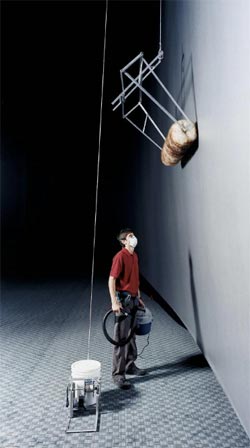
What about cleaning huge IMAX screens? We use a machine because the extension poles can’t reach that high; most are seven or eight stories. Pulleys connect cleaning heads, which are made of wax-infused lamb’s wool, to an electric motor that moves the heads up and down.

Does that hurt your upper body? Andrew and I are not very muscular – we’re two tall skinny guys. It does wreck your shoulders. Driving home the next day, it’s hard to touch the top half of the steering wheel.

How long does it take to clean one screen? An IMAX screen takes 8 hours. We’ll go in at midnight or 2 a.m., work through the night, and finish in the morning. You have to get on a different schedule.

What do you charge? Varies by size. Regular movie screen, local, $90; IMAX screen, local, $5,000; additional airline costs depending on location.

Grossest things you’ve cleaned off? Spit wads, lugies, silly string, and anything you can find at a concession stand – like gummy bears and nacho cheese.

Best career advice: Remain positive and stay away from people who say you can’t do it. A lot of people said we couldn’t clean IMAX screens, but we knew it could be done, so we pursued finding a process.

LAUNCHING YOUR CAREER>>
Looking to start a business in a niche market? Michael Quaranto offers three tips.

1. If you’re looking to start a new business, keep your full-time job. Don’t completely quit without knowing whether your product will sell. Then, once you figure out a business model, patent the process. For us, that took about two years.

2. Attend conventions and join associations related to your target market. That way, you can find out what other people with similar businesses are doing to stay fresh. For example, we occasionally attend conventions for the Giant Screen Cinema Association.

3. Seek out the decision-makers at companies. Recently, I sent direct mailers to about 100 people, including before/after images of our screens. Even if we only get four responses, that will pay for itself. I took the time to hand-write the envelopes and make the notes personal.

Would you quit your desk job to clean movie screens, even if it meant having 100% flexibility and control over your schedule? Comment below!

5 Ways to Make Your Business Card Stand Out

Photo credit: themarketingguy.wordpress.com

A few years ago, I began collecting business cards everywhere I went — restaurants, boutiques, hair salons, coffee shops — and stored them in a 3×5 index card file. Today, I dumped them all out to take an inventory. Of the 132 cards in my box, I was most attracted to about 10 of them. I noticed a few commonalities among these 10 cards, and each trait can be translated into a tip to make yours just as noticeable.

1. Include a visual element. Choose a concept that connects to what you do. An image can help jog someone’s memory of who you are, and will reinforce your brand if used on your website and resume, too. Images should use color and take up at least one-fourth of the total surface area.

2. Utilize both sides of the card. Many of the most attractive cards in my box used one side for name and visual element, and the other side for contact information. On some, one side was a solid color, and the opposite side was a white background with that same color for text.

Photo credit: evancarmichael.com

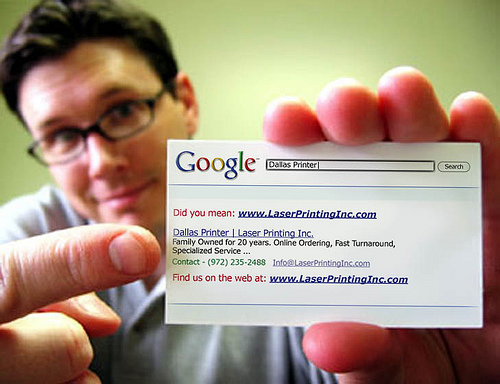
3. Show, don’t tell. Add a creative twist that suggests your passion or field of expertise. For example, the “Google Me” business card to the right implies an interest in programming and technology.

4. Try non-traditional color schemes. Most of the cards in my box had a white background, so the light-text-on-darker-background cards really stood out. Also try going vertical with your layout.

5. Don’t include extraneous information. Pick and choose from these basics: name, email address, phone number, Twitter handle, LinkedIn URL, and personal website/blog address.

Want to really push the envelope? The following suggestions will definitely set you apart from the crowd, but make sure your alterations have purpose and adhere to your product or brand.

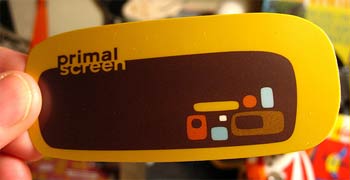
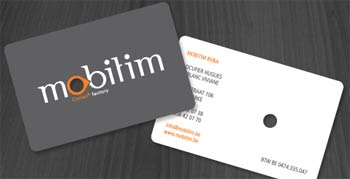
Play with shape. Some cards in my box were squares, circles, and ovals.


Add bite marks or holes.

Photo credit: allgraphicdesign.com


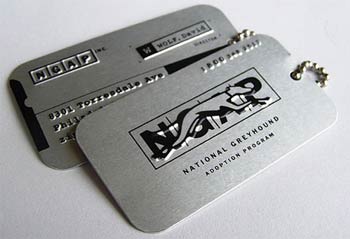
Non-cards. Several businesses have online catalogs for personalized chocolate cards. Other materials I’ve seen include leather and dog tags.

Photo credit: reencoded.com

Remember to keep a few business cards with you at all times – not just during networking events. You never know when you’ll meet someone at a bar or on a train ride!

What do you think is the most important element on business cards? What does yours look like?