Foodie Friday: The Serious Eater

Carey learning to toss coffee cherries on a trip to a coffee farm in Brazil. Photo credit: Liz Clayton

Carey Jones, the editor of the Serious Eats: New York website, has reviewed smoked trout crepes and pumpkin-goat cheese croquetas. She’s tasted rose petal doughnuts, mushroom toast, and roasted pear pizza. But at the end of the day, sometimes all she wants is a plate of scrambled eggs. “I have all this delicious food in my work life, which makes it easy to eat boring stuff the rest of the time,” she says.

From hunting down the best cookies in New York to learning how coffee grows in Brazil, Carey’s job allows her to eat, travel, and write – many a foodie’s dream. At Serious Eats: New York, the five-person editorial team is interested in the way that food, value, atmosphere, and story intertwine, she says. A meal is just as much about the people making it as about the food itself.

Age: 25
Has held the position for: 2 years
Salary: Standard editorial rate, but enough to live comfortably in New York – which isn’t true of all editorial positions
Graduated from: Princeton University, degrees in English and literature
Previous jobs: Freelance writer at New York, New Jersey Monthly, and UrbanDaddy.com

Job description in one sentence: I eat, write, and deal with what others have eaten and written.

How she got the job: I interned for Serious Eats the summer before my senior year at Princeton, in 2006, before the site officially launched. After graduating, I continued freelancing for the site, and was brought on as the editor of the New York section two years later.

(L to R): Emeril Lagasse; Ed Levine, who launched Serious Eats; Carey Jones. Photo credit: J. Kenji Lopez-Alt

Best part of the job: Our staff is somewhere between a secret club and a weird family. I’ve also been able to do a ton of traveling; last year, I went to a coffee plantation in Brazil during coffee harvest season.

Hardest part of the job: Eating when you don’t want to eat. If I’ve had six slices of pizza, I don’t want the seventh, but still have to discern whether it’s good pizza.

Does the site endorse restaurants or simply describe the food? Everything is colored through the lens of our opinion. We review restaurants twice a week, which are written by myself and a few other editors. For the most part, if we eat a mediocre sandwich, we probably won’t write about it. But if it’s amazing, we’ll certainly tell people.

Do you get preferential treatment at restaurants? We enter anonymously, buy the food, and write about it. Otherwise, it’s not fair.

What defines a Serious Eats review? At the end of the day, people aren’t typically eating four-star $40 entrees. So instead, we look at what people want to know on a daily basis; we publish a daily column called “A Sandwich a Day.” We also put an emphasis on the food over service and atmosphere.

Brussels sprouts and speck pizza from Motorino. Photo credit: Robyn Lee

If you had to live on one food for the rest of your life? Either Neapolitan-style pizza from Motorino Pizza in NYC’s East Village, or Greek yogurt.

Most-despised food: Black licorice.
Guilty pleasure: Huge, gooey cinnamon buns.

How do you not gain 500 pounds at work? You learn really quickly that you can never take more than two bites of anything, no matter how delicious. It’s all about moderation. On my off days, I have the most boring diet – eggs, lentils, and spinach. And I work out a lot.

Where do you see yourself in five years? Journalism is changing so quickly, it’s hard to imagine what media will look like in five years. Right now, I feel like I’m holding onto the edge of a rocket ship. My job never gets boring because Serious Eats changes every day, and the industry changes every day. I’m always working on new projects.

The aftermath of a 14-pie breakfast at Hoosier Mama in Chicago. Photo credit: Robyn Lee

Like what? Finding the best chocolate chip cookies in New York. I’ll draw up a list of places, coordinate research efforts for taste tests, and write up the article.

Your biggest project? This November, we’re releasing a book called Serious Eats: A Comprehensive Guide to Making and Eating Delicious Food Wherever You Are (available now for pre-order on Amazon). Spearheading the book has been a huge part of this past year.

Yummiest but most under-appreciated food: Soft, mild Italian cheeses, like a perfect ricotta or mozzarella.

What are you working on right now? Our site could do a much better job of giving discerning entry-level information for tourists who are just visiting New York for a few days. I’m working on roundups of where to eat in places like Grand Central Station and Times Square, and hope to create more of a home base for people who want to get their feet wet.

Adam Richman on Travel Channel's Man v. Food. Photo credit: latimesblogs.latimes.com

What do you think about America’s obsession with competitive eating shows, like Man v. Food? There will always be low-brow entertainment. People watch it for the gross-out factor and the novelty.

LAUNCHING YOUR CAREER>>
Love eating, writing, and traveling? Carey Jones sets you down the right path.

1. Write as wisely as possible. Freelancing was very unrewarding at first; I would write 50 pitch letters in a week and only receive one response, which would usually be “no.” Pitch to a broad range of publications, and turn responses into dialogues. Instead of stopping at a “no,” follow up with another pitch.

2. Express a genuine curiosity and nuanced interest about food, not just, I love food! I eat all the time! I’m such a foodie! Instead, talk about a specific food or culture you want to learn about. Also, since online food photographs are huge, know how to take a decent, clear picture.

3. Balance the elements of people, their story, context, and food. You’re not just writing about a restaurant – you’re also writing about a chef. Lots of people submit pitches about new openings or hidden gems, which make my eyes glaze over.

Click here for more Foodie Fridays! You can follow Carey Jones on Twitter at @CareyJones and @SeriousEatsNY.

The Urban Honey Beekeeper

Photo credit: Matthew Sandager Photography

Think of them as your new pets. Your best friends. Your companions. You know, the kind of companions that might sting you – and then fly away, leaving their guts and stingers behind.

Go ahead, scoff. But Noah Wilson-Rich, the founder of Best Bees Company, transports tens of thousands of honey bees to hives across the greater Boston and Cape Cod areas. He considers them his pets. In fact, he’s received so many bee stings over the past five years that he barely notices them anymore.

Noah’s organic beekeeping service is the only of its kind. He develops and installs honey bee hives in gardens and on rooftops in urban habitats and revisits them every two weeks. The proceeds from thankful hive-owners contribute to Noah’s development of vaccines to help bees better survive the winters and avoid diseases.

Bees weren’t always Noah’s best friends. As a kid, he was terrified of bugs. Below, he explains his connection with them – as well as the science behind the “disappearing bees” phenomenon. Plus: you’ll never guess what wallet item he uses to remove stingers!

No, this isn't Noah. Just a fellow bee-lover. Photo credit: Reuters/Eliana Aponte

Age: 29
Working with bees since: 2006
Graduated from: Northeastern University, Bachelor’s degree in biology; Tufts University, Ph.D. in biology
Previous jobs: Clinical researcher, phlebotomist [someone who draws blood], and nurse’s assistant at Children’s Hospital Boston

Job description in one sentence: I deliver, install, and maintain honey bee hives for gardeners and property owners and the greater Boston and Cape Cod areas to raise money for my research to improve honey bee health.

Where did you learn about bees? I helped manage honey bee hives at the veterinary school at Tufts. I’m also a 2007 graduate of the Bee School at the Essex County Beekeepers Association in Topsifield, Mass.

I have a mental image of students dressed in black and yellow, buzzing around the classroom. I actually thought it was only gonna be me and a couple of weirdos in the class. But there were 80 people enrolled – all regular, everyday people who just wanted a little piece of nature in their lives.

What sparked your interest in honey bees? Initially, because of my background in medicine, I was interested in learning how bees could resist diseases. There’s an innate connection between humans and honey bees that’s existed for thousands of years.

Coolest thing people don’t know about your job? Watching honey bees is extremely relaxing. Hive owners just sit with a cup of coffee, watching the bees bring in pollen and nectar. It defies the common Omigod, bees! I’m so nervous! mentality.

You’ve never been scared of them? The beekeeper suit is like an invincibility cloak – it gives me confidence. But I still get stung regularly, which is never fun.

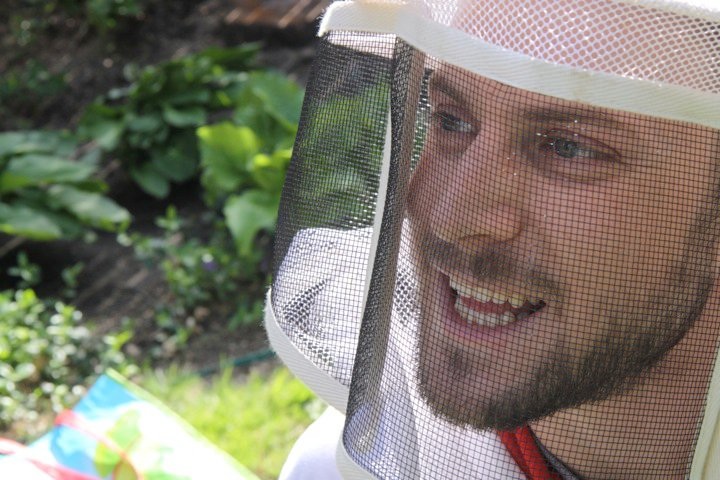
Noah wearing his beekeeper suit. Photo credit: Izzy Berdan

What does the suit look like? It’s a white onesie jumpsuit with full arms and legs, and at the neck there’s a zipper attached to a veil. The veil is mesh that surrounds my head and has a hole at the top made of harder mesh. It sits like a safari hat.

Why you should care about honey bees: Ecologically, they help plants reproduce by transferring pollen, which contributes to the fruits and veggies that humans consume. Economically, the estimated value of all the crops they pollinate around the world is about $15 billion annually. If honey bees are less available, costs of produce pollinated by honey bees will rise. We’ve already seen that with almond products.

Number of honey bees in each hive: Tens of thousands.
Number of bumblebees in each hive: About 100.

Tell me about the “disappearing bees” phenomenon. Just around 2006, when I started working with bees, news started popping up that they were dying from colony collapse disorder. Basically, that means thousands of older foraging bees were just vanishing from their hives – there were no dead bodies to examine what killed them. The younger and baby bees were still there, the queen bee was still laying eggs, and the hive looked healthy, with plenty of pollen and nectar.

Note: Beekeper suits do not actually resemble Lady Gaga's beekeeper hat. Photo credit: idolator.com

Why is that so bad? Without [the older foraging bees], younger bees are forced to collect pollen before their immune systems are fully developed. So those younger bees would bring back disease agents and bacteria to their hives – or so we think.

How do you explain the disappearing? Researchers are still furiously figuring it out. Three leading hypotheses are pesticides, poor nutrition, and disease. The strongest argument is for disease: when fungi and viruses infect the hive, it collapses.

Is there a way to help? Oral supplements and bee yogurt filled with probiotics can help strengthen their immune systems. Immune boosters are added to a mixture of water and pollen, forming a peanut butter-like consistency. The goop is shaped into paddies and placed into hives for consumption.

Hardest part of the job: Although I patented a vaccination for these diseases, it’s been impossible to get funding from grants. Best Bees Company is a way to raise money for my research.

Are your hive installation services in high demand? Right now, I’m managing 32 hives. I check on the hives once every two to three weeks, so I’m constantly traveling from Gloucester through urban Boston down to Cape Cod.

Charge for a honey bee hive: $975 for the first year, which is all-inclusive; $750 to $850 for each subsequent year, depending on location. We’ll replace the bees at no additional cost if they don’t make it through the winter.

I’m assuming these aren’t killer bees, then. They’re totally non-aggressive Italian bees. If you’re not a flower, they won’t care about you. Killer bees are from tropical habitats like Africa. Aggressive traits in honey bees were favored over time in tropical habitats because of selection pressure from predators.

Honey bees improve the quality and quantity of garden crops. Photo credit: gmo-journal.com

Benefits of a honey bee hive: The honey is delicious – just take out the frame from inside the hive, which will be covered in honey and capped with wax. Remove the wax, let the honey drip into a pan, and dip a spoon in. No processing is required since we don’t use any chemicals.

Little-known way to help a bee sting: Dribble vinegar onto a paper towel, and press it to onto the sting.

Little-known way to remove a stinger: The stinger still pumps venom after a bee sting, so the faster you can remove it, the better. Slide out the stinger with a credit card; your fingers can push the venom in with an accidental pinch.

Biggest pet peeve: Slow drivers. I have tens of thousands of bees in my car, people.

LAUNCHING YOUR CAREER>>
Noah Wilson-Rich gives the buzz on sustainable beekeeping practices.

1. Take a beekeeping course. You’ll not only learn how to become a beekeeper, but also become part of a community and a greater network. For example, the Barnstable Academy in Cape Cod offers classes on how to breed local queen bees instead of importing them.

2. Join your local beekeepers association. Unless you want to do research, you don’t necessarily need a background in science or biology. In fact, most of the people in the New York City Beekeepers Association are lawyers.

3. Remember, this isn’t a cheap hobby.

Visit BestBees.com to learn more about the Boston screening of “Vanishing of the Bees,” a documentary film about honey bees, their importance, and their baffling disappearance, on June 23.

The Rain, Wind, and Snow Man

Photo credit: 123rf.com

The Day After Tomorrow, 2012 – yeah, we’ve heard it all before. The world is ending and global warming may kill us. But how much of the noise can we really believe?

Jon Gottschalck, 39, provides local and regional forecasts at the National Oceanic and Atmospheric Administration, more commonly known as NOAA. Their National Weather Service weather service is the official voice of the U.S. government for issuing warnings during life threatening weather situations (think Snowpocalypse ’10).

The former NASA researcher has been pafmatssionate about weather since the age of 6, when he loved frolicking in the snow. Indeed, weather now consumes Gottschalck’s life – he often gets blamed (jokingly, he insists) at dinner parties for incorrect predictions. But the public doesn’t realize how far weather predictions have come in the past 30 years, he says. Read on for his explanation – and if the world is really ending.

Title: Head of Forecast Operations, Climate Prediction Center, NOAA [National Oceanic and Atmospheric Administration]
Age: 39
Salary: $115,000/year
Based out of: Camp Spring, MD
Graduated from: Penn State, Bachelor’s and Master’s degrees in science
Previous jobs: Senior research association at University of Miami; research staff member at NASA’s Goddard Space Flight Center

Job description in a sentence (or two): I manage 10 to 15 forecasters, and ensure that all operational forecasts are accurate and timely. I’m also responsible for interjecting any new ideas into operational forecasts.

Snow days: a kid's best friend. Photo credit: kidsblogs.nationalgeographic.com

Have you always been fascinated by the weather? I always knew I wanted to be a meteorologist. Since I was 6 years old, I always loved snow. That expanded from wanting to get a day off from school to my interest in extreme weather, like tornadoes, hurricanes, and heat waves. I wanted to learn more about it, so I made a decision to choose science as my major. Even now, after all these years, I still like it quite a bit.

During parties, do your conversations always fall back to weather? I can never get away from it – people are always asking me about the weather. Especially when things don’t work out, they blame us. [Laughs.]

What has worried you lately about trends in extreme weather? The past year or two of increased extreme weather has definitely raised eyebrows. Is it a bubble that will go back to a normal level soon, or a general increase to be expected over the next 30 years? That hasn’t been answered yet. We’re worried about it, but that work takes time.

Would you say you’re more worried than the general public? Frenzy develops among meteorologists with extreme weather. We congregate around computers and maps, generating our own vortex, getting very excited over it.

So walk me through your day. My days are never the same. But first thing in the morning, I make sure all the resources to make forecasts are available – like data sets and graphics. Then, I draft up forecast maps to make sure they’re accurate. You know, that they’re the right date, in the right locations, no obvious glitches. I know exactly what they should look like.

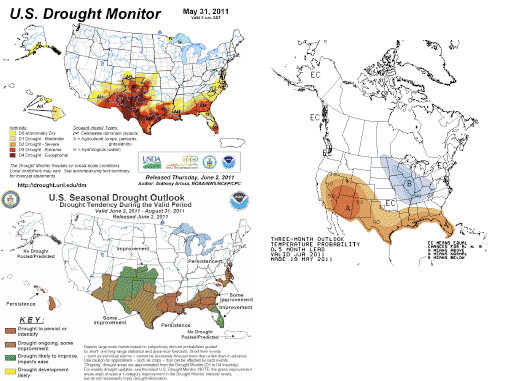
Map monitoring droughts throughout the U.S., drafted by Gottschalck.

Then what’s usually on your afternoon agenda? Often, I’m involved in meetings and coordinating new research projects. I also work on my own set of research projects to help move forecast skills forward.

What types of research projects are you working on right now? I’m looking at how changes in the deep tropics – such as El Niño and La Niña – can have an impact on where we live [in the Northeast]. El Niño is characterized by unusually warm temperatures, and La Niña by unusually cool temperatures in the equatorial Pacific. We’re trying to learn as much as we can from tropical rainfall patterns to improve weather forecasts in the two, three, and four-week future.

Who have you always wanted to meet? Max Mayfield, the director of the National Hurricane Center during Hurricane Katrina.

How do you explain all the crazy weather lately, from tsunamis to hurricanes? There have been lots of media requests for us to explain what’s going on in relation to the climate. It’s difficult to say, because very often, these things [extreme weather events] just happen. It’s the normal variability in the atmosphere. There’s no clear metric bullet why this is happening, but it’s not necessarily related to climate change.

What did you think of the movie The Day After Tomorrow? It’s not realistic, and way over the top, even in our changing climate world.

Does your job deal with long-term climate change, like global warming? There are two types of climate change: long-term projections, like 100 years, and short-term climate projections, which is what we focus on. So we don’t really deal with global warming – we’ll send people to the Geophysical Fluid Dynamics Laboratory to deal with those questions.

What did you do at NASA? I studied interactions between land and the atmosphere, and how that impacts climate.

Do you wear your pajamas inside out in hopes of snow days? We joke that when weather forecast models predict a big snowstorm a week or more ahead of time, [the snowstorm is] never going to happen. When the models don’t predict snow – that’s when there’s hope.

Something people don’t know about your job: The public doesn’t have a handle on how far weather forecasting has come over the past 30 to 40 years. Although predictions certainly fail at times, they’re relatively accurate, but the public is quick to criticize. When I was a child, forecasts wouldn’t go out more than four days in advance. Now, we issue detailed ones for a week and beyond. But no forecasts are foolproof, even 24-hour ones.

Something people don’t know about you: I’m a lot calmer at work than I am at home. I have three kids.

Ron Burgundy and Jon Gottschalck have very, um, different approaches to covering the weather. Photo credit: dreamworks.com

LAUNCHING YOUR CAREER>>
Want a career in weather? Jon Gottschalck tells you what you need to know.

1. Measure your interest in math and physics; those two subjects are the basis of meteorology. I’m talking about hardcore science, not just pretty radar pictures or maps. You also need a very good background in weather and climate, which can range from understanding synoptic meteorology (day-to-day weather) to understanding El Niño. One way to acquire this background is by interning or volunteering at a local weather center.

2. Hone your computer skills on a Windows-type PC. It’s essential to know computer programming techniques and languages to process, filter, and display weather data.

3. Subscribe to and read various weather and meteorology journals. Subscription costs can rack up, but you learn a lot about science, where the jobs are, and different mini-disciplines within meteorology – from climate to oceans to space weather. Weatherwise Magazine is a good introductory publication that includes a wide range of topics, and isn’t written it total scientific jargon.

What have you always wanted to know about climate? Comment below, and your questions will be relayed to Jon!

You can follow NOAA on Twitter at @usnoaagov.

The Wilderness Adventurer

Matt Sacco on the ropes course at Cayuga Nature Center.

In honor of National Get Outdoors Day on June 11, this week’s No Joe Schmos will be totally outdoor-themed.

At the Cayuga Nature Center in Ithaca, N.Y., Matt Sacco comes to work prepared with a change of clothes, socks, and extra shoes. In any given day, he may be responsible for using a chainsaw, driving a tractor, and teaching kids about poisonous berries.

The nature center, a non-profit organization located on 120 acres of land overlooking Cayuga Lake, was originally the Cayuga Preventorium. When tuberculosis ran rampant in the country, it was believed that the disease could be prevented by exposure to good, fresh air. Now, almost a century later, the center welcomes 25,000 visitors each year. It instills team building and leadership skills with 45-foot climbs and nature hikes along streams and gorges. After recently merging with the Museum of the Earth, the center plans to function as an educational resource for schools across the nation.

But it can be challenging to make people realize Cayuga isn’t an amusement park, Sacco says. He’s come a long way in two years – from setting himself on fire during his first week at work to inspiring troubled teens to attend colleges with outdoor recreation programs.

Position: Director of TEAM Challenge, Cayuga Nature Center
Age: 26
Salary: Between $30,000 and $50,000/year
Hours: When it’s busy, I work 7 days a week, year-round. There’s no overtime; you’re just here when you need to be.
Has held the position for: Just over one year
Previous jobs: Working with at-risk youth; landscaper; camp counselor and ropes course facilitator at Cayuga Nature Center

Job description in one sentence: I manage the ropes course, equipment, booking programs, and help with environment education – like teaching kids about local wildlife and wilderness survival.

Dream job as a kid: Wildlife biologist. Since elementary school, I loved learning about animals – I chased rabbits around my backyard. At a young age, my dad taught me to fish and track deer, so I followed deer tracks around the woods.

One of the elements, Whale Watch, is a large teeter totter. Photo credit: cayuganaturecenter.org

Most people don’t realize that: Working a ropes course isn’t just hanging out in the woods. We have to work on keeping things up to standards, ensuring that cables and staples in trees aren’t damaged from severe storms.

What surprised you most about the job? How easy it is to blow someone’s mind. We’ll get 50-year-olds from New York City who have never been exposed to this environment, who have never seen wild deer. They’ll call their friends and yell, “Hey man, you’ll never guess what I’m looking at right now!”

Coolest team activity: The Flying Squirrel. An entire group is wearing harnesses, and 10 people are clipped into ropes, like a dogsled team. Those 10 people run forward, and the rest of the participants on the other end get swung forward at 40 feet in the air. It’s like the Superman roller coaster ride.

What age groups do you work with the most? This time of year, we get every fifth grade class in the local school district. In the summertime, we’ll work with corporate groups, doing staff development with engineers and various adults. Our college groups begin in the fall.

How do adults versus fifth graders handle fears of heights? You’d be amazed how many scared participants, with the right moral support, go up the full 45 feet. Oftentimes, the kids at the bottom of the totem pole – the ones that get picked last for kickball – climb the highest, proving to the class they can do it. It’s the same thing with adult groups. Sometimes, the big strong guy is the one who falls or says he doesn’t want to climb.

Most challenging part of the job: One group of middle school kids is the same as the last, so it’s tough to keep it fresh and exciting. You just have to remember it’s their first time, even though it’s your hundredth.

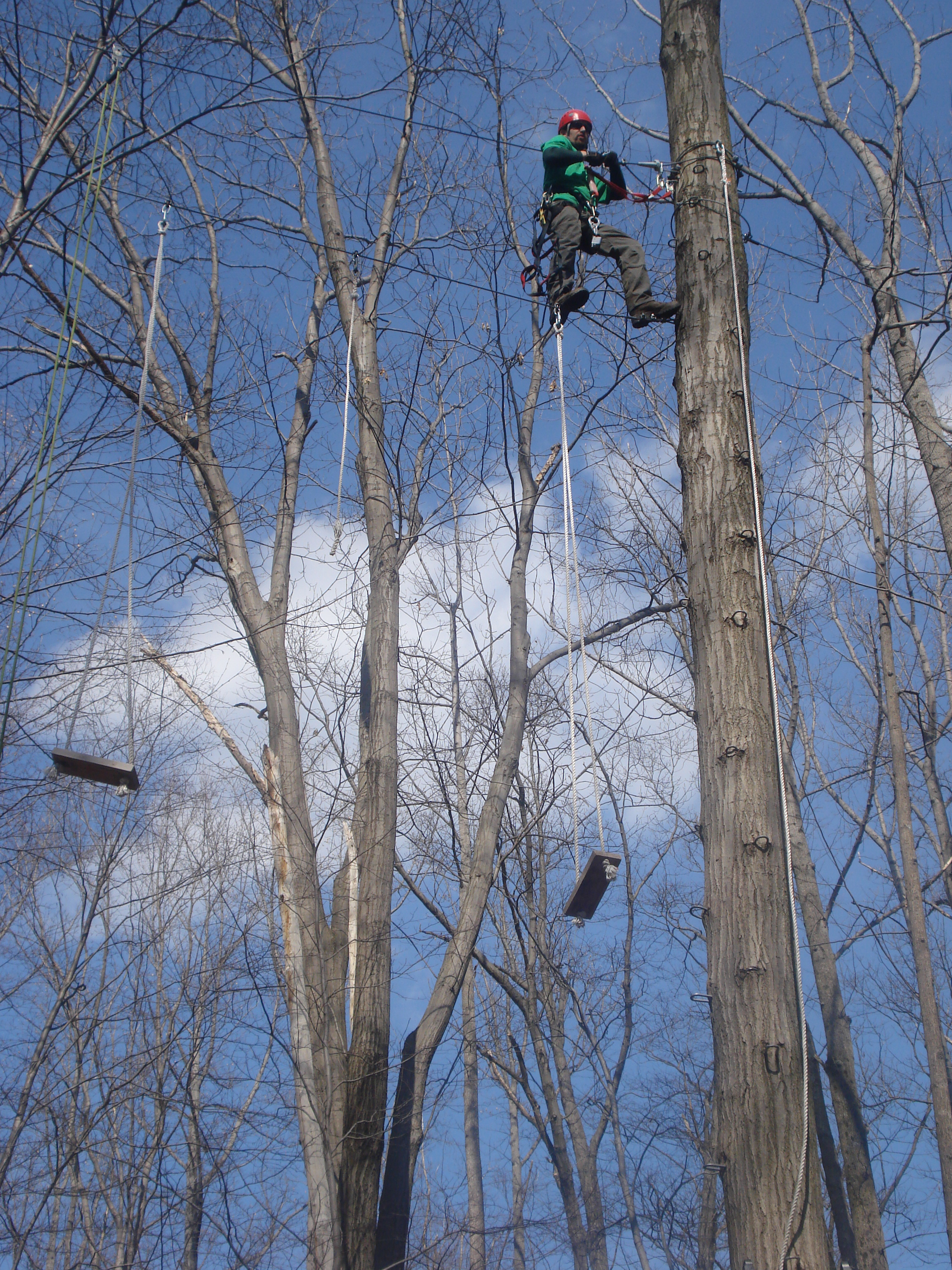
Climbing a 45-foot element on the course.

Best part of the job: I like coming work and wearing muddy boots all day. It’s also amazing to have such a lifelong positive impact on people in the two hours you’re working with them.

What type of impact? Once, these two high school kids on a school trip were having a hard time. Their teachers hadn’t wanted them to come; their grades and behavior were terrible, and they were talking about dropping out of school. Halfway through the TEAM challenge, though, the boys went up to a teacher and asked if she would help them find a college that had an outdoor recreation program.

What makes you great at what you do? I have lots of outdoor knowledge, and I want to share it to get kids involved with activities outside of video games.

Your biggest flaw? I take things personally if someone criticizes a trip.

Most embarrassing moment at work? I lit myself on fire during my first week at work. I was in a rush to get a fire started for a field trip of campers, and it wasn’t working because of the rain. I cheated and threw gas on, and it ignited and my leg caught on fire. I had to put it out with a fire extinguisher. All the hair on my leg burned off.

Do you coworkers let you live that down? As I was running for the fire extinguisher, I remember thinking, Where else can I apply to work? I never heard the end of it.

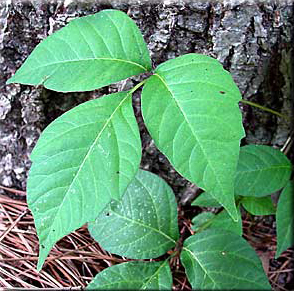
Poison ivy has three jagged leaves, like these. Photo credit: mri.usd.edu

What should everyone know about wilderness survival? How to identify poison ivy – it has three leaves with jagged edges. You should also know how to build a friction fire using a bow drill or with flint and steel.

Other hobbies? When I’m not working, I’m hunting, fishing, or in my boat.

Favorite meat? Venison.

Tell me about the working environment at the nature center. We’re a tight-knit bunch of five full-time staffers. It’s pretty casual, and everyone wears many hats; most of us run tractors and chainsaws, help mow the lawn, teach groups about aquatic insects, and then do climbing work with kids for the rest of the afternoon. Everyone brings a change of clothes and extra shoes and socks.

Guilty pleasures: Chocolate and dark beer. A few of my friends are brewmasters, so I like anything they make.

If you had all the money and resources in the world, what business would you start? An outfitter service offering fishing trips in Alaska. Some years ago, I lived in Alaska and worked at a remote salmon hatchery.

Could you see Russia from there? No.

LAUNCHING YOUR CAREER>>
Don’t miss out on a great experience because you’re worried it won’t look relevant on your resume. If you’ll get something out of it personally, then go for it! Also get to know people in different parts of the country – there’s lots of crossover in wildlife education. For example, Caguya hooked up with a spot in Georgia that runs a camp, and we bounce ideas off each other.

You can follow the Cayuga Nature Center at @CayugaNatureCen. For more information about the TEAM Challenge, visit CayugaNatureCenter.org.

Exclusive Behind-the-Scenes Video Scoop!

Did you love this week’s Foodie Friday post about Mayumi Ando, the creative director of Dylan’s Candy Bar? >> Check out the No Joe Schmo Facebook page for an exclusive behind-the-scenes video of Mayumi during her time as a cast member in the hit Broadway musical RENT. Be sure to “like” the Facebook page while you’re at it!

Remember: feel free to submit any ideas for a future No Joe Schmo on our suggestions page.