
Foodie Friday: The Food Spotter

Amy Cao in her kitchen in Brooklyn, NY.

Amy Cao, the head of community at Foodspotting, admits it straight up: she can’t cook. In fact, she’s afraid to cook; she’s worried it will make people sick. So instead, she dines out half the week and orders in the other half.

And that’s perfectly acceptable – lots of people can’t cook. But those people typically don’t blog about food, host cooking shows, and hold positions at websites centered on finding good food. Amy does all three.

Below, Amy dishes about the one food that freaks her out, how she avoided the Freshman 15, and a new Foodspotting project launching in July.

Position: Head of community, Foodspotting
Age: 27
Graduated from: Boston University, degree in mass communications
Has held the position for: 9 months
Previous jobs: Editor at Zagat Survey; freelance food writer for Zagat, Tasting Table, and others

Job description in one sentence: I handle Foodspotting’s conversations on and offline, meaning I work on everything from customer service to content creation to video production to social media.

What’s the purpose of Foodspotting? It’s a website and mobile app for finding good food around you, based on photos of dishes that our users recommend. [Editor’s note: a previous Foodie Friday, Mayumi Ando – she’s the creative director at Dylan’s Candy Bar – uses Foodspotting regularly!]

How you got the job: I built a strong following on my blog, Amy Blogs Chow. The job opening at Foodspotting was ideal because they were looking to define their voice online, and I love building relationships with people. It’s a combination of personal and professional.

Latest crazy food you tried: Live lobster at 15 East [a Japanese restaurant] in Union Square. It was presented live, then whisked away to the kitchen.

Why is it important to connect with foodies online? You can dine out and enjoy the experience, but sharing it makes the experience last longer. Everyone is a food critic now, or passes as one – and people aren’t looking to experts as much as they’re looking to their peers. Word of mouth from a trusted source is extremely valuable to our decision-making.

How did you come to terms with your love for food? I love food because it’s welcoming to everyone. When someone cooks for you, it means they care about you. My parents weren’t amazing cooks, but if I wanted to eat something, they would get it for me. There was never a no – food was always a big yes. We had a wonderful dining hall at [Boston University] where I spent a lot of time; I loved being surrounded by food all day.

Does that mean you gained the Freshman 15? I didn’t. Though I eat constantly, I only eat until I’m full. And my roommate, Jenna, whom I dined with most often, would eat half my food. I have a pretty fast metabolism, and if I craved a late night snack, it would be a chicken Caesar salad, which isn’t the worst thing to have at midnight.

Favorite dining hall delicacy? Fresh peanut butter cookies.
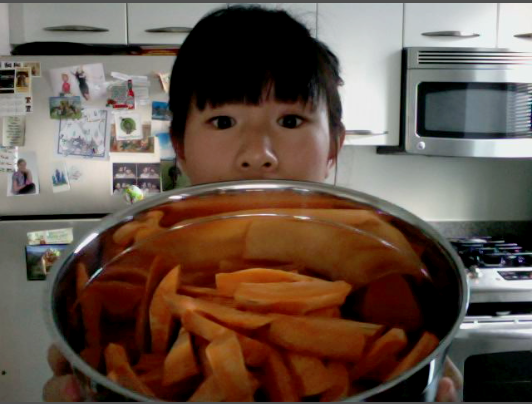
Amy with a batch of homemade baked sweet potato fries.

Cooking videos can be long and boring to watch. How do you keep your video series, “Stupidly Simple Snacks,” short and sweet? Each video needs to be under three-and-a-half minutes, and I edit the footage to fit the background music. Cooking isn’t the most approachable thing for me, so I make my videos silly and goofy. The goal is entertainment, and to make food less scary.

How long does editing take? Filming takes less than an hour, but editing a three-minute video can take two days. And that’s in between working full-time [at Foodspotting].

What do you use to record videos? The built-in iSight camera on my MacBook.

Your favorite episode? I had a great time working with [NYC restaurant owner and beverage director] Joe Campanale on the wine cocktails video. We made three refreshing, stupidly simple wine cocktails: a spritz from Austria, Tinto de Verano from Spain, and Bicicletta from Italy.

Something you always cook wrong: Well, lots of things. But mainly, I’d say rice – I never know how long to keep it boiling for. I either don’t use enough water or use too much.

Never-fail snack: Strawberry yogurt parfait from Pret A Manger.
Food that freaks you out: Dried fruit. I don’t like the texture.
Best comfort eats: Anything with spicy mayo; fried chicken; cupcakes; banana pudding; and lattes, if I need energy.

What are you working on right now? We just launched a beautiful app for Windows Phone 7, and we’re launching a new video series in mid-July called Foodspotting with Amy. I’ll be updating users about company news and talking to food experts in New York and beyond.

Which food blogs do you follow? A Cup of Jo, Sunday Suppers, and Tasting Table. I also love fashion blogs like Oh Joy! for the gorgeous photographs. I rarely read recipe blogs, since I don’t cook.
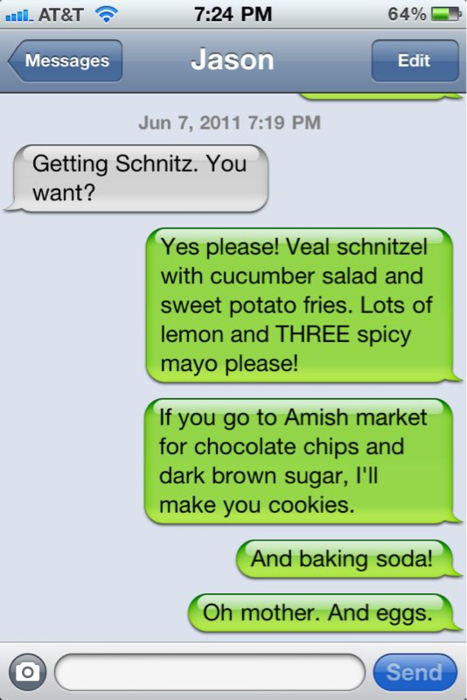
A typical conversation for Amy. She did say she loved spicy mayo.

Wait, you don’t cook? You just eat out and order in? Yep, that’s why I do Stupidly Simple Snacks. I dine out half the week, and order in the other half. I’m afraid to cook, because I’m scared I’ll make people sick.

What do you order? A lot of schnitzel, which is a traditional Austrian dish of deep fried veal cutlets. And Thai takeout. I wish I could make pork chops, because I love them – but I know they’d just be raw in the center if I tried.

You’ve always wanted to meet: My grandfather, who passed away when I was one month old. And Michelle Obama.

LAUNCHING YOUR CAREER>>
Engage with people who share your own interests online, and those relationships will help you find a job. It’s not just enough to have a resume; you need an online presence. Also, if you have an idea, go for it – or else someone will! The best time to start anything is yesterday. Whenever possible, do something to help someone; that’s where the joy is, and that’s where you can relate.

Follow Amy on Twitter at @AmyBlogsChow and check out her Tumblr. All photos courtesy of Amy Cao.

PLUS: Click here for more Foodie Fridays!

The CollegeHumor.com Editor

Photo credit: collegehumor.com

After making a name for himself at his badass college newspaper, Streeter Seidell joined the crew at CollegeHumor.com in 2005 to help write the site’s first book, The CollegeHumor Guide to College. Since then, he has co-starred on MTV’s Pranked, forced CollegeHumor interns to belt out karaoke during Intern Appreciate Night, and embarrassed a coworker in front of 18,000 people. But more on that later.

Seidell was named editor in chief of CollegeHumor just two weeks ago, so he’s still shaping his responsibilities. He begins our chat with an apology: “Sorry if you can’t understand me, but I’m eating a Twix,” he explains. “I admit that I sometimes take part in a little midday candy.” See also: cheeseburger enthusiast.

Title: Editor in Chief, CollegeHumor.com
Age: 28
Graduated from: Fordham University, degree in communications
Previous jobs:
Intern at The Gersh Agency; restaurant waiter; landscaper
A landscaper? I never mowed lawns as a kid, and I couldn’t believe what I had been missing out on. There’s something really satisfying about looking at how straight you made the lines.

Job description in one sentence: I’m responsible for the overall tone of content, including videos, articles, and photos.

How you got the job: In college, I wrote for the badass student-run paper – you know, the paper that said f*ck. I stumbled upon CollegeHumor.com and emailed some of my clips to [editor and co-founder] Ricky Van Veen. He put my work up on the site, and I started working for CollegeHumor the day after graduation.

How you moved up the ranks: Early on, I had a theory that proved correct: If I aggressively sought crappy work, I’d be indispensable. I noticed that Ricky was doing tons of manual labor, like sorting through links and pictures, so I relieved him of those duties while still writing.

You acted in skits, too? We started making videos at CollegeHumor before anyone else did, which was a real game changer. Our initial ones were 15 minutes long without professional lighting or sound.

Check out Streeter’s favorite sketch he was in:

Something people don’t know about your job: There’s this image of CollegeHumor being a no holds barred party. There is quite a bit of joking around, but it’s much more serious than people think. Sometimes, interns are surprised they have to do real work.

Formula for a successful CH video: There’s no set type or grand plan, which can be frustrating, but is also crucial to our success. It means we can try weird stuff all the time. You might spend forever writing a sketch you think will be huge, but nobody likes it – and then a video of a kid falling off a coffee table is the biggest hit.

Turnaround time for videos: About two weeks. Less if it’s super-timely.
Staff size: About 100, plus freelancers.

Were you the class clown growing up? No. I was really hoping for that superlative, though.

I’m sorry. Was the kid who won funnier than you? All kids are funny, but it takes a certain type to think, “Okay, I’m funny. Will someone pay me to be funny?” That’s the type of kid who ends up with a career in comedy.

Best prank: When I convinced [my co-worker] Amir that he won a half million dollars for talking a half-court shot at the University of Maryland basketball game. It was one of the single greatest moments of my life – 18,000 people did exactly what I told them to do.

Most embarrassing CH moment: In my early sketches, I was 20 pounds fatter and had a little chin goatee going on. Getting on camera right after college probably wasn’t the best for me.

In CH videos, everyone on staff seems so close. I’ve worked with the same core group of six or seven people for the past six years, which is unheard of today. My work friends are my real friends – there’s no separation.

The CollegeHumor writing staff, L to R: Ethan Doughty, Amir Blumenfeld, Streeter Seidell, Jeff Rubin, and Sarah Schneider. Photo credit: flickr.com/Zach Klein

Do you have any special traditions at the office? Lots, actually. An ad salesman who used to work here was notorious for writing bad jokes in reply-all emails. So we created a trophy called the Turby – named after this ad salesman, whose nickname was Turbo. We award the trophy to whoever sends a really shitty reply-all email, and it keeps getting passed around. We have a nominating committee and everything.

That’s hilarious. What else? Whenever it’s someone’s birthday in the office, the entire staff stands at his or her desk and claps for a while. It was much easier with just 15 people on staff – now, it can get out of hand to move 60 or 70 people over to a desk. But we do it anyway. Oh, and we make the interns sing karaoke on Intern Appreciation Night.

Streeter is a pretty unique name – do you go by a nickname? Nicknames have never stuck because my name is just so weird. I’d love one, though.

Favorite TV show of all time: It’s a toss-up between Lost and the British version of The Office.

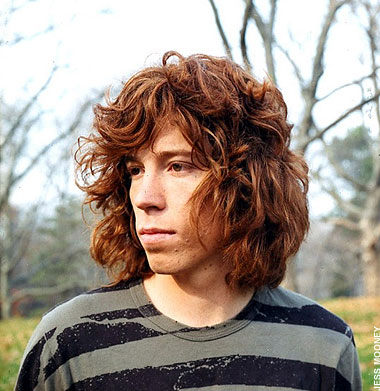
That face is just asking to be punched. Photo credit: thinlinestupid.wordpress.com

Celebrity you’d like to punch in the face: Shaun White. I think that would make a lot of skateboarders and snowboarders really happy.

Comedian role model: Mike Birbiglia. His work is sad, moving, and funny; you leave his shows feeling you just watched Forrest Gump.

Go-to joke during an awkward silence: At Christmas, someone will give a very personal gift that they’ve obviously put a ton of thought into. And I’ll yell, “That’s from all of us!” My dad still cracks up every time.

LAUNCHING YOUR CAREER>>
1. Nobody is going door to door asking if any funny people live there. You need to build your own fan base and distribute your writing and videos.

2. The entertainment and comedy industries can be foreboding, but just accept that you probably won’t level up to the huge personalities right away. Identify where you’d like to work, and find an in by interning or writing for the show.

3. Comedians are very cliquey, and recommendations will get you everywhere. Form a group for yourself by performing regularly at the same comedy clubs – you’ll start seeing the same people. A more formal way to meet people is taking classes at the Upright Citizens Brigade.

Follow Streeter on Twitter at @StreetSeidell and check out his personal website at StreeterSeidell.com. What’s your favorite CollegeHumor sketch?

Foodie Friday: The Head Beer Brewer

Alan Brady couldn't imagine doing anything else for a living. Photo credit: Curt Potter

As the head brewer at The Blue Point Brewing Company, Alan Brady brews 150 kegs a day. But he only drinks a glass or two – he’s too busy modifying brewing processes, overseeing production operations, and maintaining quality control.

At 17, Brady brewed batches and batches of beer at home – so many, in fact, that he started throwing it out (“It cost me next to nothing,” he rationalized). Below, Brady describes how he nailed his first brewery job, why he doesn’t believe non-beer drinkers, and his favorite toast – one that’s bound to raise eyebrows among any company.

Title: Head brewer, The Blue Point Brewing Company
Age: 35
Based in: Long Island, NY
Graduated from: Nowhere. I’m a high school dropout.
Previous jobs: Worked at a beer and soda retailer in Westchester, NY; at a homebrew supply shop; at breweries in Connecticut and Boston
How he learned to brew: When I was 17, my mom and I bought my dad a homebrew beer kit for Father’s Day. I was more interested in it than he was, so I started brewing like crazy – a couple of times a week.

That must have been a hit at high school parties. There’s a different responsibility when you’re making beer. It’s not something you buy at the 7-Eleven for $2, get drunk on, and have a hangover from the next day. I had a beer here and there, but it wasn’t like my friends were getting hammered all the time.

Something people don’t know about your job: Brewers don’t sit around all day and get wasted. We’re running machinery and are surrounded by dangerous chemicals and boiling hot water.

First major screw-up: I was using bleach to sanitize my materials at home, and I didn’t rinse it out well enough. It affected the beer like crazy.

Alan Brady takes a whiff of whole leaf hops, which add bitterness and act as a natural preservative.

What are the main ingredients in any beer? Water, barley, yeast, and hops. But you can combine those four ingredients in millions of different ways.

Go-to beer: American pale ale. It’s one of the best beers we make.
Weirdest beer ever tasted: Garlic beer and chili pepper beer.

How do you develop a new recipe for a beer? I’m inspired by other beers, ingredients, and flavors – or, from a business perspective, whatever is in demand. The first batch of a new beer might not be exactly what I’m looking for, but I sit down with a notebook and analyze the taste: Is it too bitter? Too strong?

What kind of ingredients inspire you? I cook a lot, so I was making a dish at home using Szechuan peppercorns. They numb your tongue, and even used to be illegal in the United States. I bought some online – after they became legal, that is – and incorporated that flavor into the beer. Going outside the box can really work.

What are you brewing now? Our summer ales have been out for a few months. One of our other new beers is called No Apologies, which has a pretty high alcohol content but isn’t a real moneymaker. We brew it because it’s cool.

How did you end up in Long Island? The brewery I worked at in Connecticut went out of business, and then I got laid off from a brewery in Boston. I saw that a place in Long Island [Blue Point Brewing Company] was hiring, and have been here ever since.

Mmm, that's the stuff. Photo credit: BluePointBrewing.com

How did you stand out during job interviews? When I was brewing at home, I had all the freedom in the world. I made a concoction of Canadian lager, apple cider, and a bunch of spare ingredients – like plum extract and apricot extract. It was actually pretty good, so I bottled it and brought it to my first interview.

Pros of brewing in Long Island: The brewing scene is blowing up here right now. We helped pave the way with that.

Cons of brewing in LI: There’s no manufacturing here, and utilities are very expensive.

Best part of the job: Our tasting room, which is open a few days a week. After sweating and cursing at broken machinery, I’ll enjoy a brew in the tasting room with a customer who really appreciates our work.

Worst part of the job: The stress – we’re growing extremely rapidly.

Do you get tipsy on the job? I’ll usually have a beer before I leave work, but that’s it. Even though I get free beer, you can’t just drink it endlessly.

I know people who would beg to differ, but I digress. Where does the name Blue Point originate? It’s the town over from our brewery. The owners, Mark Burford and Pete Cotter, lived there and homebrewed before opening up shop. By using the town’s name, they were also trying to cash in on the world-famous bluepoint oysters.

How much beer do you brew each day? 150 kegs.

What beers should all beer-drinkers try at some point? All my beers. [Laughs.] There’s some funky stuff out there, like Belgian beers brewed with certain bacteria that makes them super-sour. Or beers brewed with wild yeast instead of cultivated yeast.

What about people who don’t like beer? I don’t want to hear that someone doesn’t like beer because they don’t like Budweiser. They just haven’t found the right one. Read the labels on bottles, so you can learn what you like and what you don’t.

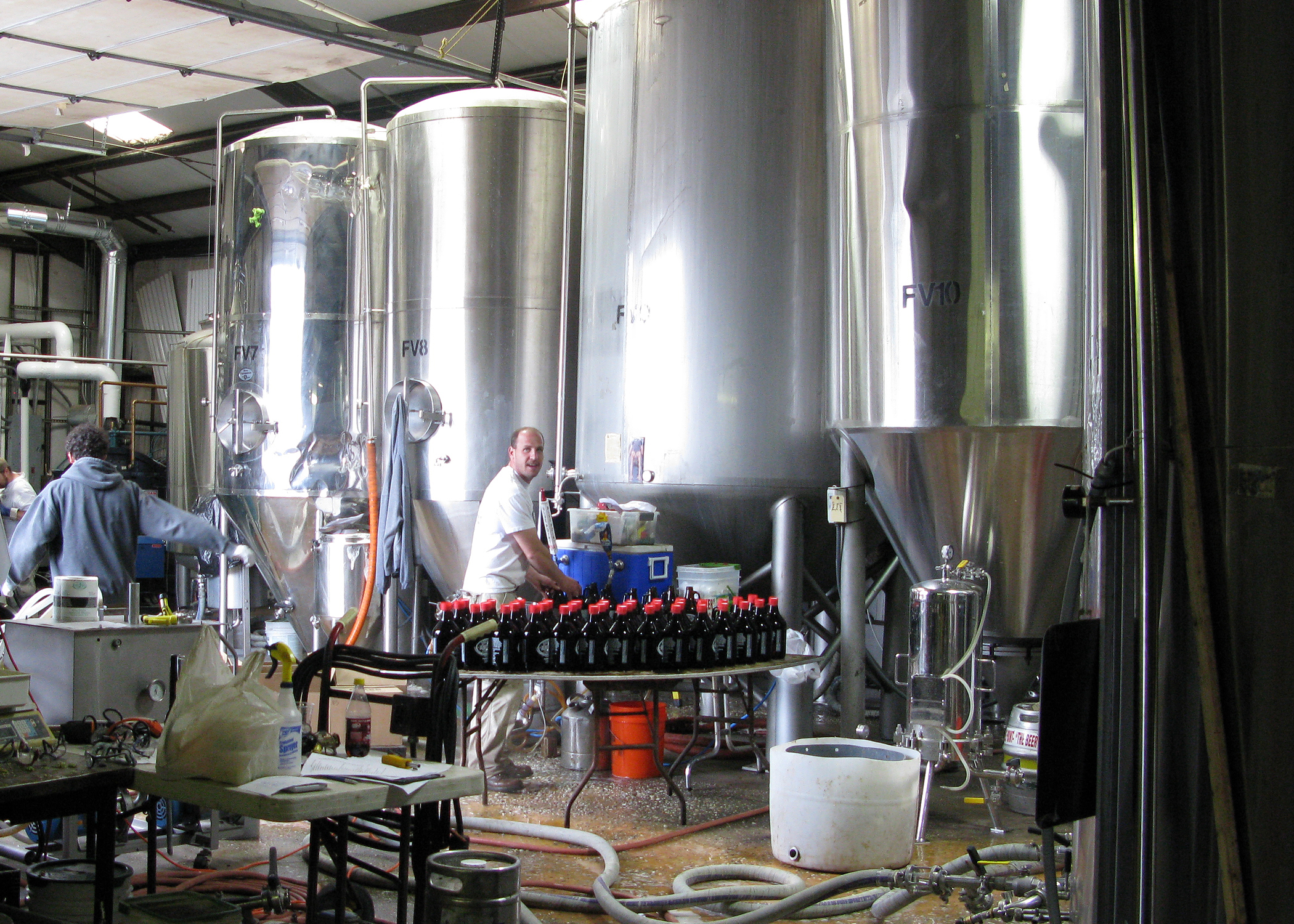
An average day inside the brewhouse. Photo credit: Curt Potter

Where is your favorite spot in the world for craft brews? These days, the U.S. is on top of the game. In Europe, brewing is very traditional – they stay away from new styles, which we embrace.

Favorite toast: I knew a guy from Colorado who would always scream, “Sore unipa!” when making a toast. When I finally asked him what it meant, he told me it’s said in [the video game] Mortal Kombat, when players attack each other. So now I’ll sometimes say sore unipa – which means absolutely nothing – or simply cheers.

LAUNCHING YOUR CAREER>>
From beer to career: Alan Brady shares what’s on tap.
Make beer on your own as a way to get your foot in the door. It’s tough, because everyone wants to brew, but there are only so many jobs. During interviews, I can’t stress the importance of a good handshake, paying attention, and communicating a strong work ethic. Brewing is unique because it incorporates biology, microbiology, chemistry, physics, cooking, and refrigeration – so it can help to have a background in science.

Follow The Blue Point Brewing Company on Twitter at @BluePointBrewer, check out its Facebook fan page, and salivate over its selection of more than 15 microbrews.

For exclusive behind-the-scenes coverage inside the brewery, visit exclusive photos on the No Joe Schmo Facebook page.

Foodie Friday: The Serious Eater

Carey learning to toss coffee cherries on a trip to a coffee farm in Brazil. Photo credit: Liz Clayton

Carey Jones, the editor of the Serious Eats: New York website, has reviewed smoked trout crepes and pumpkin-goat cheese croquetas. She’s tasted rose petal doughnuts, mushroom toast, and roasted pear pizza. But at the end of the day, sometimes all she wants is a plate of scrambled eggs. “I have all this delicious food in my work life, which makes it easy to eat boring stuff the rest of the time,” she says.

From hunting down the best cookies in New York to learning how coffee grows in Brazil, Carey’s job allows her to eat, travel, and write – many a foodie’s dream. At Serious Eats: New York, the five-person editorial team is interested in the way that food, value, atmosphere, and story intertwine, she says. A meal is just as much about the people making it as about the food itself.

Age: 25
Has held the position for: 2 years
Salary: Standard editorial rate, but enough to live comfortably in New York – which isn’t true of all editorial positions
Graduated from: Princeton University, degrees in English and literature
Previous jobs: Freelance writer at New York, New Jersey Monthly, and UrbanDaddy.com

Job description in one sentence: I eat, write, and deal with what others have eaten and written.

How she got the job: I interned for Serious Eats the summer before my senior year at Princeton, in 2006, before the site officially launched. After graduating, I continued freelancing for the site, and was brought on as the editor of the New York section two years later.

(L to R): Emeril Lagasse; Ed Levine, who launched Serious Eats; Carey Jones. Photo credit: J. Kenji Lopez-Alt

Best part of the job: Our staff is somewhere between a secret club and a weird family. I’ve also been able to do a ton of traveling; last year, I went to a coffee plantation in Brazil during coffee harvest season.

Hardest part of the job: Eating when you don’t want to eat. If I’ve had six slices of pizza, I don’t want the seventh, but still have to discern whether it’s good pizza.

Does the site endorse restaurants or simply describe the food? Everything is colored through the lens of our opinion. We review restaurants twice a week, which are written by myself and a few other editors. For the most part, if we eat a mediocre sandwich, we probably won’t write about it. But if it’s amazing, we’ll certainly tell people.

Do you get preferential treatment at restaurants? We enter anonymously, buy the food, and write about it. Otherwise, it’s not fair.

What defines a Serious Eats review? At the end of the day, people aren’t typically eating four-star $40 entrees. So instead, we look at what people want to know on a daily basis; we publish a daily column called “A Sandwich a Day.” We also put an emphasis on the food over service and atmosphere.

Brussels sprouts and speck pizza from Motorino. Photo credit: Robyn Lee

If you had to live on one food for the rest of your life? Either Neapolitan-style pizza from Motorino Pizza in NYC’s East Village, or Greek yogurt.

Most-despised food: Black licorice.
Guilty pleasure: Huge, gooey cinnamon buns.

How do you not gain 500 pounds at work? You learn really quickly that you can never take more than two bites of anything, no matter how delicious. It’s all about moderation. On my off days, I have the most boring diet – eggs, lentils, and spinach. And I work out a lot.

Where do you see yourself in five years? Journalism is changing so quickly, it’s hard to imagine what media will look like in five years. Right now, I feel like I’m holding onto the edge of a rocket ship. My job never gets boring because Serious Eats changes every day, and the industry changes every day. I’m always working on new projects.

The aftermath of a 14-pie breakfast at Hoosier Mama in Chicago. Photo credit: Robyn Lee

Like what? Finding the best chocolate chip cookies in New York. I’ll draw up a list of places, coordinate research efforts for taste tests, and write up the article.

Your biggest project? This November, we’re releasing a book called Serious Eats: A Comprehensive Guide to Making and Eating Delicious Food Wherever You Are (available now for pre-order on Amazon). Spearheading the book has been a huge part of this past year.

Yummiest but most under-appreciated food: Soft, mild Italian cheeses, like a perfect ricotta or mozzarella.

What are you working on right now? Our site could do a much better job of giving discerning entry-level information for tourists who are just visiting New York for a few days. I’m working on roundups of where to eat in places like Grand Central Station and Times Square, and hope to create more of a home base for people who want to get their feet wet.

Adam Richman on Travel Channel's Man v. Food. Photo credit: latimesblogs.latimes.com

What do you think about America’s obsession with competitive eating shows, like Man v. Food? There will always be low-brow entertainment. People watch it for the gross-out factor and the novelty.

LAUNCHING YOUR CAREER>>
Love eating, writing, and traveling? Carey Jones sets you down the right path.

1. Write as wisely as possible. Freelancing was very unrewarding at first; I would write 50 pitch letters in a week and only receive one response, which would usually be “no.” Pitch to a broad range of publications, and turn responses into dialogues. Instead of stopping at a “no,” follow up with another pitch.

2. Express a genuine curiosity and nuanced interest about food, not just, I love food! I eat all the time! I’m such a foodie! Instead, talk about a specific food or culture you want to learn about. Also, since online food photographs are huge, know how to take a decent, clear picture.

3. Balance the elements of people, their story, context, and food. You’re not just writing about a restaurant – you’re also writing about a chef. Lots of people submit pitches about new openings or hidden gems, which make my eyes glaze over.

Click here for more Foodie Fridays! You can follow Carey Jones on Twitter at @CareyJones and @SeriousEatsNY.

The Rain, Wind, and Snow Man

Photo credit: 123rf.com

The Day After Tomorrow, 2012 – yeah, we’ve heard it all before. The world is ending and global warming may kill us. But how much of the noise can we really believe?

Jon Gottschalck, 39, provides local and regional forecasts at the National Oceanic and Atmospheric Administration, more commonly known as NOAA. Their National Weather Service weather service is the official voice of the U.S. government for issuing warnings during life threatening weather situations (think Snowpocalypse ’10).

The former NASA researcher has been pafmatssionate about weather since the age of 6, when he loved frolicking in the snow. Indeed, weather now consumes Gottschalck’s life – he often gets blamed (jokingly, he insists) at dinner parties for incorrect predictions. But the public doesn’t realize how far weather predictions have come in the past 30 years, he says. Read on for his explanation – and if the world is really ending.

Title: Head of Forecast Operations, Climate Prediction Center, NOAA [National Oceanic and Atmospheric Administration]
Age: 39
Salary: $115,000/year
Based out of: Camp Spring, MD
Graduated from: Penn State, Bachelor’s and Master’s degrees in science
Previous jobs: Senior research association at University of Miami; research staff member at NASA’s Goddard Space Flight Center

Job description in a sentence (or two): I manage 10 to 15 forecasters, and ensure that all operational forecasts are accurate and timely. I’m also responsible for interjecting any new ideas into operational forecasts.

Snow days: a kid's best friend. Photo credit: kidsblogs.nationalgeographic.com

Have you always been fascinated by the weather? I always knew I wanted to be a meteorologist. Since I was 6 years old, I always loved snow. That expanded from wanting to get a day off from school to my interest in extreme weather, like tornadoes, hurricanes, and heat waves. I wanted to learn more about it, so I made a decision to choose science as my major. Even now, after all these years, I still like it quite a bit.

During parties, do your conversations always fall back to weather? I can never get away from it – people are always asking me about the weather. Especially when things don’t work out, they blame us. [Laughs.]

What has worried you lately about trends in extreme weather? The past year or two of increased extreme weather has definitely raised eyebrows. Is it a bubble that will go back to a normal level soon, or a general increase to be expected over the next 30 years? That hasn’t been answered yet. We’re worried about it, but that work takes time.

Would you say you’re more worried than the general public? Frenzy develops among meteorologists with extreme weather. We congregate around computers and maps, generating our own vortex, getting very excited over it.

So walk me through your day. My days are never the same. But first thing in the morning, I make sure all the resources to make forecasts are available – like data sets and graphics. Then, I draft up forecast maps to make sure they’re accurate. You know, that they’re the right date, in the right locations, no obvious glitches. I know exactly what they should look like.

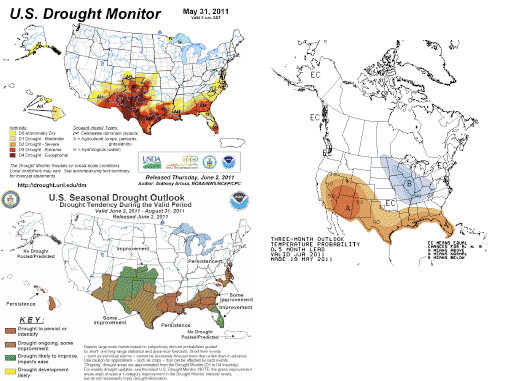
Map monitoring droughts throughout the U.S., drafted by Gottschalck.

Then what’s usually on your afternoon agenda? Often, I’m involved in meetings and coordinating new research projects. I also work on my own set of research projects to help move forecast skills forward.

What types of research projects are you working on right now? I’m looking at how changes in the deep tropics – such as El Niño and La Niña – can have an impact on where we live [in the Northeast]. El Niño is characterized by unusually warm temperatures, and La Niña by unusually cool temperatures in the equatorial Pacific. We’re trying to learn as much as we can from tropical rainfall patterns to improve weather forecasts in the two, three, and four-week future.

Who have you always wanted to meet? Max Mayfield, the director of the National Hurricane Center during Hurricane Katrina.

How do you explain all the crazy weather lately, from tsunamis to hurricanes? There have been lots of media requests for us to explain what’s going on in relation to the climate. It’s difficult to say, because very often, these things [extreme weather events] just happen. It’s the normal variability in the atmosphere. There’s no clear metric bullet why this is happening, but it’s not necessarily related to climate change.

What did you think of the movie The Day After Tomorrow? It’s not realistic, and way over the top, even in our changing climate world.

Does your job deal with long-term climate change, like global warming? There are two types of climate change: long-term projections, like 100 years, and short-term climate projections, which is what we focus on. So we don’t really deal with global warming – we’ll send people to the Geophysical Fluid Dynamics Laboratory to deal with those questions.

What did you do at NASA? I studied interactions between land and the atmosphere, and how that impacts climate.

Do you wear your pajamas inside out in hopes of snow days? We joke that when weather forecast models predict a big snowstorm a week or more ahead of time, [the snowstorm is] never going to happen. When the models don’t predict snow – that’s when there’s hope.

Something people don’t know about your job: The public doesn’t have a handle on how far weather forecasting has come over the past 30 to 40 years. Although predictions certainly fail at times, they’re relatively accurate, but the public is quick to criticize. When I was a child, forecasts wouldn’t go out more than four days in advance. Now, we issue detailed ones for a week and beyond. But no forecasts are foolproof, even 24-hour ones.

Something people don’t know about you: I’m a lot calmer at work than I am at home. I have three kids.

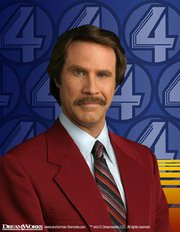
Ron Burgundy and Jon Gottschalck have very, um, different approaches to covering the weather. Photo credit: dreamworks.com

LAUNCHING YOUR CAREER>>
Want a career in weather? Jon Gottschalck tells you what you need to know.

1. Measure your interest in math and physics; those two subjects are the basis of meteorology. I’m talking about hardcore science, not just pretty radar pictures or maps. You also need a very good background in weather and climate, which can range from understanding synoptic meteorology (day-to-day weather) to understanding El Niño. One way to acquire this background is by interning or volunteering at a local weather center.

2. Hone your computer skills on a Windows-type PC. It’s essential to know computer programming techniques and languages to process, filter, and display weather data.

3. Subscribe to and read various weather and meteorology journals. Subscription costs can rack up, but you learn a lot about science, where the jobs are, and different mini-disciplines within meteorology – from climate to oceans to space weather. Weatherwise Magazine is a good introductory publication that includes a wide range of topics, and isn’t written it total scientific jargon.

What have you always wanted to know about climate? Comment below, and your questions will be relayed to Jon!

You can follow NOAA on Twitter at @usnoaagov.