The LEGO Artist

Sawaya posing with one of his life-size LEGO sculptures.

Nathan Sawaya is 37 going on 12. A really talented 12-year-old.

Growing up, Sawaya played with a 36-square-foot LEGO city. While most kids eventually trade in their bricks for video games, Sawaya brought the LEGOs to college – and then to law school. He rediscovered LEGOs not as a toy, but rather as a medium.

Now, his studio holds about 1.5 million colored bricks at any time. The New York corporate lawyer-turned-LEGO artist traded in a six-figure paycheck and health benefits to build 3-D life-size sculptures at $15,000 a pop.

In addition to building his own projects, which are featured in art museums across the country, Sawaya works on commission. Read on for some of his weirdest requests — including one from Pete Wentz.

Self-proclaimed title: Brick artist
Age: 37
Graduated from: New York University; New York University School of Law
Pricing: Sculptures in museums and galleries sell in the $10,000 to $20,000 range
Previous job: Corporate lawyer in New York City

Many of Sawaya’s sculptures, like “Trapped,” are about transition and metamorphosis.

Number of bricks in a life-size sculpture: 15,000 to 25,000 pieces, depending on complexity and body positioning.

Time frame per project: My first projects took me three to four months at a time. Now, I can build a life-size figure in two or three weeks.

How does a Wall Street lawyer begin to tinker with LEGOs? At the end of my workdays, I needed a creative outlet, so I would draw, write, paint, and sculpt. One day, I wondered if I could sculpt larger-scale pieces with LEGOs as the medium.

You happened to have huge tubs of LEGOs lying around? I saved my bricks from when I was kid, so I just dug them out of my closet. As I started working on larger pieces, I bought more online or in stores.

How did it segue from a hobby to career? I began to put photos of my creations on my website, and soon, it crashed from all the traffic. I said, Okay, there’s something here. So I made the decision to play with bricks full-time.

How did your family and coworkers react? Mostly, my friends and family were very encouraging. Of course, there were people who made fun of my adventure, and I learned to cut those negative relationships out of my life. It’s important to surround yourself with support.

Describe the creative process. It must be more than dumping out a pile and going to work, right? Yes. There’s tons of sketching involved; in fact, I always carry a sketchpad with me and am constantly jotting down ideas. I put a little glue on each individual brick, which is a very consuming process. My girlfriend says I go into a trance while I work.

Watch Nathan Sawaya building at top speed:

In 2004, you won LEGOland’s nationwide search for a master model builder for the 128-acre children’s theme park. What was the selection process like? I went through several rounds of different building challenges. During one, I was given a pile of bricks and was instructed to build a sphere in 45 minutes.

Did you get a lifetime supply of LEGOs? Unfortunately not. I still buy my bricks like everyone else.

Something people don’t know about your job: If a project doesn’t look right, I might have to chisel away at entire sections – days’ worth of work – since it’s all glued together. That can be heart-wrenching at times.

What are you working on right now? I’ve found lots of ways to take bricks in new directions, like into fine art galleries and museums. I currently have two museum exhibitions in North American and one in Australia. I’m also producing a film, which has been extremely eye-opening. [Editor’s note: check out yesterday’s post on a freelance filmmaker!]

Did you love LEGOs growing up? My very accommodating parents allowed me to have a 36-square-foot LEGO city in my house.

Sawaya working in his studio, where sculptures adorn the walls.

What about now? Do bricks consume your apartment? I have a separate art studio for my work, which holds about 1.5 million LEGO bricks at any time.

How are they organized? Into clear bins, sorted in rows by shape and color. It’s a bit like walking into a rainbow. I listen to pop music to keep me jumping while I work.

Weirdest request for a sculpture: Pete Wentz requested a giant bumblebee. Another really weird request was for a life-size nude woman with the head of a cat. I passed on that project.

Inspiration for your personal projects: I put lots of emotion into my artwork. Many are about metamorphosis and going through transitions.

“Yellow” is Sawaya’s most iconic sculpture.

Favorite sculpture: I always say that my favorite project is my next one. But the most iconic is probably “Yellow” (see right). It’s been widely used with and without my permission; fortunately, since I used to be a lawyer, that’s all worked out.

Hours per day spent with LEGOs: 12 to 14.

Your job must be inspiring for little kids. I’ve found an interesting market of art collectors who enjoy my work because their kids love it. They’ll tell me, “I have a Damien Hirst, I have a Warhol, and my kids don’t care. But I bring home a Sawaya, and they get excited.”

LAUNCHING YOUR CAREER>>
Nathan Sawaya discusses the building blocks of the biz. Pun intended.
For LEGO work, a background in arts and engineering are very helpful. Kids often ask me how they can be like me, and the first thing I tell them is to practice and think big. It sounds cliche, but I came up with the concept of creating fine art out of LEGOs because it hadn’t been pursued very much. Also, be sure to surround yourself with a very supportive group.

Follow Nathan on Twitter at @nathansawaya and check out his hilarious segment on The Colbert Report. Don’t forget to check out the No Joe Schmo Facebook page for more photos of Nathan and other featured artists!

PLUS: Think LEGO building is cool? Here are 10 other cool jobs you wanted as a kid…

All photos courtesy of BrickArtist.com.

The Filmmaker & The Film Editor

Alexis Boling, left, and his wife, Alex, right. Photo credit: DiBezi.com.

Alexis Boling and his wife, Alex, live together in “the closest thing to a hippie art business commune” in Brooklyn, NY. Their walls are filled with artsy shots of traffic cones instead of smiling family photos.

Alexis, a freelance cinematographer, started Harmonium Films and Music and shot and directed the first-ever music video for Vampire Weekend. Alex, a freelance video editor and producer – and an amateur metalsmither, as her Tumblr reveals – has worked on videos for a slew of corporate clients and websites, including ConsumerReports.com and RollingStone.com.

Below, the film-savvy couple discusses their favorite movie snack, the difficulties of working in the same industry, and the confusing nature of their names (remember, Alexis is the husband; Alex, which is short for Alexander, is his wife).

Age: Alexis, 32; Alex, 28
Graduated from: Alexis, University of Georgia, B.A. in English; Alex, Barnard College, B.A. in English
Salary: Everything is negotiable on a sliding scale; starting rate as a production assistant is typically $200/day

How did you get started in film?
Alexis: I was involved in theater in high school, but never thought of starting my own business. Then I worked on a small art film in college, and was officially bitten by the film bug.
Alex: I wanted to act, but didn’t want to be waiting tables for years while auditioning. So I interned at various production companies, where I found out about an opening for an office manager. I got the job and started three days after graduation.

How did you build your credibility?
Alexis: I put a really nice video camera on my credit card, took over my parents’ garage for a year, and shot anything and everything I could. That was the beginning of Harmonium Films and Music, which I eventually moved to New York City.
Alex: After working at my first job for two years in a one-room office, I began freelancing for HBO and PBS. In the past year, I’ve shifted from production coordinating to editing.

Alexis shot and directed Vampire Weekend’s first music video, “Mansard Roof.” Alex produced and edited it.

Where do you draw inspiration from?
Alexis: Stories that otherwise wouldn’t be told, voices that deserve to be elevated.

Like?
Alexis: For seven years, I’ve been working on a documentary called “French Monster Trucks,” about a family in France that used to run a small traveling circus and now runs a monster truck show. They bought these huge trucks and taught themselves stunts. It’s incredible to watch them bring the trucks down tiny European streets.

Seven years!? I hope to finish it this year. You need a lot of patience in this job.

Does working in the same industry put a strain on your marriage?
Alex: We’ve learned what dynamics don’t work, like when I’m producing and Alexis is directing. We would fight about money and bring the arguments home with us. But when he shoots and I edit, or when he directs and I act – that’s easy.

What’s the hardest part about working for yourself?
Alexis: You’ll never work harder than when you work for yourself. But people get very tied up in job security and think freelancing is too unstable. I don’t buy that at all. One job from one single employer is the least secure option; that one company can shut you down. Freelancers survive by a wave of relationships.
Alex: Unemployment between projects is hard. You should always have stuff in the pipelines for when you have downtime, but it can be difficult to understand that downtime will end.

Watch Alex’s acting reel:

Favorite movie?
Alexis: Buffalo ’66.
Alex: Children of Men.

Favorite movie snack?
Simultaneously: Cherry Coke.

Movie theater or Netflix?
Alexis: Rachel Maddow and HBO.
Alex: HBO on Demand. Or going to plays — I really enjoy theater.

Alex editing her work on Final Cut Pro.

What decorates the walls of your apartment?
Alexis: Our 1870s brownstone in Bed-Stuy [Bedford-Stuyvesant, Brooklyn] is as close as you can get to a hippie art business commune. We have lots of photography from our family — not of our family. [Laughs.] Instead of smiling happy family pictures, we have art photos of traffic cones.

Something people don’t know about you?
Alex: My uncle invented stove top stuffing. He pioneered the idea of selling stale bread to people.

Alexis is typically a female name, and Alex can be a male one. Do people get confused?
Alex: Yes, definitely. Alex is my middle name — my first name is Bodine, but that doesn’t make things easier. People think we did the Alex-and-Alexis thing on purpose.

LAUNCHING YOUR CAREER>>
Alexis and Alex share 4 tricks of the film trade.

Follow Alex on Twitter at @bodine and follow Alexis at @alexisboling.

The Elvis Impersonator

Schulz performing at Turner Field before a Braves game. Photo credit: Flickr.com/Richard Roberson

Harold “Elvis” Schulz wears a red-and-white shirt, blue jeans, and white boots when he’s Country Western Elvis. He wears a G.I. Blues uniform when he’s Army Elvis. He wears a black velvet shirt, gold vest, and white patent leather shoes when he’s Return to Tupelo Elvis.

For over a decade, Schulz and his trio, Young Elvis and the Blue Suedes, have been performing strictly 50s tunes for thousands of adoring fans at nursing homes, corporate events, and weddings around the world.

Schulz’s natural resemblance to The King is striking. For shows, he simply applies Suave Mega Hold hairspray and some red chapstick, and he’s ready to go. Even Elvis’ own stepbrothers tell him he looks like Elvis’ ghost.

Title: Celebrity look-alike and performer
Age: It’s a trade secret – somewhere between 30 and 35
Graduated from: University of Georgia, B.B.A. in marketing
In the industry for
: 11 years
Salary: $200 to $250/hour for nursing homes; $350 for 30-minute private parties; up to $2,000 for 3-hour conventions and corporate events
Previous jobs:
Regional and national salesman at various companies, including Siemens

Biggest crowd: 10,000 people in Kansas City for New Year’s Eve in 2008.
Average crowd: Anywhere from 40 to 5,000.
Total number of shows: In the thousands. In my busiest month, I worked 19 shows.

Schulz performing in Memphis.

How you got the job: My ex-wife was garnishing wages from my corporate job, so I only had about $400/month to live on. To make some extra money, I started singing karaoke at different venues for fun. I entered a contest and happened to sing Elvis, and the DJ called me afterward. He asked if I had ever thought about being an Elvis impersonator, and my first thought was, I’m not a fat guy, and I’m not putting on a white jumpsuit.

What changed your mind? He told me I could make $500/hour performing, which perked my ears up. I started practicing, and made $850 for 45 minutes during my first gig. After I was laid off from my corporate job, I decided to go into showbiz full-time.

You call yourself “young Elvis.” What are the restrictions? I’m strictly a 50s Elvis – not that fat guy in a white jumpsuit. I perform mostly blues – you know, “Heartbreak Hotel” and “Don’t Be Cruel.”

How do you resemble Elvis? My hair lifts high like his, and we’re the same height and weight. I also practice all his mannerisms, like singing to the microphone and the little inflections in his voice.

That must take a ton of practice. In the beginning, I spent thousands of hours in front of the mirror. And I’m always practicing my voice – usually in my car, since I drive around a lot. [Begins belting out “You Don’t Know Me.”]

Schulz with Elvis' stepbrothers, Rick Stanley (L) and Billy Stanley (R).

What makes your show unique? All our instruments – including our microphones – are vintage, meaning they’re worth about $145,000. My group is officially endorsed by Rick and Billy Stanley, Elvis’ stepbrothers, and Billy once told me that it freaks him out how much I look like Elvis.

How many guys do you work with? A trio, just like the original Elvis trio: a drummer, guitarist, and bassist. We also do some Frank Sinatra and Dean Martin shows.

And you do all the singing? Yep, and I play some acoustic guitar, just like Elvis did. I’m pretty much a one-man shop: I manage the marketing, bookings, advertisements, video editing, production, web design, and sales. My business background helps with all of that.

Where do you perform? Lots of nursing homes, retirement homes, and events like the Special Olympics. But to pay the bills, I’ll do larger venues, like performing arts centers, corporate events, the occasional casino, and private parties – weddings, anniversaries, and birthday parties.

Do you travel across the United States? All over the world, actually. If they’re paying, we’re playing.

Something people don’t know about your job: Elvis crosses all cultural and socioeconomic borders. We perform for kids to teens to people in their 90s. Playing for older clients is cool, because we’re bringing music back to life that they grew up with.

Channeling Elvis' style, Schulz sings to the microphone "like it's his woman."

Do you refer to yourself as “The King”? No, never ever, ever. When I’m on stage, I’m on, but when I’m off, I’m off.

You seem like a pretty normal guy, but there must be some crazies out there who think they’re actually Elvis. Last year, I went to Elvis Week in Memphis for the first time. Some of the people there made Trekkies look normal.

Did you grow up listening to Elvis? Elvis, Frank Sinatra, Dean Martin, Nat King Cole – all the classics.

Is your house decorated with memorabilia? I’ve never bought that kind of stuff, but people always give it to me – 45s, books, framed photos. My living room is decorated very classy, with some 45s and some black-and-white photos from Jailhouse Rock.

How do you pump up the crowds? Elvis was always a practical joker, so I’ll do lots of comedy and banter on stage to keep things fresh. I also spend about half the show off the stage, walking around the room and singing to ladies.

Funniest memory from a show: Once, I heard a woman whisper to her husband, “That guy must have had plastic surgery.” So I snuck up behind her and said into my mic, “Nope, no plastic surgery!” She screamed.

Routine before a show: I’ll apply a little mascara to my eyebrows, some red chapstick to my lips, and occasionally some self-tanner to bring out my eyes. Some of the Elvis impersonators I’ve seen wear so much makeup that they look like French prostitutes.

You mentioned an ex-wife earlier. Was she an Elvis fan? She hated it. In the beginning, she pretended to like it, but we couldn’t eat dinner without people asking to take a photo with me. I didn’t mind it.

Schulz with a group of adoring fans after a show.

So you have lots of fans? Once, during a dinner in Florida, a group of eight girls came up to me to take photos. Their boyfriends were sitting at the next table, giving us dirty looks. I was like, Hey man, they came over to us. Get mad at them.

Favorite Elvis number: I have about 10 favorites, mostly ballads, including “Love Me Tender,” “Can’t Help Falling in Love,” and “All Shook Up.”

LAUNCHING YOUR CAREER>>
1. While it’s important to seek the advice of industry experts, think outside of the box. Everyone told me to build a fan base, but I didn’t want to. I like working with new people at each show, so I always go after different venues and fresh audiences.

2. Find a niche in the market. All Elvis impersonators were doing the jumpsuit thing, so I opted to do young Elvis. Also, market your services as selling an experience. I sell the entire 1956 style, feel, energy, and vintage instruments– not just a guy who looks like Elvis.

3. It helps to have a business background. Otherwise, you’re at the mercy of your manager. Just look at Billy Joel’s $90 million lawsuit against his ex-brother-in-law and former manager; the guy didn’t know anything about his own books.

Check out more videos of Young Elvis and the Blue Suedes! Unless stated otherwise, all photos courtesy of bluesuedeent.com.

Foodie Friday: The Food Spotter

Amy Cao in her kitchen in Brooklyn, NY.

Amy Cao, the head of community at Foodspotting, admits it straight up: she can’t cook. In fact, she’s afraid to cook; she’s worried it will make people sick. So instead, she dines out half the week and orders in the other half.

And that’s perfectly acceptable – lots of people can’t cook. But those people typically don’t blog about food, host cooking shows, and hold positions at websites centered on finding good food. Amy does all three.

Below, Amy dishes about the one food that freaks her out, how she avoided the Freshman 15, and a new Foodspotting project launching in July.

Position: Head of community, Foodspotting
Age: 27
Graduated from: Boston University, degree in mass communications
Has held the position for: 9 months
Previous jobs: Editor at Zagat Survey; freelance food writer for Zagat, Tasting Table, and others

Job description in one sentence: I handle Foodspotting’s conversations on and offline, meaning I work on everything from customer service to content creation to video production to social media.

What’s the purpose of Foodspotting? It’s a website and mobile app for finding good food around you, based on photos of dishes that our users recommend. [Editor’s note: a previous Foodie Friday, Mayumi Ando – she’s the creative director at Dylan’s Candy Bar – uses Foodspotting regularly!]

How you got the job: I built a strong following on my blog, Amy Blogs Chow. The job opening at Foodspotting was ideal because they were looking to define their voice online, and I love building relationships with people. It’s a combination of personal and professional.

Latest crazy food you tried: Live lobster at 15 East [a Japanese restaurant] in Union Square. It was presented live, then whisked away to the kitchen.

Why is it important to connect with foodies online? You can dine out and enjoy the experience, but sharing it makes the experience last longer. Everyone is a food critic now, or passes as one – and people aren’t looking to experts as much as they’re looking to their peers. Word of mouth from a trusted source is extremely valuable to our decision-making.

How did you come to terms with your love for food? I love food because it’s welcoming to everyone. When someone cooks for you, it means they care about you. My parents weren’t amazing cooks, but if I wanted to eat something, they would get it for me. There was never a no – food was always a big yes. We had a wonderful dining hall at [Boston University] where I spent a lot of time; I loved being surrounded by food all day.

Does that mean you gained the Freshman 15? I didn’t. Though I eat constantly, I only eat until I’m full. And my roommate, Jenna, whom I dined with most often, would eat half my food. I have a pretty fast metabolism, and if I craved a late night snack, it would be a chicken Caesar salad, which isn’t the worst thing to have at midnight.

Favorite dining hall delicacy? Fresh peanut butter cookies.

Amy with a batch of homemade baked sweet potato fries.

Cooking videos can be long and boring to watch. How do you keep your video series, “Stupidly Simple Snacks,” short and sweet? Each video needs to be under three-and-a-half minutes, and I edit the footage to fit the background music. Cooking isn’t the most approachable thing for me, so I make my videos silly and goofy. The goal is entertainment, and to make food less scary.

How long does editing take? Filming takes less than an hour, but editing a three-minute video can take two days. And that’s in between working full-time [at Foodspotting].

What do you use to record videos? The built-in iSight camera on my MacBook.

Your favorite episode? I had a great time working with [NYC restaurant owner and beverage director] Joe Campanale on the wine cocktails video. We made three refreshing, stupidly simple wine cocktails: a spritz from Austria, Tinto de Verano from Spain, and Bicicletta from Italy.

Something you always cook wrong: Well, lots of things. But mainly, I’d say rice – I never know how long to keep it boiling for. I either don’t use enough water or use too much.

Never-fail snack: Strawberry yogurt parfait from Pret A Manger.
Food that freaks you out: Dried fruit. I don’t like the texture.
Best comfort eats: Anything with spicy mayo; fried chicken; cupcakes; banana pudding; and lattes, if I need energy.

What are you working on right now? We just launched a beautiful app for Windows Phone 7, and we’re launching a new video series in mid-July called Foodspotting with Amy. I’ll be updating users about company news and talking to food experts in New York and beyond.

Which food blogs do you follow? A Cup of Jo, Sunday Suppers, and Tasting Table. I also love fashion blogs like Oh Joy! for the gorgeous photographs. I rarely read recipe blogs, since I don’t cook.

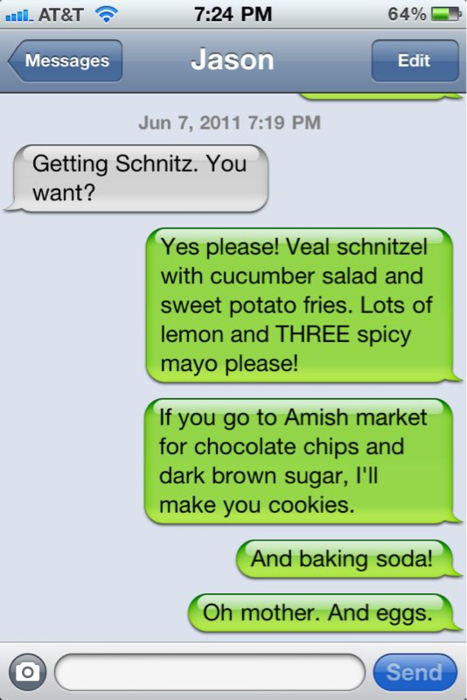
A typical conversation for Amy. She did say she loved spicy mayo.

Wait, you don’t cook? You just eat out and order in? Yep, that’s why I do Stupidly Simple Snacks. I dine out half the week, and order in the other half. I’m afraid to cook, because I’m scared I’ll make people sick.

What do you order? A lot of schnitzel, which is a traditional Austrian dish of deep fried veal cutlets. And Thai takeout. I wish I could make pork chops, because I love them – but I know they’d just be raw in the center if I tried.

You’ve always wanted to meet: My grandfather, who passed away when I was one month old. And Michelle Obama.

LAUNCHING YOUR CAREER>>
Engage with people who share your own interests online, and those relationships will help you find a job. It’s not just enough to have a resume; you need an online presence. Also, if you have an idea, go for it – or else someone will! The best time to start anything is yesterday. Whenever possible, do something to help someone; that’s where the joy is, and that’s where you can relate.

Follow Amy on Twitter at @AmyBlogsChow and check out her Tumblr. All photos courtesy of Amy Cao.

PLUS: Click here for more Foodie Fridays!

The CollegeHumor.com Editor

Photo credit: collegehumor.com

After making a name for himself at his badass college newspaper, Streeter Seidell joined the crew at CollegeHumor.com in 2005 to help write the site’s first book, The CollegeHumor Guide to College. Since then, he has co-starred on MTV’s Pranked, forced CollegeHumor interns to belt out karaoke during Intern Appreciate Night, and embarrassed a coworker in front of 18,000 people. But more on that later.

Seidell was named editor in chief of CollegeHumor just two weeks ago, so he’s still shaping his responsibilities. He begins our chat with an apology: “Sorry if you can’t understand me, but I’m eating a Twix,” he explains. “I admit that I sometimes take part in a little midday candy.” See also: cheeseburger enthusiast.

Title: Editor in Chief, CollegeHumor.com
Age: 28
Graduated from: Fordham University, degree in communications
Previous jobs:
Intern at The Gersh Agency; restaurant waiter; landscaper
A landscaper? I never mowed lawns as a kid, and I couldn’t believe what I had been missing out on. There’s something really satisfying about looking at how straight you made the lines.

Job description in one sentence: I’m responsible for the overall tone of content, including videos, articles, and photos.

How you got the job: In college, I wrote for the badass student-run paper – you know, the paper that said f*ck. I stumbled upon CollegeHumor.com and emailed some of my clips to [editor and co-founder] Ricky Van Veen. He put my work up on the site, and I started working for CollegeHumor the day after graduation.

How you moved up the ranks: Early on, I had a theory that proved correct: If I aggressively sought crappy work, I’d be indispensable. I noticed that Ricky was doing tons of manual labor, like sorting through links and pictures, so I relieved him of those duties while still writing.

You acted in skits, too? We started making videos at CollegeHumor before anyone else did, which was a real game changer. Our initial ones were 15 minutes long without professional lighting or sound.

Check out Streeter’s favorite sketch he was in:

Something people don’t know about your job: There’s this image of CollegeHumor being a no holds barred party. There is quite a bit of joking around, but it’s much more serious than people think. Sometimes, interns are surprised they have to do real work.

Formula for a successful CH video: There’s no set type or grand plan, which can be frustrating, but is also crucial to our success. It means we can try weird stuff all the time. You might spend forever writing a sketch you think will be huge, but nobody likes it – and then a video of a kid falling off a coffee table is the biggest hit.

Turnaround time for videos: About two weeks. Less if it’s super-timely.
Staff size: About 100, plus freelancers.

Were you the class clown growing up? No. I was really hoping for that superlative, though.

I’m sorry. Was the kid who won funnier than you? All kids are funny, but it takes a certain type to think, “Okay, I’m funny. Will someone pay me to be funny?” That’s the type of kid who ends up with a career in comedy.

Best prank: When I convinced [my co-worker] Amir that he won a half million dollars for talking a half-court shot at the University of Maryland basketball game. It was one of the single greatest moments of my life – 18,000 people did exactly what I told them to do.

Most embarrassing CH moment: In my early sketches, I was 20 pounds fatter and had a little chin goatee going on. Getting on camera right after college probably wasn’t the best for me.

In CH videos, everyone on staff seems so close. I’ve worked with the same core group of six or seven people for the past six years, which is unheard of today. My work friends are my real friends – there’s no separation.

The CollegeHumor writing staff, L to R: Ethan Doughty, Amir Blumenfeld, Streeter Seidell, Jeff Rubin, and Sarah Schneider. Photo credit: flickr.com/Zach Klein

Do you have any special traditions at the office? Lots, actually. An ad salesman who used to work here was notorious for writing bad jokes in reply-all emails. So we created a trophy called the Turby – named after this ad salesman, whose nickname was Turbo. We award the trophy to whoever sends a really shitty reply-all email, and it keeps getting passed around. We have a nominating committee and everything.

That’s hilarious. What else? Whenever it’s someone’s birthday in the office, the entire staff stands at his or her desk and claps for a while. It was much easier with just 15 people on staff – now, it can get out of hand to move 60 or 70 people over to a desk. But we do it anyway. Oh, and we make the interns sing karaoke on Intern Appreciation Night.

Streeter is a pretty unique name – do you go by a nickname? Nicknames have never stuck because my name is just so weird. I’d love one, though.

Favorite TV show of all time: It’s a toss-up between Lost and the British version of The Office.

That face is just asking to be punched. Photo credit: thinlinestupid.wordpress.com

Celebrity you’d like to punch in the face: Shaun White. I think that would make a lot of skateboarders and snowboarders really happy.

Comedian role model: Mike Birbiglia. His work is sad, moving, and funny; you leave his shows feeling you just watched Forrest Gump.

Go-to joke during an awkward silence: At Christmas, someone will give a very personal gift that they’ve obviously put a ton of thought into. And I’ll yell, “That’s from all of us!” My dad still cracks up every time.

LAUNCHING YOUR CAREER>>
1. Nobody is going door to door asking if any funny people live there. You need to build your own fan base and distribute your writing and videos.

2. The entertainment and comedy industries can be foreboding, but just accept that you probably won’t level up to the huge personalities right away. Identify where you’d like to work, and find an in by interning or writing for the show.

3. Comedians are very cliquey, and recommendations will get you everywhere. Form a group for yourself by performing regularly at the same comedy clubs – you’ll start seeing the same people. A more formal way to meet people is taking classes at the Upright Citizens Brigade.

Follow Streeter on Twitter at @StreetSeidell and check out his personal website at StreeterSeidell.com. What’s your favorite CollegeHumor sketch?