
The Permanent Makeup Artist

We’re guessing that Marilyn’s lips weren’t enhanced. Or were they? Photo credit: topnews.in

The trick to making money today, Michael Katz says, is finding something that not a “thousand zillion people are doing already.”

For him, that something is surgically tattooing makeup onto people’s faces. Katz has never been a typical 9-to-5 person, and now, as the owner of Miche Permanent Cosmetics (pronounced mee-SHAY), he is one of fewer than 70 professional technicians in New Jersey.

In addition to working on women’s eyes, eyebrows, and lips all day, Katz trains aspiring cosmeticians at Miche. The job allows him to take center stage – just the way he likes it – and maintain a side job of coordinating singles cruises to the Bahamas. Below, Katz discusses his golden rule, the startling costs of procedures, and how to be diplomatic with customers who want Spock-like eyebrows.

Age: 52
In the makeup business for: 14 years
Graduated from: Queens College
Trained by: Alexis Lawson, creator of SofTap, Inc.; Sandi Hammons of Premier Pigments
Previous jobs: Bass player; used car dealership owner; CPR teacher for the American Red Cross; makeup salesman, technician, and artist at various top spas across the country

Services offered at Miche: Aesthetic tattooing, including eyebrows, eyes, lips; and medical tattooing, like areola restoration, restoring hair follicles, scar camouflage, and correcting cleft palettes.

Katz goes for a more natural look. Photo: mybeautyblog.co.uk

By “eyes,” do you mean tattooing on blue eyeshadow? No. I stick to natural requests, like eyelash enhancements, or tattooing on netural-colored eyeliner (in black or brown). I made an exception for one woman who worked as a Marilyn Monroe impersonator and needed the big 1940s eyebrows and ruby-red lips.

Equipment used: Sterile needles, which implant color under the skin like a tattoo, and a two-coil tattoo machine. Eyebrows hurt the least, but we use topical anesthetics to make procedures more tolerable. Lips are torture, so a nearby dentist numbs my clients by injection so they don’t feel anything.

How are tattoos and permanent makeup different? We don’t go as deep, and we use cosmetic pigments instead of tattoo dyes for a more natural-looking result. The tradeoff is that tattoos easily last 20 years, but permanent makeup often only lasts two to five years.

So it’s not really “permanent,” then. In my opinion, it’s more about enhancing and defining features on your face, or creating an illusion. Instead of permanent makeup, we should call it “semi-permanent definition.” [Laughs.]

Did you always love makeup? Not really. But I’ve always looked for careers that are unique and interesting.

So why this profession? The trick to making money today is finding something that not a thousand zillion people are doing already. There are less than 70 professional technicians in New Jersey. As a regular makeup artist, I attended trade shows where I saw permanent cosmetics — and thought it was the bomb. I was fascinated by it, so I got into the field.

Eyebrow enhancements at Miche, circa 2003. Photo: Michael Katz

What made you decide to start your own business? In New Jersey, if you do permanent makeup in a day spa or salon, you get fined. My options were limited to working in a doctor’s office or opening my own place, and the state asked me to open a training center. So I opened Miche eight years ago to do procedures and run accredited training courses.

Perks to owning a business: Being your own boss. On the side, I’m also a cruise coordinator for singles groups in Florida. I sail from the Bahamas to Europe to Alaska, and I think I’ll be doing that forever.

Hardest part of owning a business: Cold calling and knocking on doors when I first started. Now, my business sells itself through word of mouth and my website.

Main clientele: Primarily women in their 40s, 50s, and 60s. Typically, clients don’t come in because they’re lazy about doing their own makeup – they come in because they’re missing half an eyebrow or have very thin lips. We augment them to make look more natural.

Cost of procedures: $500 for eyebrows, upper and lower eyes, or lip line. Upper or lower eyes only are $ 300. It’s $750 for lip lining and filling lips.

Preparation for a procedure: On average, each procedure takes an hour and a half. The preparation is half of that time – before-and-after photos, numbing the area, consent paperwork, and discussing shape and color.

Best part of your job: Meeting people from every walk of life. No two eyebrows are the same, no two eyes, no two lips.

Most challenging part of your job: Perfecting my radar with people so they’re not wasting time or money. I will diplomatically tell someone that permanent makeup can make them feel younger and look good, but it won’t save their marriage. I screen my students to make sure they have potential.

What types of students enroll in your course at Miche? Lots of people who are in the midst of a total life change – they may be changing careers because of the economy, or because of a divorce, or because they’re bored with life.

“Some customers want eyebrows out of Star Trek,” Katz said. “In a week, they’d be back with their lawyers, so I have to be diplomatic and say no.” Photo: krcarnes17.wordpress.com

Do you get nervous that you could totally mess up someone’s face? In the beginning, I was like, oh my God, talk about responsibility. I was scared to death! Now, my golden rule is that less is more. I work very conservatively.

As a male in a female-dominated industry, do you feel out of place? Having a good rapport with customers counts more than whether you’re a man or woman.

If you had to work at a desk job: I’d probably cry my eyes out.

LAUNCHING YOUR CAREER>>
Michael Katz gives the low-down on the chops to permanently alter faces.

1. Find out the regulations in your city or state for permanent makeup. Most schools won’t tell you this; they’ll just train you and send you off, but state regulations control where you can practice.

2. Search for a training program that is certified by the American Academy of Micropigmentation (AAM) or the Society of Permanent Cosmetics Professionals (SPCP). Some fly-by-night schools in New York City teach doing eyebrows on a grapefruit. At Miche, we use live models after students have completed their 60 hours of training.

3. You don’t need to be a makeup artist, but you do need to be able to deal with people. I’ve had successful bankers and nurses come through my classes because it’s something they’ve always wanted to do. Do your homework and decide whether this is something you’ll enjoy; you can’t be squeamish and refuse to use needles.

Are you a potential client? Search for a board-certified technician, and ensure their certification is recent. Ask: (1) How long have you been doing this; (2) How much does it cost; and (3) How much does it hurt?

Find out more about Miche Permanent Cosmetics on the company’s Facebook page.

What’s your opinion on permanent makeup? Would you agree to have eyeliner or eyebrows tattooed on your face?

Foodie Friday: The Oscar Mayer Hotdogger

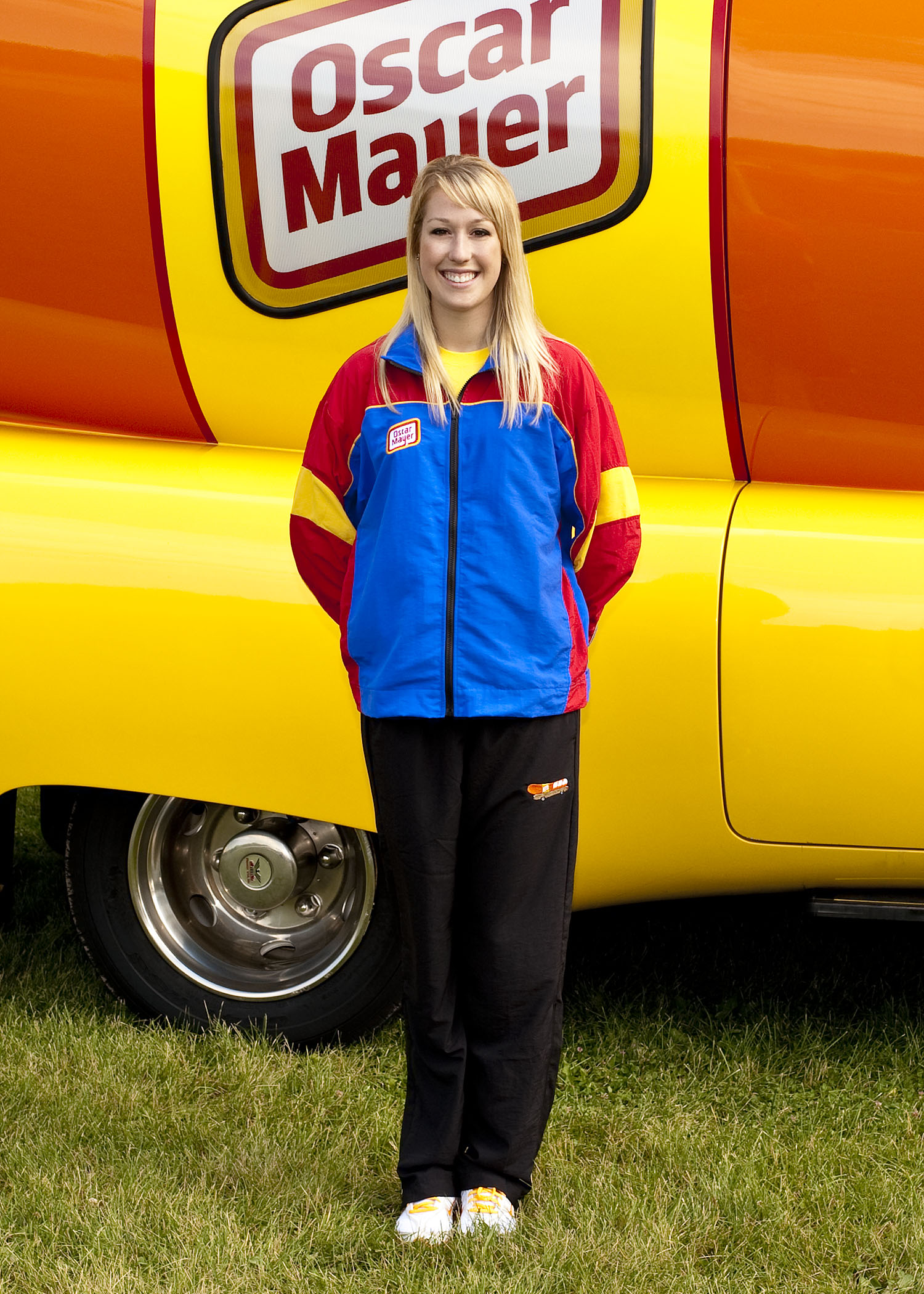
Ketchup Kylie in front of the Oscar Mayer Wienermobile.

Kylie Hodges graduated twice within one month. Once was from the University of Wisconsin-Oshkosh, where she turned her tassel and received a diploma; and once was from Oscar Mayer’s Hot Dog High, where she took an oath with a hot dog in hand.

Even though Ketchup Kylie – as she’s affectionately known by her fellow Oscar Mayer Hotdoggers – just graduated in May, she has pursued the position ever since auditioning to sing the Oscar Mayer jingle as a little girl. Growing up in Madison, Wisc., home of the hot dog headquarters, Kylie saw the Wienermobile maneuver around town on a regular basis.

After 14 days of Hot Dog High and 40 hours of Wienermobile driving training, she hit the road. For one full year, Kylie and one fellow Hotdogger traverse the northeastern part of the country, with Destiny’s Child music blaring from the van’s speakers.

Title: Oscar Mayer Hotdogger
Age: 21
Graduated from: University of Wisconsin-Oshkosh, degree in radio/television/film
Previous jobs: Waiting tables in college

What the job entails: We’re brand ambassadors for Oscar Mayer and the Wienermobile, so we attend fairs, festivals, parades, and promotional events to talk with people and hand out coupons, stickers, and wiener whistles.

How you got the job: Oscar Mayer’s Hotdogger program recruits at a handful of different major universities across the United States, but I knew I wanted this job since I was a little kid. I applied online and found out I got the job before graduation; I graduated on May 15 and started on June 5.

Hot dog fate? Kylie, age 6, in front of the Wienermobile.

Coolest part of the job: Last week, for the 75th anniversary of the Wienermobile, I handed out wiener whistles on the floor of the New York Stock Exchange while Oscar Mayer’s vice president rang the opening bell.

Wow, the Mobile is 75 years old? Carl Mayer, the nephew of Oscar Mayer, designed it in 1936 as a way to sell hot dogs around Chicago. Over the years, it was revamped into a marketing tool. Now, it’s nostalgic to American culture.

So you don’t sell hot dogs from it anymore? No.

Something people would be surprised to learn about the job: People think we live in [the Wienermobile], but we stay at hotels every night.

That must get pricey. On top of our weekly salary, Oscar Mayer takes care of our accommodations and gives us a food allowance. But I still negotiate for my stays when I tell hotels I’m bringing the Wienermobile, which teaches me about sales.

Favorite part of the job: The Wienermobile brings out the gracious part of people. It’s magical to kids. I also love traveling the country; it’s like my own little study abroad.

Most challenging part of the job: Sometimes, on my off days, I get homesick or don’t want to leave the hotel. But then I make myself go places, and I talk to the coolest people.

Like whom? One family we met at the Safeway National Barbecue Battle in Washington, D.C. were huge Wienermobile fans, so they invited us over for a true Maryland seafood dinner and showed us around Annapolis. That’s something you won’t experience at a regular job.

Ketchup Kylie and her co-Hotdogger, Dylan (aka Dyl-icious) in New York City.

What does the Wienermobile look like inside? It’s painted to look like a sunny blue sky with clouds. The roof – which we call a “bun roof” instead of sunroof – opens up, so we can sit on top during parades and wave. The floor has condiment-splattered carpeting, and the door opens up like the DeLorean in Back To The Future (see left). The six seats are ketchup- and mustard-colored.

You can’t possibly drive across the entire country all year. There are six Wienermobiles with two Hotdoggers per vehicle. We’re each assigned to a specific region of the country, and I do the northeast area, from Maine to Virginia and as far west as Indiana.

Do the other Hotdoggers have names like “Ketchup Kylie”? Yes! Some include Turkey Dog Tyler, Beefy Brian, Deli Fresh Danica, Bacon Lettuce and Taylor, and Dyl-icious. They’ll probably all be at my wedding.

Are you sick of hot dogs yet? No, since I usually eat at restaurants and hotels. Hot dogs were one of my favorite foods as a little kid – either with ketchup or some macaroni and cheese, if I’m feeling crazy.

Your driving mix: Beyonce and Destiny’s Child before an event to get pumped up. During events, we play CDs with 20 different versions of the Oscar Mayer jingle – from the Beach Boys version to the hip-hop version to the Spanish version.

What’s the prep process for becoming a Hotdogger? We attend Hot Dog High for two weeks, at the end of which we say an oath with a hot dog in hand. So I graduated twice in one month – once from college, and once from Hot Dog High. I’m not sure which I’m more proud of.

Where do you see yourself at the end of the one-year gig? I plan to apply for NBC’s Page Program. Hopefully, in five years, I’ll be living in Los Angeles and producing for a live television show.

WATCH: [via 5min]

LAUNCHING YOUR CAREER>>
Working as a Hotdogger is a great way to relish life, Kylie says.

1. To apply, submit your resume online or mail a hard copy to the Oscar Mayer Wienermobile Department. I altered my resume to include things I wouldn’t normally include, like hosting a college radio show called “Mama Kylie’s Feel Good Elixir.” Many Hotdoggers include theater or music experience.

The close-knit group of Hotdoggers send each other letters and mix CDs in mail.

2. Oscar Mayer recruiters look for a four-year degree, but you don’t need a specific major. It’s all about personality and what you can bring to the table that makes you sparkle. You need to be fun, animated, and really flexible, since people will be talking to you all the time. (SEE: the perks of a side job outside your industry.)

3. This is a job about being goofy; you can embrace your strangeness and dance like a weirdo outside the Wienermobile. Pretty much any Hotdogger will tell you it was the best year of their life. You’ll forever be a changed person, in a better way.

Check out the Hotdoggers’ blog about their on-the-road experiences at Hotdoggerblog.com and follow Oscar Mayer at @OscarMayer and @Wienermobile. All photos courtesy of Kylie Hodges; for additional pictures, check out the No Joe Schmo Facebook page.

PLUS: Click here for more Foodie Fridays, like the co-founder of Crumbs Bake Shop, a fortune cookie writer, and a flavor developer at Cold Stone Creamery!

Smart Career Choices: Combining Passion with Social Good

Photo: lindseypollak.com

One of my all-time favorite blogs is Lindsey Pollak’s career advice blog, which was recently named by Forbes as one of the Top 100 Websites for Women. Lindsey is a Generation Y career expert and LinkedIn spokesperson.

Last week, Lindsey interviewed Emily Dubner, a social entrepreneur and the founder of Baking for Good. Baking for Good, an online bakery that gives 15 percent of every purchase to charity, works with more than 200 nonprofit and community organizations.

I’ve always thought that it’s especially important to keep a “social good” factor in mind when choosing a career or starting a business. Emily is a great example of a way to combine a passion — in this case, baking — with, well, good.

Check out the full Q&A here on Lindsey’s career blog.

What do you think about integrating charity work into a career choice?

The Die-Hard Dancer (Who Keeps Meryl Streep On Her Toes)

Warren Adams, founder of Home4Dance, has been dancing since age 7.

Growing up in Apartheid South Africa, Warren Adams loved to dance. From classical ballet to contemporary performances, wherever melodies soared and bodies leapt across stage, Adams felt an intense physical and emotional connection.

That connection continued as he spent time in London and Australia and finally landed in America, working for various dance companies. As a choreographer, his work ranged from ensuring Meryl Streep didn’t fall in her 5-inch heels in Julie & Julia to interpreting one of Barack Obama’s speeches into a ballet.

Now, Adams has relinquished his choreographing days (for now, at least) to focus on a new venture connecting the entire dance community: Home4Dance.com. The newly relaunched site, which already boasts nearly 6,500 members, creates jobs and opens doors by allowing dancers, videographers, choreographers, and costume designers — anyone in the field, presumably — to share resumes and contact information in one central hub.

Title: Founder and CEO, Home4Dance
Age: 34
Graduated from: Brunel University, The Rambert School, London, UK
Favorite genres: Classical ballet, contemporary/modern
Previous jobs: Choreographer for, among others: Disney’s Toy Story: The Musical and Julie and Julia

How Home4Dance was founded: A few years ago, I ruptured my Achilles tendon and was out of commission for many months. For the first time in my life, I was unable to pay my bills with my legs. My life slowed down and I started looking at dance from outside the bubble; I began exploring ideas of how dance could use technology to better itself on a global scale. After much research and development, I found a business partner in Anil Kappa, who also became my angel investor.

Adams building Home4Dance's brand during the video shoot.

What it does: Home4Dance connects the dance ecosystem; our primary focus is on identity, connections, and jobs, but as the community grows, so do the opportunities. A young choreographer looking for a costume designer might not be able to afford that expense, but there might be a student graduating from the Fashion Institute of Technology looking to expand his or her portfolio. Home4Dance has the ability to connect them, and the membership is now up to about 6,500 members.

Are you still choreographing, too? I took a leave of absence from choreographing; the last work I did was Magdalena in Paris in May 2010. But I do plan on getting back to that in the future.

How long have you been dancing? I’ve been dancing since age 7. I was born and raised in Apartheid South Africa, and a few months after Nelson Mandela became president in 1994, I won the Nelson Mandela/Sainsbury Scholarship sponsored by Linbury Trust. After graduating from The Rambert School in London, I joined a contemporary dance company, traveled to Australia, and then moved to the United States.

Where do you draw inspiration from? It’s never just one thing. For example, in [the ballet] “The Audacious One,” I based [the dance] on the “Audacity of Hope” speech Obama gave in 2003 at a convention in Massachusetts. I took the text apart and interpreted the philosophy into a dance, which premiered in 2008.

No Joe Schmo exclusive! Go behind the scenes of the Home4Dance video shoot:

How is your choreography distinctive? When listening to music, I don’t just listen to the rhetorical structure — all of the bits in between give you so much information, allowing you to create many layers. There are so many layers to choreography when you understand the music, versus just choreographing to the down beat.

Why is dance so important to you? It’s something I’ve done since I was a little boy, there is a physical and emotional connection second to none. Plus, dance has been around since the beginning of time. I try to imagine a world without dance, and that would be absolutely terrifying.

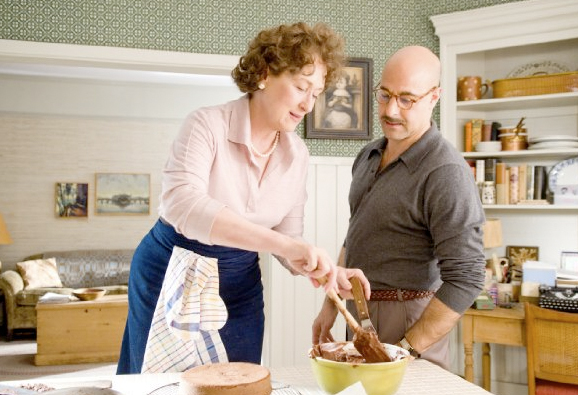
Meryl Streep as Julia Child in Julie & Julia. Photo credit: imdb.com

Tell me about working with Meryl Streep in Julie and Julia. I staged a wedding scene where Stanley Tucci and Meryl were dancing. Meryl she was wearing very high platforms — Julia Child was extremely tall, but Meryl isn’t nearly as tall. So we staged a shot where Meryl was being twirled around in 5-inch platforms, and had to make sure she didn’t fall down.

If you could choreograph any show or program on TV, what would it be? I’d love to do a long commercial showing New York City just using motion.

Technology you’re fascinated by: Avatar’s capture of motion.
Favorite music of the moment: Kid Cudi and anything by Jay-Z.
Favorite dance piece: The dance scene in Stormy Weather with the Nicholas brothers. I could watch it over and over.

What’s the typical salary for a dancer? 92% of the industry is freelance, so even when you have a job, you’re thinking about your next job. In terms of that 8% that is “full time” — that’s still only 40 weeks of the year. On average, a working dancer usually makes $30,000/year, but there’s a range from $25,000 to $100,000/year.

The last time you laughed really hard: I met a friend at the fountain in Lincoln Center [in Manhattan] the other day, and without us realizing, the fountain rose 15 feet and soaked us both. Everyone else had seen it coming, so they moved.

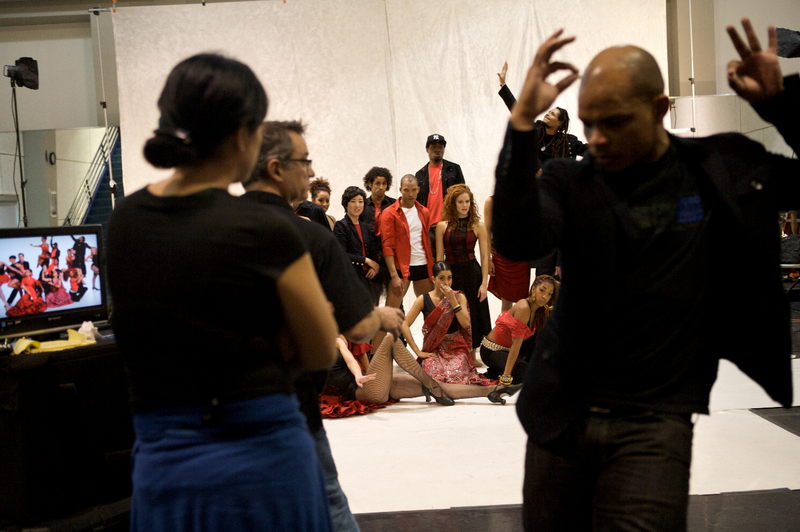
On the Home4Dance set: Russell Ferguson, winner of So You Think You Can Dance (L) and Kevin Hunte, top 20 finalist of So You Think You Can Dance (R).

LAUNCHING YOUR CAREER>>
Warren Adams distills the “move to New York and become a dancer” pipe dream.

1. My director at The Rambert School, Ross McKim, gave me great advice: the first company you dance in, is almost never the company you want to end up in. Have the tenacity to stick with it. Realize that it’s not going to be quite as you’ve planned, but that’s what makes it exciting.

2. Find mentors, stick with them, and learn from them. My mentor was Lynn Taylor-Corbett, who choreographed the very first Footloose with Kevin Bacon. She opened so many doors for me.

3. When you get to New York City, go where the traffic is. Visit the large studios like the Broadway Dance Center and Steps on Broadway. Your information will come from there. The most innovation comes from interacting with others, not by sitting at a desk, so go to studios and just interact – you’ll see job postings or overhear something. Most of my early gigs came from accidents.

Click here to join the Home4Dance membership base. You can follow Warren on Twitter at @WarrenAdams and @Home4Dance. Unless noted otherwise, all photos courtesy of Eduardo Patino.

The Trash Talker: TerraCycle’s VP of Media Relations

"Every day is Earth Day at TerraCycle," Zakes says.

Albe Zakes is constantly surrounded by a shrine to garbage. The desks in his office are made from old doors, the walls from soda bottles, and the front showroom covered in recycled Astroturf. The desk dividers are made from vinyl records, and graffiti covers every wall.

But considering his job, the workplace makes sense: he’s in charge of media relations for TerraCycle Inc., which sells consumer products made from recycled waste. The company launched in 2001, selling worm poop as fertilizer to retailers like Home Depot and Wal-Mart. Now, TerraCycle recycles items like Frito-Lay chip bags, Clif Bar wrappers, and Capri Sun pouches to create tote bags, iPhone cases, and MP3 speakers.

Zakes first planted his environmental roots at the University of Colorado, where he worked for Hip Hop Congress, a group spreading social and political awareness through art, music, and poetry. Below, he talks about eating worm poop, a surefire way to get hired, and the grossest thing he’s ever made from trash.

Title: Global Vice President of Media Relations, TerraCycle, Inc.
Age: 26
Graduated from: University of Colorado Boulder, degree in literature and psychology
Based out of: Trenton, N.J.
TerraCycle’s annual revenue: $18 to 20 million projected for this year
Previous jobs: There aren’t any. I began interning at TerraCycle right out of college.

In your own words, what is TerraCycle? It began as a way to reduce garbage output. We collected waste and fed it to worms, then sold the worm poop to farmers in soda bottles, which gave us market distinction in the early years. Since we couldn’t make money just from the fertilizer, we expanded our product base. We try to challenge the way people think.

The Capri Sun lunchbox is made from Capri Sun wrappers sewn together.

How you got the job: Right after I graduated in 2006, [TerraCycle CEO and founder] Tom Szaky was on the cover of Inc. Magazine. I read about what the company stood for, and it called to me – so I applied for a job, and ended up with an internship that turned full-time.

How did you shape the PR department? Initially, we were required to make 50 pitch phone calls a day. I eventually convinced Tom that we needed to research people and contact them slowly, to develop relationships. I never allowed email blasts. I also make sure we treat everyone the same way, from a mommy blogger in Montana to the executive editor of Businessweek.

How did your activism in college affect your job choice? I felt that the environmental movement and people around me [at University of Colorado] were short-sighted and thought small; the resistance against working with big corporations felt like spinning our wheels in the mud. Then I read Tom’s interview about the “belly of the beast” – if you want to change the way things are done, you need to do it from the inside. You need to work with them, not against them.

What have you learned at your job that nobody else knows? What worm poop tastes like.

And it tastes like? Dirt. It’s high-nutrient, organic-rich dirt.

The walls of the TerraCycle office are covered with graffiti.

Why the location choice of Trenton, N.J. for your headquarters? I have to confess, it is the seventh most dangerous city in the country based on homicide per capita. But Tom, a Princeton dropout, needed to buy cheap factory space, and Trenton offered that. He bought out an abandoned space that was once used for The New York Times printing distribution.

Are you planning on moving anytime soon? We’re absolutely staying here.

What are your hiring requirements? We’re a second-chance employer, which means we’ll hire people regardless of who they were become they came to us – regardless of criminal records. That has definitely backfired; we once had U.S. marshals on our factory floor, and almost-knife fights. But then again, we have people who have been working for us for years.

Biggest setback: Being tossed into a managerial job at a young age with almost no training. Hiring people is so difficult – some people look good on paper and do well in an interview, but then can’t deliver. It’s hard to figure out what’s bullshit.

How did you overcome that? With time. I set up weekly reports and meetings, and became more organized.

TerraCycle’s best-selling product: Historically, we’ve sold the most of worm poop. But another huge win was our line of back-to-school products for Target in 2009, which we sold hundreds of thousands of in one season.

Coolest product: Portable MP3 speakers made from recycled paper and various wrappers. [Sold at Urban Outfitters, Zumiez, Five Below, and elsewhere.]

Grossest thing you’ve ever recycled from trash: We’re working on using cigarette butts, feminine hygiene products, and dirty diapers. So one of my jobs was going around and collecting cigarette butts.

Watch TerraCycle on Oprah, NBC, CNN, and more:

What’s the process of using chip bags and cookie wrappers to create new products? There are two ways. With upcycling, the wrappers maintain their branded look – you can still see the logo. We use heat presses to fuse the wrappers together, put on bolts, and cut and sew the material together like you’d do with regular fabric.

And the other way? It’s closer to regular recycling. The wrappers and containers are shredded and melted down into plastic pellets and can be used for garden paving stones and garbage cans.

How many chip bags are used to make one garbage can? A 32-gallon outdoor trash can with a lid takes 1,500 chip bags.

Inside TerraCycle's offices, where the rugs are made from other rug remnants.

What does your office look like? It’s a shrine to garbage. The desks are made from old doors, the walls from soda bottles, the front showroom covered in recycled Astroturf with a mini putt-putt golf course. The desk dividers are made from vinyl records, and there’s graffiti on every wall – big, beautiful graffiti. The rugs are created from all different rug remnants, which can be a little nauseating.

What’s up next for TerraCycle? We’re moving to Australia and New Zealand, and then to Japan, India, and China next year.

LAUNCHING YOUR CAREER>>
Zakes suggests how to turn a green passion into a sustainable career.
1. Combine a degree in business with environmental studies or biology. Those business skills will always help – you need to be able to sell yourself and sell your company.

2. Instead of walking into a room and telling a potential employer what you could do, show them. Build your idea, and then walk in with a portfolio and present the materials and assets. Say, here’s what I would bring to the table on day one. If someone did that to me, they’d walk out of my office with a job.

3. Be willing to sweep the floors first if you really want to work somewhere.

Follow Terracycle on Twitter at @Terracycle and on its Facebook page. You can also find out more about how the company helps the environment. All photos courtesy of TerraCycle.net.

Check out more eco-friendly posts on No Joe Schmo >> Elizabeth Olsen, founder of Olsenhaus, makes vegan shoes from purely recycled materials.