
Exciting news for No Joe Schmo! Last week, we were featured on the homepage of BlogHer.com as a BlogHer Spotlight. BlogHer is the largest community of women who blog, attracting 25+ million unique visitors per month; its mission is to “bring women bloggers exposure, education, community, and economic empowerment.” Check out the full post here on BlogHer!
The Two-Person Orchestra
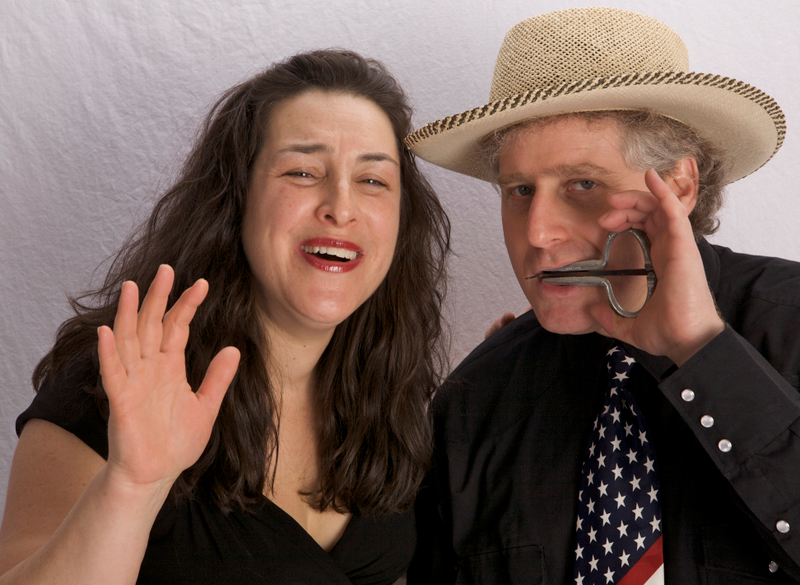
In one life, Lisa Mayer and her husband, Sruli Dresdner, dress in all black and play Jewish folk music at Bar and Bat Mitzvahs and weddings. In another life, they are Hoot ‘n Annie, an American folk music duo donning red, white, and blue bandanas. And in yet another life, they are the proud parents of 2-½-year-old twins and run a Wacky Instrument Workshop and summer day camp called The Clubhouse Camp in Manhattan.
They live each of these lives simultaneously, if not always harmoniously. The couple is constantly surrounded by a cacophony of 17 instruments, ranging from accordion to washtub cello to musical saw. But all their shows have a warm, living-room feel: “When you come to our concerts, you spend time with us, not just our music,” Lisa says. “We like to schmooze, have fun, and laugh with the audience. We’ve always been in the people business.”
Both Lisa and Sruli threw away their full-time jobs – Lisa as a high-powered advertising executive, Sruli as a corporate lawyer – to start a family band and raise twins in New Jersey. The multi-instrumentalists and vocalists have performed across the world, from New York to Portland to Jerusalem. Now, they stay at Holiday Inns instead of five-star hotels – but, to Lisa, they’re “rich in children and music.”
Age: 48
Graduated from: Queens College, degree in English
Full-time musician for: 14 years
Previous jobs: Associate creative director at Ogilvy
Shows per year: About 125
How did you meet Sruli? Through music. I moved into a new neighborhood, and I heard this guy playing clarinet. I told him that I played violin, and he told me to go get it. And there it was – 15 years later, we have a band and a family.
How did your career in music take off? Sruli and I both loved music and decided to start a little Klezmer band, so we started playing for our synagogue in Scarsdale, NY. The next thing we knew, we started getting calls to play at parties, festivals, and concerts, and then we put a children’s album together.

Do you have children of your own? Sruli and I each had two children from our previous marriages. We formed a family band in the last 15 years and play at weddings and Bar and Bat Mitzvahs all over the country – and the world. Recently, we packed up a big van with our kids, all our equipment, and our dogs, and drove to New Orleans for a concert. Sruli and I also have twins – 2 ½ year-olds – who have already indicated they want to play the violin, trumpet, and banjo.
You also play American folk music. Sruli and I have another life where we call ourselves Hoot ‘n Annie and perform at lots of schools. For those shows, we have an Americana theme; I wear a red, white, and blue boa, and we both wear red bandanas.
Do you come from a musical background? My family goes back to being rabbis and cantors for three generations. Sruli has a scholarly background in Jewish music and also comes from a musical family.
What was behind the decision to leave your corporate job to play music? Sruli and I both wanted to play this type of music together, and ultimately, that’s what pushed us over the edge. Once, I was performing on a float during the Israeli Day Parade, and afterward I had to hustle to Los Angeles to shoot a commercial [for Ogilvy]. It was a seminal moment for me. I said, “I can’t do this; I can’t have it all at the same time.”
Your lifestyle must have changed when you made the transition. Musicians without day jobs have to get good, fast – there is no net. Within the first two weeks of leaving my advertising job, I started playing better.
Combined, how many instruments do you and Sruli play? 17.

Weird instrument scale: It ranges from accordion and drums (which Sruli plays simultaneously during the Hora dance), to the ukulele and washtub cello, to the sheepdog whistle and banjo. Then there’s the cookier stuff, like the musical saw, which is like a bow that you hold between your knees. It’s a little spooky-sounding.
Between all your shows and looking after your twins – how do you stay energized? Lindt dark chocolate with sea salt. For Sruli, it’s those little pigs in a blanket they serve at gigs. [Laughs.] But we also both work out – we have to be in shape for our jobs. And we’re naturally energetic people.
Best advice about working with your husband: You need to put things in boxes and separate work time, romantic time, and family time.
Weirdest thing you’ve seen during a performance: At a very elaborate Bar Mitzvah in Long Island, the kid rode in on a camel while Sruli blew the shofar and I played violin. Then he jumped off the camel into a pool.
Most meaningful compliment: When the family of the Bat Mitzvah says that you’ve made this the best day of their lives. Or after a concert, when someone says that you’ve brought them back to their childhood at their grandma’s house. We frequently get invited out after shows because we schmooze and connect with the audience.
When you’re not working: I lead and teach lots of Jewish dancing.
On your bucket list: Sruli and I want to start a Wacky Instrument Festival in New York. It’s also Sruli’s dream to rent a Winnebago and tour the country with the Hoot ‘n Annie Family Band.
Watch a family jam session:
LAUNCHING YOUR CAREER>>
Lisa Mayer sounds off about choosing music as a career path.
1. As an artist, constantly watch other performers – attend the opera and go to concerts. But keep your day job; you have to be crazy to do this full-time.
2. Pep yourself up and believe that what you’re doing is important and worthy. To do that, you have to be a little self-stroking. Nobody else is going to do that for you.
3. Don’t choose this career unless it’s the only thing you want to do – or that you can do. It’s a tough job, and you don’t always make it. You must be prepared for a different lifestyle, one where material things aren’t as important. That said, if you’re going to do this, jump in and don’t look back. There’s nothing more thrilling than performing for an audience.
Sing and dance along with Sruli and Lisa at sruliandlisa.com or hootnannie.us. All photos courtesy of Sruli Dresdner.
PLUS: For more musical No Joe Schmos, check out the die-hard dancer who keeps Meryl Streep on her toes and the opera singer who compares singing to a hot fudge sundae.
No Joe Schmo’s Monthly Roundup
If you wanted to be woken up when September ends, well, that time is coming soon. And that means it’s time for another roundup: a brief look at the most-shared and most popular posts this month. Which was your favorite? Who would you like to see a Q&A with in the future?
> Great Balls of Fire: The Glass Blower // Rene Steinke, Teacher at Rainbow Glass in Sacramento, Calif.
> 7 LinkedIn Tips for Recent Grads
> The Alligator Wrestler // Tim Williams, Dean of Gator Wrestling at Gatorland in Orlando, Fla.
> King of the Jungle // Kevin Bell, CEO and President of Lincoln Park Zoo in Chicago, Ill.
PLUS: Don’t forget to “like” the No Joe Schmo Facebook page for exclusive videos, photos, and scoops on upcoming features!
The Traveling Puppeteer

Eleven years ago, Erik Torbeck locked himself into his apartment in upstate New York to sew hundreds of sheep puppets. He and his brother, Brian, decided to put on puppet shows like The Three Little Pigs – but using sheep instead, since they were an easier pattern. The brothers called it “Operation Make a Million Dollars by Christmas.”
While their plans didn’t exactly pan out, that summer was the beginning of their careers in puppetry. Now, Erik, the eldest of three, belongs to a puppeteering troupe comprised of himself, Brian, and his sister Robin – more commonly known as the Frogtown Mountain Puppeteers.
The trio travels around New England in a large van – with hand-stitched polar fleece pirates, birds, and headless horsemen in tow – and performs hundreds of shows each year at schools, libraries, and churches.
Age: 40
Graduated from: College of the Atlantic, degree in human ecology with a focus on video production
Frogtown Mountain Puppeteers has existed for: 11 years
Based in: Bar Harbor, Maine
Previous jobs: Gave tours around Bar Harbor on a “lobster bike”; held various nightly janitorial jobs

What sparked your interest in puppetry? In college, I took an elective on puppetry because it sounded fun and easy. That got me started – I did a few video projects with puppets as the main characters. Then, when my brother graduated, we started putting on shows together at the Renaissance Fair and other festivals.
Did you create the puppets yourselves? Yes, because I had learned how to sew. We locked ourselves in our apartment in upstate New York and made hundreds of sheep puppets.
Your sister is now also part of your troupe. When my brother took off for the Peace Corps, it just so happened that my sister was available, so I pulled her into doing puppeteering with me. [Editor’s note: Brian Torbeck rejoined the group upon returning from the Peace Corps.]
Are you the oldest? Yes.
So I guess that means they had to do as you said. [Laughs.] We were all interested in the arts even though we didn’t have a background in the arts – so puppeteering was perfect. We hacked our way through it, and were eventually able to quit our janitorial night jobs and do puppet shows full-time.
Where do you draw inspiration for your shows? I grew up with The Muppet Show and Sesame Street, so my main inspiration is Jim Henson and the Muppets. I created many of my puppets by piecing them together from stuff I tore apart, including my brother’s Kermit. He never let me forget that.
Your repertoire includes four regular shows, correct? Yes. We have “Everybody Loves Pirates,” “The Legend of the Banana Kid,” “The Headless Horseman,” and “Tales From the Nest.”

Which is most popular? Probably “Everybody Loves Pirates.” Pirates have had a real resurgence lately.
You mentioned ripping apart other puppets to create yours. Can you elaborate on the process? We originally mainly used felt, but now we’re using polar fleece to trace out big patterns. A stick supports the weight of the body, and extended rods are attached to the neck with a rubber band. Two sticks pull a rope to open the puppet’s mouth so that we don’t have to reach up and open it with our hands.
Do you kneel behind a stage? The stage we most commonly use is 20 feet across and 6 feet high, which is just above our heads. So we stand with our hands above our heads. We enjoy working on our feet – the knees are just too uncomfortable.
Don’t your arms get tired? If you can put your hands down for just a few seconds, you can usually get a few more minutes out of them. [My arms] get most tired when we’re rehearsing.
Do you play the same characters in each show? We actually switch characters during shows. My sister is shorter [than my brother and me], so we gave her Frankenstein shoes to add another three inches in height. If I’m switching characters with her, the character can’t all of a sudden be three inches shorter!
Typically performs at: Schools and libraries in the New England area. We’ve spread out in the last four years: we’ve been to Canada, as far south as Key West, Fla., and as far west as Arizona. We also perform at the National Puppetry Festival every two years, and have done three or four colleges.
Where did the troupe’s name originate? We grew up on a mountain in south-central Pennsylvania called Frogtown Mountain. We didn’t know that growing up, but our friend had a crazy old grandpa who pulled out a map one day and showed us.
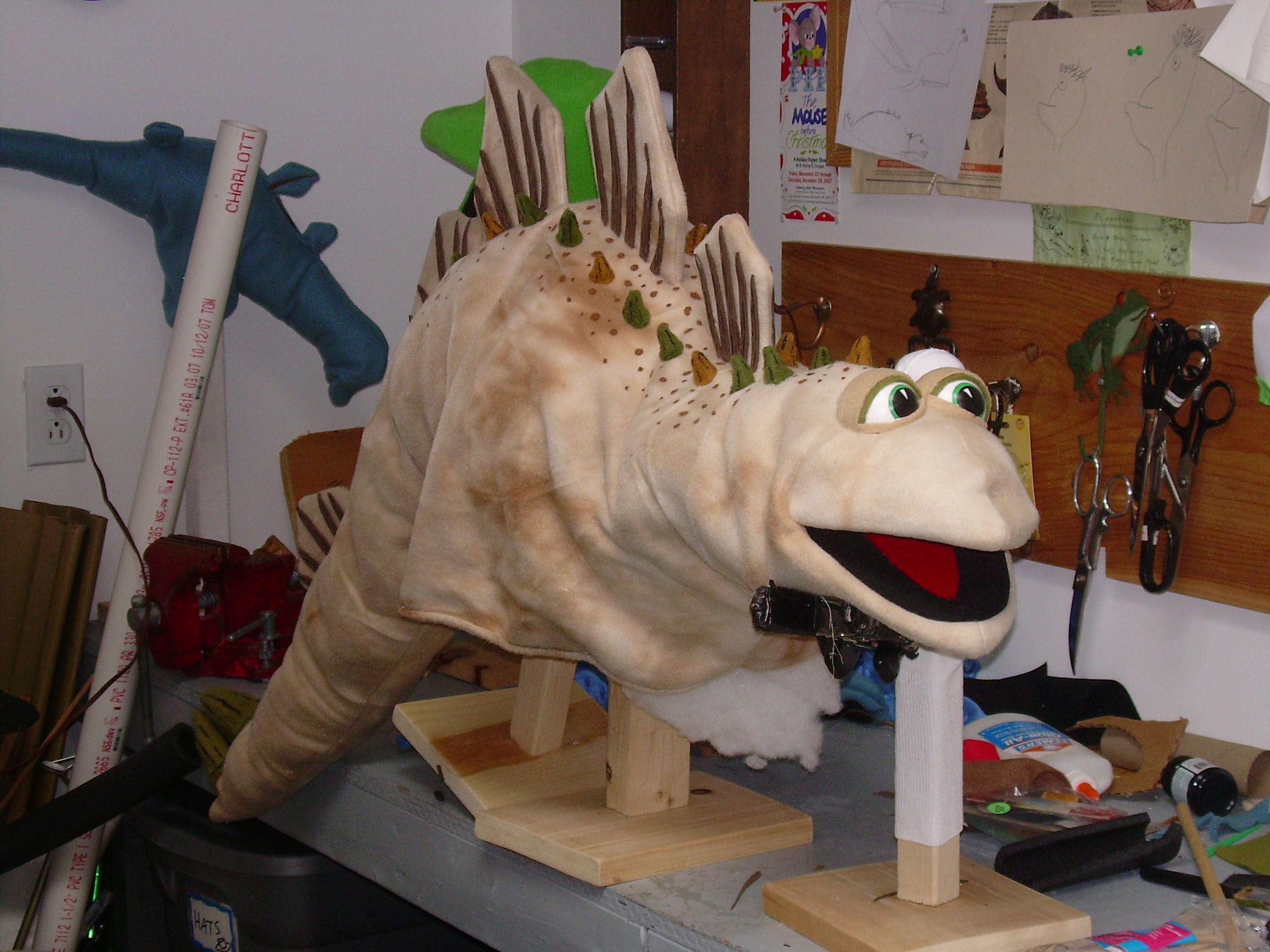
Are you working on anything new right now? We’ve been working on a new dinosaur show for about three or four years, piecing it together in our time between other shows. We have about 10 dinosaurs built so far, and it’s a musical. We hope to be done by the end of the year.
Cost per show: If hired to perform at a school or library, we charge $500 per show plus travel costs. We try to keep local shows in Maine affordable, though, at $4 per ticket. Our rate is flexible so we’re not denying people puppet shows.
Wildest audience: In our early days performing at the Renaissance Fair, we did a show in a petting zoo, which was really distracting. The animals were loud and kids were picking up rocks and throwing them, so there were rocks flying backstage.
Most embarrassing moment during a show: I had accidentally bumped my sister’s headset so it covered her eyes. During the show, her microphone slid over her head, and she was reaching out with her tongue, trying to pull it back in. I had trouble getting back in the groove after laughing so hard.
If you could have any superpower in the world, it would be: The ability to control squirrel’s minds. I feel like that could come in handy.
Watch Frogtown Mountain Puppeteers’ Sausage Boy/Susan Boyle parody:
LAUNCHING YOUR CAREER>>
1. Jump right in and put on a show. You can talk about doing something forever, but until you actually do it, you won’t gain momentum.
2. Attend national festivals and look into the Puppeteers of America. It’s a great resource with so many people willing to help, like writing consultants and puppet-making consultants.
3. Go out and see as many puppet shows as you can. You’ll see what’s working and know how it’s being perceived by the audience.
Unless otherwise stated, all photos courtesy of Frogtown Mountain Puppeteers/Robin Erlandsen. Check out more of their work on their YouTube channel.
PLUS: Check out other traveling No Joe Schmos, like a monster truck driver, an Oscar Mayer hotdogger, and a traveling motivational speaker!
Why Odd Jobs Are So Important

If nothing else, No Joe Schmo has proven that people find their jobs in the most unexpected places. A cop injured in line of duty was forced to medically retire from police work, so she turned her passion for animals into a nonprofit organization. A successful lawyer tinkered with LEGOs after work as a creative outlet, and eventually left Wall Street to play with bricks full-time. A divorced, burnt-out corporate slicker sang karaoke only to make some extra cash until a DJ told him he’d make a great Elvis impersonator.
Many seemingly odd, entrepreneurial ventures can be great launching pads to personally rewarding careers. I recently came across a book that promotes the same message: 101 Weird Ways to Make Money by Steve Gillman. Gillman points out that “‘normal’ ways to make money suddenly have less competition — and more income potential — once you come at them from a new angle or find a new niche.” He admits that not every niche is a good one; some are bound to leave you financially strapped. Nevertheless, your experience, willingness to take risks, and understanding of what it takes to own a business will give a leg up (well, three legs up, I guess…) in a fiercely competitive market. Plus, most niche-specific jobs are easier to start, as they have more relaxed requirements.
After reading 101 Ways, I realized why unusual jobs and No Joe Schmos are truly so important — besides, of course, being fun to read about. Gillman offers three distinct reasons, which I’ve paraphrased:
1. It’s more fun to make money doing something cool and innovative than sitting at a desk or in an assembly line day after day, week after week, year after year.
2. These “odd jobs” have much less competition, so they provide opportunities to get rich by offering services that nobody else does. Perfect example: The guys that clean eight-story IMAX screens recognized a gap in the screen-cleaning market; now, they receive business internationally.
3. You might find something that you never considered before as a viable career, but it makes you want to get up and go to work every morning.
After more than three months of interviewing No Joe Schmos and hearing their ups, downs, and aha! moments (here’s looking at you, Oprah), I know one thing for certain: I’ll never settle for a career that I don’t love.
 No Joe Schmo