
The Fountain Pen Doctor

Richard Binder admits to having poor handwriting, but he’s working to develop a “legible but still characterful sloped script.”

After bailing out of the computer industry, Binder became a full-time fountain pen doctor, meaning he repairs and restores fountain pens. His small family business charges anywhere from $20 to well into three figures for pen restoration – more often than not, ones of high sentimental value. The pens come from everywhere: New Zealand, South Africa, Japan. Work on a single pen may take anywhere from ten minutes to several hours. Once restored, its nib – the point through which the ink flows  – should glide over paper like an ice skate. (The same cannot be said of ballpoint pens, he aptly notes.)

“I’m not changing the world in any big way, but I am making a better world one pen at a time, and that’s a good thing to do,” Binder says. “People send me their toys and pay me to play with them. It doesn’t get any better than that.”

Age: 65
Based out of: Nashua, New Hampshire
Has repaired pens for: About 15 years
Previous jobs: Mechanical drafting and tool design; technical illustration; computer engineering

Do you employ a staff? My wife, Barbara, manages the business while I work on pens. We have one assistant and one shipping person who are each here two days per week.

What do you do at work all day? I personally test and adjust every pen or nib we sell. When I’m not preparing pens we’ve sold for shipment, I’m repairing and restoring pens, or answering customer emails.

What’s a nib? The front part of a fountain pen that actually does the writing. It’s usually made of gold or steel.

Do you work a typical 9-to-5 five-day workweek? Yes, with a half hour for lunch.

Briefly describe the pen restoration process to a newbie. It varies from pen to pen, but the general run involves disassembly, cleaning, restoring the filling system, reassembly, adjustment to write well, and a little polishing. Most pen collectors prefer that their pens be in as close to new condition as possible.

How many pens do you restore on a regular basis? We have served several thousand people in more than 60 countries. We do a lot of business with Australia and New Zealand.

Price per pen restoration: It depends, but standard restoration is $35. Repairing major damage can sometimes reach three figures.

That seems more expensive than just buying a new pen. True, but sentimental value drives many of our sales. A grandfather’s cherished pen doesn’t have a dollar sign in front of it.

Is your office teeming with pens? My “office,” which we refer to as the pen studio, is in a converted bedroom. My pen collection is confined to a 12-drawer metal map chest in the pen studio.

Watch:

How many pens are in your collection? About 400, since I started my collection in 1998, but I haven’t counted for some years.

Best part of the job: After I’ve sent a particularly challenging family heirloom pen home, I sometimes receive a heartfelt thank-you note, which I love. Pens are truly avenues to people.

Most challenging part of the job: Getting up in the morning. (Laughs.) Working in my home makes getting out of bed necessary, but still not fun. In terms of pens, one of the greatest challenges is coming up with a way to repair a type that I’ve never seen before.

Why fountain pens? My son-in-law discovered eBay and dragged me in. (Laughs.) Pens are a marvelous part of history and technology. It’s the most personal accessory you can own; it’s a means to express yourself in a purely unique way. When you write with a fountain pen, it assumes the characteristics that your hand puts into it.

The Parker 51 fountain pen, which was developed in 1939, is considered by most collectors to be the finest pen ever made.

If you could bring one pen with you on a desert island, which would it be? The Parker “51” (see left).

What do you attribute your success to? At least partially due to the fact that I embarked on this business later in life. Both my wife and I were better prepared for it than many owners of other startups are.

Where do you see yourself in 10 years? Our business is growing rapidly, so we’re going to be closing down the restoration side and concentrating exclusively on sales and customizing purchased pens. I’m also looking into offering summer camps and master classes in pen repair and restoration.

So iPads and mobile devices aren’t putting pens out of business? I think iPads tend to isolate us from others. One way to get back in touch with one another is through writing. As far as I can tell, the number of fountain pen users is climbing.

Do you own an iPad or tablet? I have a laptop, which I use because of time constraints. But I write notes all the time by hand.

LAUNCHING YOUR CAREER>>
Learn to repair insignificant pens before taking it on as a career. If you jump into it and you’re not very good, you’ll ruin thousand-dollar pens.  You must be very passionate about pens and be willing to work at it part-time, as most pen repair-people are paid very poorly. I repaired pens part-time for three or four years before taking a buyout and going full-time.

For more on Richard Binder’s pen restoration, visit RichardsPens.com. For more pen-wielding No Joe Schmos, check out the CollegeHumor.com editor.
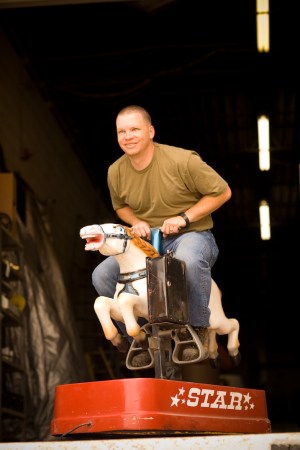
The Kiddie Ride Refurbisher

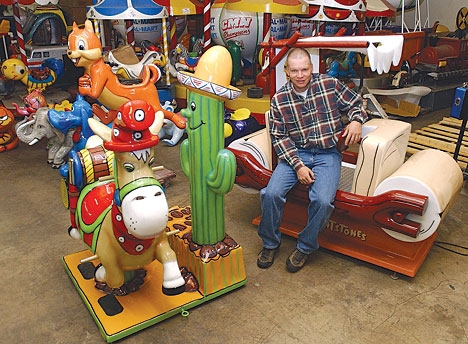
“If it was on Noah’s ark, it was made into a kiddie ride,” says Damon Carson, who refashions old carousel horses, race cars, and other rides.

At any given time, Damon Carson owns 10 quarter horses, some of which are missing a leg or two. And he doesn’t mean the Quarter Horse, a breed that excels at sprinting short distances. He means the shiny-coin-worth-25-cents horse.

Kiddie Rides USA, a 34-year-old office based in Denver, Colorado, is the last stand-alone kiddie ride company left in America. While the niche market has struggled to withstand the recession, it still sells 50 to 100 refurbished rides per year for thousands of dollars to a diverse customer base, from doctor’s offices to nostalgic grandparents.

Carson took over the company seven years ago — “I’ve always liked nostalgic things,” he says — and often relaxes after a hard day’s work by slipping some quarters into an old horse ride.

Age: 40
Graduated from: Oklahoma Baptist University
Based in:
Denver, Colo.
Bought the company in:
2004
Previous jobs: Owned a waste management company

What do you do at work all day? I deal with customers and sales – ordering parts for the rides and buying rides. We receive at least two calls a week from people who have rides for sale; I’ve developed an eye for what’s worth buying.

How do you decide which rides to buy? You’re asking me to reveal trade secrets. [Laughs.] It’s about keeping a variety. You don’t want all race cars, or all horses. In the beginning, I just bought the least expensive rides – but pricing is second to buying the right kind of rides.

Describe the refurbishing process. It’s much like restoring a car, but with fiberglass. We rewire the electronics and the painter does bodywork – like, if a carousel horse is missing a leg. Then it’s painted and sanded.

Carson goes face-to-face with a carousel horse.

Are rides ever beyond the point of repair? There’s nothing beyond repair – just maybe beyond economically viable repair.

Is your office filled with kiddie rides? According to my wife, it’s “garage sale eclectic.” People love my office. I have a stuffed parrot, a fiberglass ice cream cone, globes and airplanes hanging from the ceiling. I have a few fiberglass pieces for people to sit on, and there is one elephant and one carousel horse in the office building.

Most memorable customer: A few years ago, a guy wanted to restore a dolphin kiddie ride for his wife’s birthday – but they didn’t even have kids or grandkids. They were a couple with too much money. I also restored a miniature Corvette ride for a guy in Long Island to go along with his real-sized Corvette.

Target audience: There’s not just one. Pediatric doctors make up a certain percentage of our customers, since they buy rides for their lobbies. We also serve restaurants, museums, and the parent/grandparent base. Last spring, we did a carousel for Dr. Phil’s granddaughter, and earlier this year, we did one for the new Walmart headquarters in Arkansas.

Do you have kids? Two sons, ages 11 and 12, and a daughter, age 13.

I’m assuming they think you have the coolest job ever. They thought it was a lot more interesting when they were younger. The cool wears off.

Watch:

How do you unwind after a long day of work? I drop a couple of quarters and ride a kiddie ride.

Which rides are you partial to? The old horse ones. At any given time, I own about 10 quarter horses. Pun intended.

How is that a pun? A Quarter Horse is also a breed of horse – but I mean it as 25-cent horses. I like to tell people I spend time with my quarter horses after work.

Clearly, I’m not a horse person. That’s okay.

Do you vacation to theme parks? No, but I travel pretty extensively, nationally and internationally. Whenever I see a kiddie ride on vacation, I jump on and my wife takes a picture of me. I have photos on kiddie rides in Jerusalem, Israel.

Best part of your job: Dealing with customers who buy rides for really fun and interesting reasons. Like the Corvette guy I mentioned (see above).

Most challenging part of your job: Trying to profit at the end of the month or year. With the recession, the amount of business has gone down; we refurbish around 50 to 100 rides per year.

Amount of time it takes to refurbish a ride: Usually four to six weeks after an order is placed.

On average, how much do you charge customers to restore a ride? Around $3,000.

“If you ask people to name three kiddie rides, they’ll usually say a horse, carousel, and fire truck,” Carson says. “But there are thousands of rides.”

Something people would be surprised to learn about the profession: How many shapes and sizes kiddie rides come in. There are hundreds, or even thousands – Ferraris, Porsches, Corvettes, submarines, motorcycles, and every animal you can think of, like ducks, alligators, elephants, cows, and chipmunks. Basically, if it was on Noah’s ark, it was made into a kiddie ride.

LAUNCHING YOUR CAREER>>
There’s nothing that keeps more people from becoming entrepreneurs than debt. If you have a fancy lifestyle with big payments looming over you, you won’t be able to quit your day job and take business risks. Instead, save money and live below your means. I spent my first year out of college working seven days a week on the ski slopes at Vail to pay off my student loans.

PLUS: For more ride-loving No Joe Schmos, check out the female bull rider, the hot air balloon pilot, and the roller coaster engineer. And another No Joe Schmo who gives new life to old parts: the artificial limb maker.


Update: Damon Carson’s new company, Repurposed Materials,  focuses on reusing products that don’t need extra manufacturing or processing. The site sells refashioned industrial materials from synthetic turf (priced from $1) to wine barrels (priced from $100) to tire treads (priced from $350).


CEO Files: The CouchSurfer

"CouchSurfing attracts anyone who is interested in having authentic connections," CouchSurfing CEO Dan Hoffer says.

Couches can speak volumes about one’s style and personality. A leather reclining sofa may suggest luxury and low-maintenance, while a brightly colored sectional may suggest versatility.

In his time, Dan Hoffer has come to know hundreds of people through their couches. Eight years ago, he co-founded CouchSurfing.com, an online network that connects travelers across the globe, allowing them to “bypass the typical hotel experience by staying at the home of a local and learning about their culture.” Once threatened by a database crash that nearly shut down the site for good, CouchSurfing now boasts millions of members in over 230 countries and territories around the world.

Age: 34
Graduated from: Undergraduate studies at Harvard University; MBA from Columbia University
Based in: San Francisco, Calif.
Has held the position for: Co-founded CouchSurfing eight years ago and served as chairman of the board; starting working full-time as its CEO almost two years ago
Previous jobs: Entrepreneur in residence at a venture capital firm; executive at Semantic Technologies, a large software company

What do you do at work all day? As the CEO, I spend most of my days in meetings. I meet with everyone in the company at least once a month, and get involved in certain projects involving project strategy, communication strategy, and fundraising. CEOs need to be generalists.

Inside the CouchSurfing headquarters in San Francisco.

Something people would be surprised to learn about your job: In a leadership position, everyone watches what you do very carefully. I’ve seen people make judgments about visitors to the office based on how warmly I greeted the person.

How often do you CouchSurf? A few times a year. I’ve been to Japan, Korea, Sweden, France, Senegal, Mexico, Puerto Rico…the list goes on.

Is your own couch available to CouchSurfers? Yes, I do hosts on occasion.

Dangers of the process: Cultural misunderstanding is the biggest one, where you don’t get along on a social level with the person you meet. There’s no vetting beforehand to match people socially, but you can look at profiles and photos to get a good sense of people.

Without vetting, how do CouchSurfers know they’re staying in a safe place? It’s like online dating. You can go meet a stranger that you met on the Internet, and you don’t know if they’re going to be a nice person or an axe murderer. With CouchSurfing, you look at profiles and references left by others. We have a vouching system and an identity verification system.

Coolest part of the process: The people and the sense of community. CouchSurfing enables you to find people to meet and activities to join.

Hoffer hosts a presentation at the company's headquarters.

Biggest setback: In 2006, we had a big database crash that threatened to destroy CouchSurfing. We were planning to shut it down, but the community rallied. Thousands of volunteers wrote to us, offering to help restore the website. With their help, we did.

Best part of your job: Supporting our community of millions of members so they can experience life-changing moments. I asked one 26-year-old German CouchSurfer about her best CouchSurfing experience, and she talked about climbing a 150-foot crane in London. She had been staying with someone whose hobby was climbing skyscrapers.

Most challenging part of your job: Balancing conflicting agendas. [The CouchSurfing community] doesn’t want to pay anything, but at the same time, they want an amazing website. To build an amazing website, you need to hire amazing people who cost money.

Target audience: We tend to have more participants in their 20s and 30s, but we also have people in their 70s.

Minimum age to sign up for CouchSurfing: 18.

Best advice for recent graduates: Learning how to think in any particular discipline is invaluable. While at Harvard, I took a semester off to work on a ranch in Texas for a former Marine Corps sergeant. I learned a lot about leadership by hauling hay and building fences for him.

Okay, so it's not quite a couch...

Like what? At the time, I never guessed there would be any professional career applications. But in reality, there have been quite a few, like how to lead effectively, how to listen, and how to deal with different skill levels.

Most memorable traveling experience: I trekked through the jungle in Borneo and hiked through the Virgin Rainforest.

Your indispensable gadget while traveling: Chromebooks.

What’s always in your backpack? A water bottle and flashlight.

If you had all the money and resources in the world, what business would you start? I would focus on African refugee relief.

LAUNCHING YOUR CAREER>>
Focus on learning from the people you respect the most – not necessarily in fields that seem professionally oriented. Pursue a career where you can excel.

Follow CouchSurfing on Twitter at @CouchSurfing. Photo, top: Meredith Hoffer. Rest of photos: Jim Stone, CouchSurfing.com.

PLUS: For more high-powered No Joe Schmos, check out the CEO of Chicago’s Lincoln Park Zoo and the founder/CEO of Home4Dance

The Oyster Farmer

Buddy McClure, on the left – sans rubber gloves and heavy duty rain gear.

The world is this man’s oyster. Literally.

Buddy McClure, 44, harvests about 3,000 oysters daily during summers at Umpqua Aquaculture, a quiet fishing village on the coast of Oregon.

The slimy, briny job is something of a love/hate relationship for McClure. “I’ve been that guy in the office, and I’d rather be doing this,” he says, referring to jobs at various pharmaceutical corporations before moving to Oregon ten years ago. Now, he can’t imagine doing anything else. “I always loved the coast…I wish I would have [become an oyster farmer] a long time ago.”

Umpqua Aquaculture, which has been around for 25 years, is located in the Umpqua Triangle, where the Umpqua River meets the Pacific Ocean. Its oysters are suspended on long lines so they never touch the ocean floor.

During the off-season, in the fall and winter, McClure hunts, fishes, crabs, and spends time with his three sons, the eldest of whom has worked at the farm for the past three summers. But none of his sons eat oysters for dinner when McClure brings home some of the thousands he harvests each day. “My boys don’t like them, so I just bring home a pint for my wife and me,” he says matter-of-factly.

Below, McClure describes the perfect oyster (firm, not gritty, with an oblong bottom), his favorite way to eat ‘em, and the harvesting process.

The Umpqua Aquaculture storefront in Oregon. Photo: Wendy B./Yelp.com

Age: 44
Graduated from: Cordova Senior High School. I didn’t go to college.
Based in: Winchester Bay, Oregon
Number of oysters harvested per day: About 3,000 during the summer
In the industry for: 3 years, on and off
Previous jobs: Operations manager for a medical distribution company

How you made the transition to oyster farming: I’ve always been intrigued by the Pacific Northwest – specifically, with fishing and hunting. Ten years ago, after going through a divorce, I decided to move there, and was offered a shot to learn how to shuck and harvest oysters.

What do you do at work all day? During our peak season, from the end of May until the end of September, I orchestrate where and when to harvest the oysters, and how many. [At Umpqua Aquaculture], our oysters are situated in the Umpqua Triangle, suspended using buoys. The oysters are cleaner since they’re not sitting in silt and sand.

Oysters growing on a rope in the Umpqua Triangle. Photo credit: Macduff Everton/CorbisImages.com

Explain harvesting to someone who has never eaten an oyster before. We drive out a tractor – a new orange Kubota L4400 – and take them off a long rope. We bring back the oysters to our processing plant, where we place them into a huge cooler with a forklift and separate them by size.

Your routine during the off-season: Replenishing what we harvested over the summer. We save the shells with oyster larvae – the larvae are about the size of eraser heads – and hang them on the cleared lines.

Most important lesson learned: You need to be flexible in this industry. The weather affects what you can and can’t do. Sometimes, while working in a storm, I’ll be cold and wet – and stop to think, why am I doing this? But it’s a love/hate thing. I’ve been that guy in the office, and I’d rather be doing this.

What does the perfect oyster taste like? It shouldn’t be gritty – that means it’s been down in the muck and sand. It should taste like fresh ocean water, and the texture will be firm.

Can you tell by looks alone? The bottom should be an oblong shape. I wear orange rubber gloves all the time, since you can’t handle oysters barehanded. They’re very sharp.

What does your oyster farming outfit include, besides the orange gloves? Extra-tough Arctic insulated boots, bibs, and rain gear, including a rain hat and raincoat.

Best part of your job: I have the same tasks, but every day is a little different. I love being out on the water. It’s not really a thrill; you get the sense that you’re out in an environment that’s completely wild, but I’m not scared out there.

Most challenging part of your job: [Umpqua Aquaculture] is a small retail store, so it’s tough to balance everything. I also bring in shrimp, crab, and fresh fish when they’re available.

How often do you eat oysters? About once per week.

Raw oysters on the half shell. Photo: sweetpaprika.wordpress.com

Favorite way to eat an oyster: Fried in Panko (Japanese breadcrumbs) with cocktail sauce and horseradish. I also love shooters – opened raw oysters – with a little hot sauce.

If you could eat one food for the rest of your life: It wouldn’t be oysters. Probably a T-bone steak.

Other hobbies: Hunting, fishing, crabbing, spending time in the woods.

Any non-outdoor activities? I also bowl.

Where do you see yourself in 5 to 10 years? Right here.

LAUNCHING YOUR CAREER>>
Diversify your skill level. Before getting hired at Umpqua, I learned to operate equipment like a forklift, tractor, and boat; to fix things mechanically; and to tie different knots. All of those skills apply to my job now. But one necessary skill you need to be a plain oyster farmer is running an air chisel.

PLUS: For more outdoorsy (but slightly more intense) No Joe Schmos, check out the alligator wrestler and the urban honey beekepeer.

The Guy Who Makes Rocket Ships and Donna Karan Jewelry

Mike Dillon was always industrious: as a boy, he painted store windows around the holidays to earn extra money.

It’s a bird! It’s a plane! Well, sort of – it’s a paper plane. At 26 feet long, it’s the largest paper plane in the world – and it hovers over the entrance to Dillon Works in Mukilteo, Wash.

According to its website, Dillon Works is a design and fabrication facility that “produces dramatic environments.” Clients across the globe – from Hong Kong, Estonia, and Moscow to Tokyo, Korea, and Portugal – come to founder and President Mike Dillon seeking sculptures, models, fixtures, accessories, and displays for theme parks, hotels and casinos, television commercials, and malls.

Dillon founded the company some 25 years ago after working as an Imagineer at Walt Disney Imagineering. Its mission statement is vague for a reason: the company’s project base is inextricably broad, ranging from floats for the Macy’s Thanksgiving Day Parade to giant snow globes to jewelry for Donna Karan. But it is precisely this diversity that helps Dillon Works survive economic downturns.

Age: 50
Graduated from: Ellensburg High School in Central Washington. I didn’t go to college; instead, I started working at Disney at age 19, which I consider my schooling.
Based in: Mukilteo, Wash.
Previous jobs: Worked on mechanical characters in holiday windows for Spaeth Designs; production assistant at Nordstrom; freelance producer in Los Angeles; Imagineer at Walt Disney Imagineering.

Dillon Works is the home of the world’s largest paper airplane. Wingspan, 26 feet; weight, over one ton.

What do you do at work all day? We work on a diverse range of custom design and fabrication because we bore easily. We’ve worked on 13-foot cupcakes for Dylan’s Candy Bar and a huge PlayStation Portable for the Sony PlayStation tradeshow exhibit for E3 (Electronic Entertainment Exhibition) in Los Angeles, which needed a forklift to lift it. At any given time, we’re doing about 10 to 12 projects.

How did you come to land a job at Disney when you were only 19? While living in Los Angeles, I worked on sets and props for commercials and movies. Everyone told me that my style was very Disney, so I finally met someone – who knew someone who knew someone – who worked at Disney. I got an interview at The Walt Disney Studios, and the guy I met there connected me with someone in Imagineering.

Then you created your own company, Dillon Works. Working at Disney was a great way to get paid, and I was taught by the best, but it was pretty corporate. The people above me didn’t seem very happy, and lots of people were getting laid off. I decided to leave before I could be laid off, too.

Where did you start Dillon Works? In my mother-in-law’s basement in Seattle. I then moved it to a large garage and hired a few people to make mascot costumes. From there, we moved to a small rental space to three separate buildings to where we are today: our own 30,000 square-foot building on a large piece of property.

Number of employees: 28.

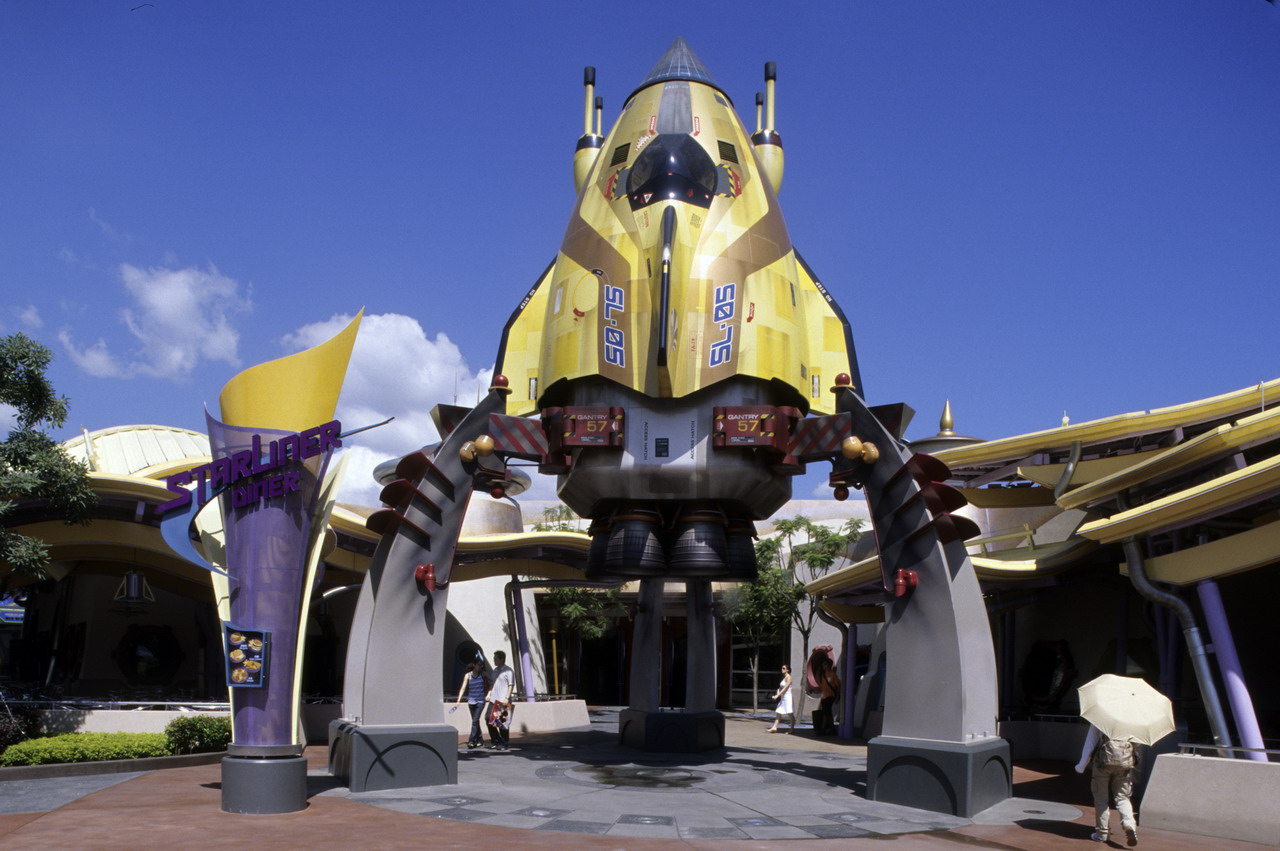
The rocket ship that Dillon Works built for Hong Kong Disneyland.

Project that received the most recognition: Our Star Wars theater was written about worldwide, because I think it really strikes a chord with people. Making floats for the Macy’s Thanksgiving Day Parade was also a pretty big deal, as was creating a 35-foot tall rocket ship for Hong Kong Disneyland that weighed 11 tons.

Biggest mistake, and how you learned from it: About 24 years ago, I built a submarine sandwich balloon for a sandwich store. It was too heavy, and I was worried whenever the wind picked up. Ultimately, I gave the store its money back because I didn’t know how to fix the problem. I should have known to tell them in the beginning that the project wasn’t going to work for their budget.

How do you drum up business? In a large part, through word of mouth or repeat business. If architect we’ve worked with then moves to another firm, they might call us to do work for that new
firm.

Best part of the job: Creativity and exceeding a client’s expectations.

Most challenging part of the job: Since I don’t have a partner, I’m the creative guy and the business guy. It’s good because I have nobody to answer to, but that also means I have no one else’s shoulder to cry on.

A large pterodactyl with a 32-foot wingspan looms over the front desk at Dillon Works.

Something people don’t know about you: I bought my first car at age 14, before I was even old enough to drive it. Oh, and in Los Angeles, I worked on Galaxy of Terror with James Cameron, before he was James Cameron – he went by Jim.

Growing up, you loved: A lot of geeky stuff, like magic and puppets. My mother sewed coat linings at home for extra money when I was growing up, so I learned to sew, too. That’s part of the reason we sewed mascot costumes in the early days of Dillon Works.

Did your kids grow up with a plethora of cool toys? My two boys grew up surrounded by toys, so they got to try out all kinds of things. But they never had video games, even though Dillon Works did lots of projects related to video games.

Pricing per project: They run from a few thousand to a few million, easily. But remember, some projects involve an entire casino hotel complex, like the Trump Hotels and Casino Resorts.

Other hobbies: About two years ago, I started a second company called Alchemy Bluff Studios, which makes functional art furniture. It helps keep our employees busy during slow times.

Which it sounds like you just have tons of. [Laughs.]

Another Dillon Works project: a hallway of arches that leads to the Trump Casino Boat in Gary, Indiana. The column capitals are vacuum-formed plastic, finished in an applied gold leaf.

LAUNCHING YOUR CAREER>>
Mike Dillon shares three never-fail life lessons.

1. Keep your word; if you say you’re going to do something, do it.

2. Be creative with where you look for work; don’t pigeonhole yourself. Dillon Works makes it in this economy because we work on almost anything, from churches, hotels, and casinos to Donna Karan jewelry.

3. My mother taught me there are three sides to every story. Each person has his or her view, then there’s the truth.

Explore Dillon Works’ portfolio here. All photos courtesy of Dillon Works.