The SNL Cue Cards Guy

“When you’ve been holding up 22″ x 40″ cards for 22 years, you develop muscles,” says Wally Feresten. “But with that muscle comes ache.” Photo: steph-was-here.tumblr.com

Wally Feresten rolls over in bed around noon on Sunday, struggling to open his eyes. He’s had a long night; he didn’t get home until 5 a.m., and his entire upper body aches. He’ll have the next few days to recuperate, but on Thursday, it’s back to Studio 8H at 30 Rockefeller Plaza, where he’s responsible for making sure all the actors and celebrities know exactly what to say come 11:30 p.m. EST on Saturday night.

Feresten started working as a cue cards guy on NBC’s Saturday Night Live more than 20 years ago, when he was almost fired for sloppy handwriting. But now he runs the show with precision and a sense of calm that is unusual for a job that requires rewriting cue cards for sketches just minutes before they air. Over the years, he has written episodes for a variety of sitcoms; but most of his writing still involves printing large letters exactly the right space apart on swaths of recycled cardstock, which he orders in batches of 10,000 and stashes beneath the bleachers in Studio 8H.

Sometimes, Feresten feels uncomfortable telling people what he does for a living. He explains that his company, NYC Q-Cards, handles all the cue card work on SNL and Late Night with Conan O’Brien, plus many other award shows, live specials, and commercials. Then he politely inquires about the professions of his new acquaintances. Oh, I’m an accountant, they’ll say. I can’t compete with that.

Age: 46
Graduated from: Syracuse University; studied television/radio/film and writing
In the business for: 22 years
Based in: New York City

Previous jobs: After graduation, I lived in Los Angeles for three years, writing scripts. I didn’t have much luck, so I moved to New York, where my brother had just started writing for the Late Show with David Letterman. He helped me get a job writing cue cards there.

Was handwriting a major factor in the hiring process? Actually, my handwriting was horrible. I had to do about half an hour of duping during my interview, which is the process of copying text from card to card. But [the job is] also a lot about getting along with everyone – you have to work long hours under stressful conditions. They liked my personality, and as for handwriting, said they’d seen worse.

Did your handwriting improve? During my first six weeks at SNL, my trainer Tony Mendez wouldn’t use any of my cards because they didn’t hold up to his standards. He was looking for an excuse to fire me. During one show, he threw me into a line of fire. For the first card, I had to stand on a ladder; for the second, lie on my stomach; for the third, get on my knees. I did it perfectly, which pretty much saved my job. Within three years, I was running the show at SNL.

Do you move around for a majority of the show? If the actors in a sketch are looking directly into the camera – say, for a press conference with Kofi Annan and President Obama – I’ll stand in place. For other sketches, I’m constantly adjusting my height so the actors can always see the cards. It’s like a choreographed dance.
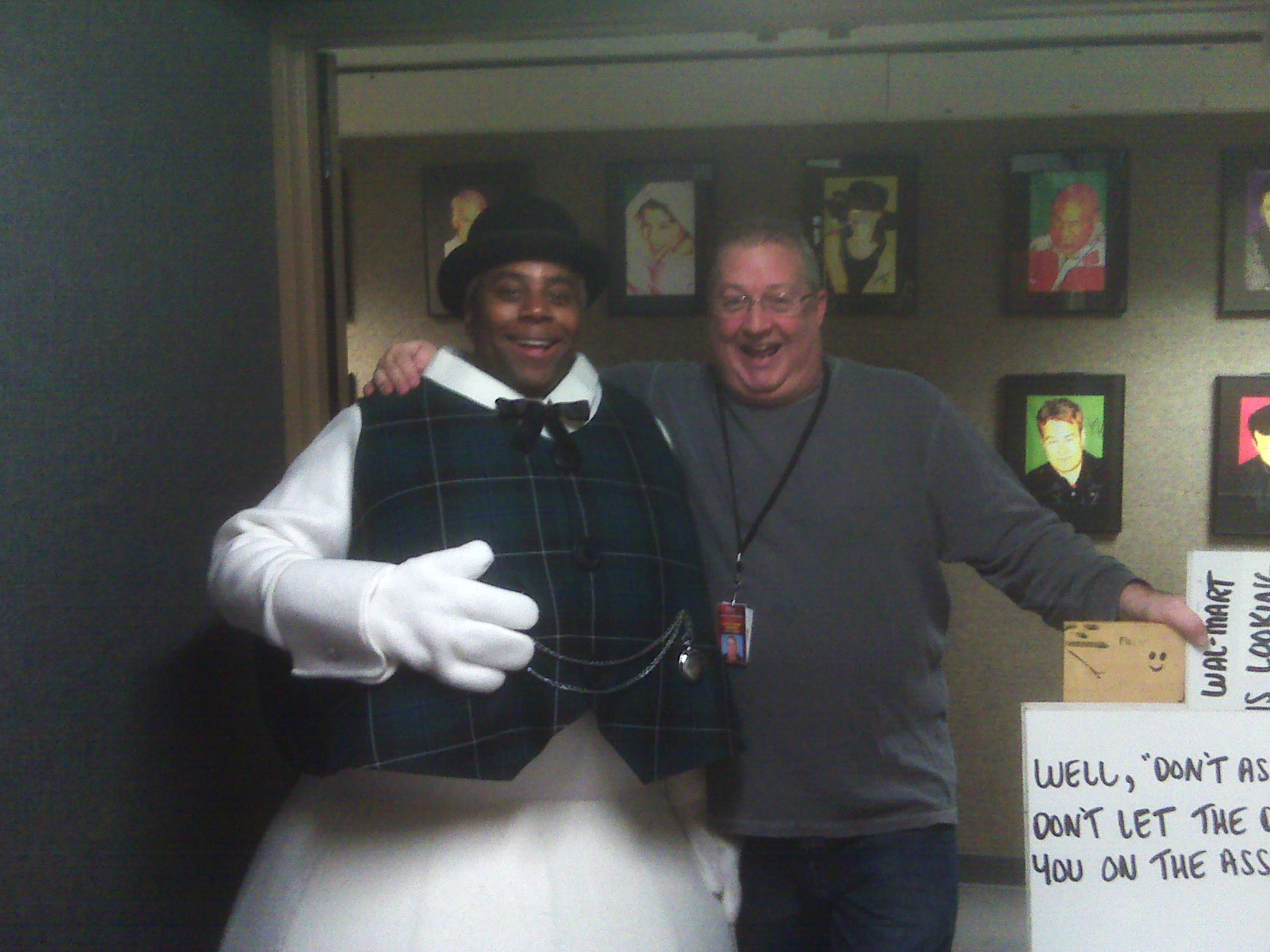
Wally Feresten (R) with Keenan Thompson on the set of SNL.

Are you right-handed or left-handed? Right-handed, as most cue card people are. If you are left-handed, your left hand would typically smudge the printing on the card. But you have to be good with both arms. You’re holding one card steadily in the palm of one hand, and balancing the other 7 to 20 cards in your other palm. I’m pretty sore at the end of the day.

Do you have noticeable muscle strain? Over the past eight years, I’ve gone to physical therapy for tendonitis in my left elbow, right elbow, left shoulder, and right shoulder. But I’m feeling pretty good now, knock on wood.

The New Yorker called preparing and holding cue cards a “dying art,” and that was more than 10 years ago. I’m surprised the industry hasn’t digitized. Timing rules everything. If a computer goes down or gets unplugged during a live show, it’s a disaster. Producers won’t allow that.

To what extent do actors improvise during SNL? They can only improvise during rehearsal, not during the actual show. [Improvising] doesn’t make sense, anyway, since writers are rewriting up to the last minute.

Define “the last minute.” We’ll do rewrites until anywhere from 12 a.m. to 12:15 a.m., sometimes rewriting a sketch just a few minutes before it starts. [Editors’ note: SNL airs from 11:30 p.m. to 1 a.m. EST].

That sounds very high-stress. How do you cope with the pressure? I love the adrenaline rush, and I don’t panic. I think that’s why they picked me to do the job 19 years ago.

You undoubtedly have front-row access to some of the most important moments in TV history. An especially memorable one was holding cards for Mayor Giuliani two weeks after September 11, with firemen standing behind me, when we were the first comedy show to come back on the air. It’s also pretty fun seeing pairs meet for the first time in the dressing rooms to discuss their monologues: Sarah Palin and Tina Fey, Jesse Eisenberg and Mark Zuckerberg.

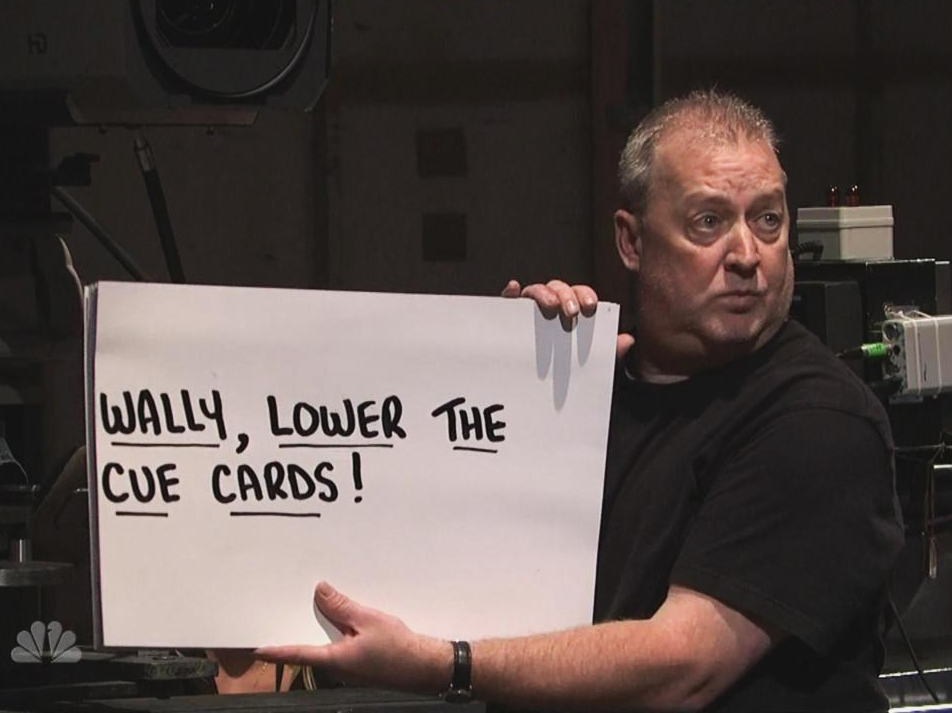
I love the Mother’s Day episode when Will Ferrell hosted. He told you to lower the cards so he could talk to his mom on stage “unscripted.” Was that scripted? Yes. Adam McKay, who used to work for SNL and now writes and directs with Will Ferrell, wrote that. I get my best reviews for that performance.


Writing utensils: M99 markers, which are big, thick, silver pens that we unscrew and fill up with ink. The fumes are really bad for you, so we try not to inhale too much.

Best part of your job: Making friends with cast members and working with our celebrity hosts. After Paul Rudd hosted for the first time, I sent him his monologue cards, and he told me he has them hanging around his house. I’ll do that for young actors who haven’t hosted before and are really excited about it.

Most challenging part of your job: Getting through the day on Friday, when we start rehearsal at 1 p.m. and aren’t done until midnight or 1 a.m. It can be tough to stay focused, especially when it takes two hours to block one sketch.

Walk me through your week. I don’t work Sundays through Wednesdays. Thursdays are light days; we rehearse three or four sketches and are out by 5 p.m. They don’t want to scare the host too much. Fridays are long and hard. Saturdays we rehearse all day, do two shows, and then party.

Do you usually attend the SNL after-parties? Yes. You get such an adrenaline rush from the live shows, that even when I just go home, I can’t fall asleep until 5 a.m. Lots of alcohol helps you relax. Then, on Sundays, I’m a mess. I get home really late, which is tough on my wife and two sons, who are 12 and 10. They let me sleep until noon.

Feresten’s company, NYC Q-Cards, also works on the set of Late Night with Jimmy Fallon. Photo: sheknows.com

Do you foresee a future in comedy for your kids? I wrote some stand-up for my older son, who performed on Late Night with Jimmy Fallon, and he totally killed.

What would people be surprised to learn about your job? The number of people who still ask whether SNL is a live show.

Best reaction to telling a stranger about your line of work: It kind of halts the conversation. Sometimes, I’ll go through my spiel about meeting celebrities, and the other guy will be like, Oh, I’m an accountant.

Most important lesson learned: The rewrite process is the most important part of writing comedy. That’s sometimes the hardest thing for a writer, since you might not want to mess with your work.

Do you consider yourself a funny guy? I do. [Laughs.] Growing up, we listened to a lot of George Carlin albums, and I always want to be a comedian.

Any summer plans while SNL is on hiatus? [NYC Q-Cards] is doing three shows at the same time: Ink Master, a tattoo reality show on Spike TV; Project Runway on Lifetime; and Late Night with Jimmy Fallon on NBC.

Salary per show: For most New York shows, I normally charge $500 for an eight-hour day. SNL is a different beast, though. And the cards cost about $1,700 for a 10,000-card order.

I read that your legal name is Chris Feresten. What’s that about? My brother nicknamed me Wally when we were kids, and it kind of stuck.


LAUNCHING YOUR CAREER>>
Practice your printing – that’s copying from script to cue cards. Meet people doing cue card work and have them show you how to hold the cards; you need someone with connections to vouch for you.

Meet more No Joe Schmos who wield pens as swords: the fountain pen doctor, the tattoo artist, and the CollegeHumor.com editor.

The Video Game Voice Actor

Need for speed | Bend your elbows and pretend you’re typing really quickly on a keyboard, Minella advises. Your fingers will act as puppeteers to move your mouth faster.

Lani Minella makes a very convincing baby boy and elderly grandmother. She’s spot-on as Nancy Drew in the Her Interactive video games and as Rouge the Bat in the Sega game Sonic the Hedgehog. Minella won’t reveal her actual age, but she is credited with voicing more than 500 video games in 365 different voices over about two decades.

In 1992, Minella founded AudioGodz, a one-stop shop to help game companies with voice acting, casting, directing, and audio. “I’d like to think anyone can be trained to do this, if you’re not tone deaf and have vocal control,” she says. “You can get a lot of your inspiration from real life. Or from watching Springer.”

Scrunching her face for a gruff six-foot Haitian soldier and stretching her lips for a sexy Katharine Hepburn are all in a day’s work. “What’s great about voice work is…you can look like holy hell,” Minella says matter-of-factly. After spending hours in cramped, overheated recording studios, one often looks like she just took a shower or walked through a tornado.

Below, Minella explains how reality TV is destroying the industry, why the gender gap doesn’t show signs of closing, and the unlikely way the voice of Spongebob nailed his job.

Age: I prefer not to say; this is a very discriminatory business. I voice anyone from a baby to a 100-year-old.
Based in: San Diego, Calif.
Graduated from: San Diego State University and United States International University; English major, art minor

Previous jobs: On-air talent and producer at various radio stations

Much like acting, voice work is an opportunity to be someone you’re not. Is that exhilarating for you? Games are the best, because you have the chance to be a multiplicity of characters. I get to have fun and create insectoid languages, which kids love. But nowadays, parents are determining what kids should hear, and they’re replacing exciting characters with “safe” ones. Producers don’t want to offend anybody.

Producers tend to run on the nervous side, Minella says. But clearly not the South Park ones. Photo: mentorless.com

What about shows like South Park? They got away with it because people were like, thank goodness someone is taking a chance and not being politically correct.

What would people be surprised to learn about your job? Lots of black parts are actually played by white people. Also, my line of work takes a lot of energy. For characters in games, you need to make dying sounds, jumping sounds, and landing sounds.

So you’re actually jumping in the recording studio? The last thing you want to do during a voiceover is sit down. You have to put the motion in games; that’s part of the fun. For hitting noises, I’m actually punching the air or doing a karate chop. I’ll often do backhanded tennis swings to make certain sounds, which impresses producers.

Most embarrassing moment: While gesturing, I once swiped my can of Coke and it splattered 50 feet away.

Speaking of getting physical, how do you switch your voice from young boy to old woman? Women can do a lot of things men can’t, like voicing a teenage boy. Pooch your lips and move your mouth forward to sound like a boy; bring your lips back against your teeth to sound like a girl. Making a tough face makes you sound masculine. It can be that easy.

Do you find a gender gap within the industry? Yes. A male might get a $500 offer on Voice123.com, while a female might get $50 or $100. It’s the way the public has always done it, and it’s the same reason people didn’t take me seriously as the manager of a stereo store. Girls aren’t supposed to know “that stuff.” It’s largely who you know and who you blow.

Best part of your job: Working with the audio guys, who are highly creative.

Most challenging part of your job: When directors tell you to “do it different” but don’t specify how. The toughest jobs really wear you down. After recording for a Lord of the Rings video game, I was so hoarse I couldn’t even swallow water.

How often do you lose your voice? It has happened three times. But I only lose my normal speaking voice; I can still go really high and really low.

The best cure for a hoarse voice: Hot liquids can temporarily relax swollen chords a bit, and humming instead of whispering or talking can help. Water just washes away your mucus lining and can lead to dry mouth.

Your dream job growing up: To do cartoon voices. I was amazed at the animations, and I was always the class clown.

Are most cartoons and games recorded in Hollywood? Looping and animation, yes. But Take-Two Interactive, one of the biggest companies that hires people for the voices in Grand Theft Auto, is based in New York. But games don’t pay that well. The real bread and butter of the industry is in commercials and promos.

Salary: It’s better pay than flipping burgers, but you’re not punching a time clock. Don’t quit your day job unless you’re the voice of Revlon.

Dress code in the studio: No jewelry, no high heels, no clothes that rustle. Don’t waste time with perfecting your hair and makeup, because sometimes, sound studios will be little clothes closets.

Has the industry shifted with the rise of reality TV? It’s done a lot of damage to the industry, just like hiring celebrities has. Reality shows get away dirt cheap without having to pay a script writer. Directors on shows like The Real Housewives of New Jersey are just like, be yourself and fight a lot.

LAUNCHING YOUR CAREER>>
1. Know your voice, control it well, and be able to read cold copy quickly. Don’t inflect your voice upward at the end of sentences, and follow directions well.

2. Go your mirror, make funny faces, and talk through them. The odder you look and the more you flail about with your hands, the more people are going to think you’re really good. Keep an open ear while you’re out, then go home and impersonate and adapt those voices.

3. At the start of your audition, say “1 of 2.” Do the first take the way the director wants, and then come up with something entirely different for the second take. By putting more lottery tickets in, you get more jobs.

Tom Kenny also voiced Dog on CatDog and Heffer Wolfe on Rocko’s Modern Life. Photo: fanpop.com

THE SPONGEBOB STORY>> Tom Kenny, the voice of Spongebob Squarepants, got his big break at a Hollywood party. He was mimicking a midget he had overheard — one who was angry about being typecast an an elf. Someone overheard Kenny, tapped him on the shoulder, and said, “Come into my office tomorrow. I might have a job for you.” And he was thus cast at Spongebob. —As told to Megan Hess

Think Lani Minella‘s job is cool? Check out the opera singer who compares singing to a hot fudge sundae.

Foodie Friday: The Submarine Chef

Culinary Specialist First Class Allen Williford puts finishing touches on lunch at the naval submarine base. (Photo: Mass Communication Specialist 1st Class Jason J. Perry/released)

It’s dinnertime at the Naval Submarine Base New London in the tiny town of Groton, Connecticut, and a room of 30 high-ranking officials are hungry. Culinary Specialist First Class Allen Williford is scrambling around the small kitchen, about the size of your typical break room, boiling lobsters. He splits them down the middle, removing all the meat. Then, he stuffs the tails with a lobster meat custard. The Lobster Thermidor − one of seven courses he’ll serve that night − is ready for plating.

Williford enlisted in the U.S. Navy at age 18 and worked on a submarine ship for five years, cooking a standard set of meals for 140 crew members. Now, as a flag culinary specialist at Commander, Submarine Group Two, he designs menus for the flag admiral and often cooks for about a dozen delegates at a time in the submarine capital of the world. His wife and two sons, who have moved with him from San Antonio, Texas, to Pearl Harbor, Hawaii, to Groton, Connecticut, are his guinea pigs for new foods. “I feel pretty open to use my own creativity [on the submarine base],” Williford says. “It’s like running my own small restaurant.”

Age: 25
In the navy for: 7 years, 9 months
Grew up in: Tulsa, Oklahoma
Based in: Groton, Connecticut

Did you enlist in the navy with the intent of becoming a culinary specialist? By the time I was 17, before I had to quit to leave for the navy, I worked on the weekends as a line cook and on the weekdays as a waiter. Then, when I was picking what I wanted to do for the military, my cousin told me to do something I really loved and enjoyed. I took his advice and decided to cook, so I went off to four weeks of training at culinary school in San Antonio, Texas.

How long are your trips below sea level? I worked as a culinary specialist on a ship in San Antonio for five years, where I cooked four meals a day for 140 crew members. We spent more than 70 percent of those five years at sea, which is a lot of time away from your family. Now, I’m a personal chef for a flag admiral.

So you just cook for one person? I also host events for delegates and other high-ranking officials.

Do you get a say in the foods you cook? I get to create a lot of my own menus – it’s like running my own small restaurant. I buy my own fresh produce and propose menus, which get approved by the flag staff. When I’m on a ship, however, it’s a standard navy menu that changes every three weeks. That can get a little boring, but we’ll try to change up some of the flavoring.

Photo: cookstr.com

Most elaborate dish you’ve cooked: For high-ranking officials, I’ll make something light and elegant, like smoked salon with an apple coleslaw. Once, I made a seven-course meal, which included oysters on the half shell, mixed greens salad with arugula and bacon vinaigrette, French onion soup, and Lobster Thermidor.

How is the submarine’s kitchen equipped? It’s all industrial sized equipment, with two ovens and one flat grill top. There’s no stove, since pots would fly all over the place. Instead, we have fixed kettles that you can put anything in and then heat up. The kitchen I work in now, on the submarine base, has more commercial equipment: a stove, oven, and refrigerator.

Size of the kitchen: Pretty small. It’s split into two sides: one for food service attendants to wash dishes and clean up, and the other side for the cook. The entire kitchen can fit about three people comfortably. You don’t need too much space.

Best part of your job: I constantly get to be creative. I had a passion for cooking and exploring how things work, and I was pretty much self-taught. It’s satisfying to produce meals that are of the caliber I produce.

Most challenging part of your job: Working by myself. It’s especially challenging for large events of 30 to 50 people, but other cooks will volunteer to help me serve.

Did you always love to cook? I spent a lot of time in the kitchen when my dad cooked dinner as a kid. As I got older, my mom worked as a nurse, so she was gone a lot. She would always have the fridge stocked for me, but I often cooked for myself. Starting at age 15, I started having friends over to cook for them, and realized I had a knack for it.

A passion for cooking more often leads to a career in the restaurant business than in the navy. I worked as a waiter at a restaurant at age 16, and one of the cooks noticed that I always showed up early to help prepare the food. He let me help out, so I’d work double duty: on the weekends as a line cook and on the weekdays as a waiter. I would see how things were produced in the kitchen, and then later in the evening see the look on people’s faces when they ate it. It was immediate satisfaction.

Favorite foods: I really enjoy seafood and Italian food.

CS1 Williford performs water rescue training at the Naval Submarine Base New London pool. (Photo: Lt. j.g. Kevin Shanley/public.navy.mil)

What would people be surprised to learn about you? There’s a little more on my plate than just cooking. Submarines are small communities; there are a lot of jobs to go around, and not a lot of people to fill them. So I also took on the job of submarine diver and rescue swimmer, and I volunteer at the local fire department.

At home, do you opt for take-out as a break from cooking? I’m one of the command’s fitness leaders – the navy has to make sure its crew is physically and mentally fit – so I try to avoid letting my kids, ages 3 and 5, eat fast food. My wife and I share the responsibility of cooking healthy meals at home. [One such nutrition tip to his submarine group: Eat according to the colors of the rainbow.]

Do you test out new recipes on your kids? My family is my guinea pig, and my wife is my best critic.

Salary range: See full pay tables here.

LAUNCHING YOUR CAREER>>
First and foremost, you need to be passionate about cooking. If that’s the case, the navy will train you and give you all the tools you need to be right where I am today.

Click here for more Foodie Fridays, like the miniature food artist and the master fudge maker.

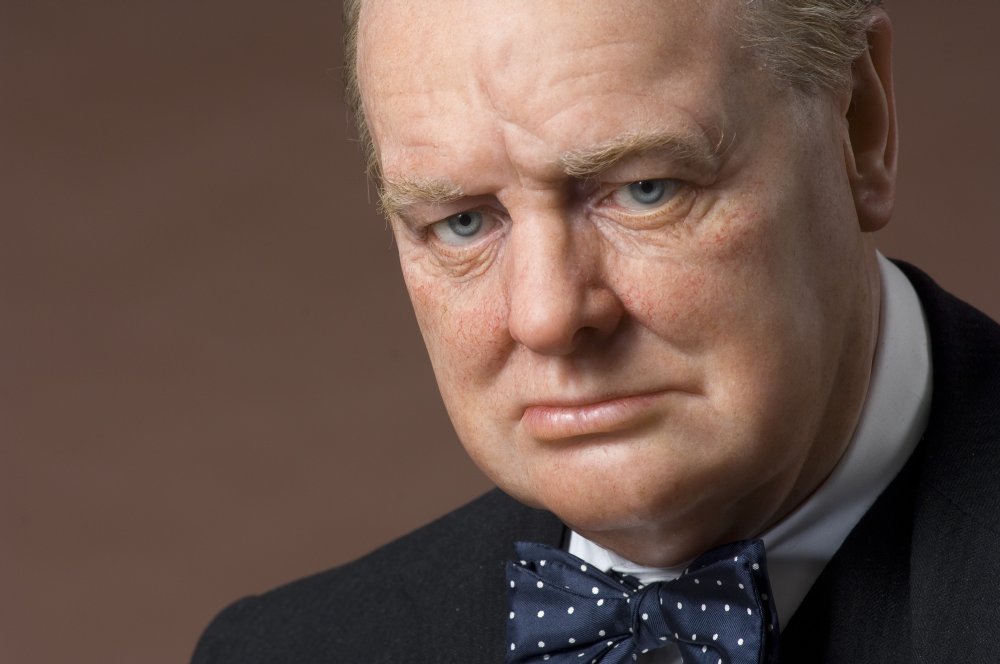
The Sommelier Wants To Sip Bordeaux With Winston Churchill

“I don’t think wine should be intimidating or pretentious,” Cree says. “My job is to introduce people to wine in a fun, down-to-earth type of way.”

When Chris Cree passed the Masters of Wine exam in the early 90s, he was one of only a handful of Americans to earn the title. Now, as one of 297 Masters of Wine in the world, he dazzles friends at guess-that-wine parties and customers at his resale shop, 56 Degree Wine, with his grape and vineyard acumen.

Sometimes, Cree opts for sparkling water or iced tea with a meal, but he mostly sticks with reds and whites. He prefers crisp, elegant ones with lower alcohol content, especially a glass of sweet Sauternes paired with pan-seared fois gras. “It’s about balance,” Cree says. “You want wine that will compliment your food, not overpower it, and vice versa.”

Below, Cree reveals how to tackle intimidating wine lists (ask for the suhm-uhl-yey), suggests his favorite reasonably-priced summer wines, and champions the oft-overlooked rosé.

[Cheers: Take 15% off your purchase at 56 Degree Wine, excluding sale items. Enter promotion code SCHMO now through July 31, 2012.]

Age: 51
Graduated from: I didn’t go to college. In high school, I began working at a large liquor store in New Jersey for college tuition, but opportunities kept coming up, and I really liked working in the wine business.
Based in: Bernardsville, NJ
In the wine industry for: More than 30 years

What initially sparked your passion for wine? I loved to cook since I was a kid, and wine became a part of that. My stepfather was a pilot, so we traveled to Europe and I was able to see a different way of eating and drinking. When the owner of the liquor store I was working at in high school passed away, his daughter and son-in-law asked me to run the wine department. That’s really where I got my start.

You’re one of only 297 Masters of Wine living in 23 different countries. What does the title mean to a non-connoisseur? A Master of Wine can taste a wine 6,000 miles away from where it was made, and 10 years after it was made, and identify the location and year of the bottle.

I bet that’s a title you brag about at parties. I’ll identify wines for customers in my wine shop, or for friends at a guess-that-wine party. It really forces you to focus on what’s in the glass.

Qualifications to become a Master of Wine: I went into the program in the early 90s, right when they began offering it in America. I was only the thirteenth American to pass. To me, the exam is a business degree based on the wine trade; we were tested on everything from grape-growing and vineyard management, to production of wine and quality control, to marketing and sales of wine. Then there’s a three-day tasting component.

You must need a pretty high tolerance to prepare for the exam. You’re wine tasting every single day for most of the year leading up to the exam, and it’s really accelerated the month before. I’d bring home five or six or 12 wines to practice with, and at the time, I lived in an apartment. I would leave some of the wine bottles outside my neighbors’ doors, but once I passed the exam, that stopped. My neighbors were sad that I had passed.

Where did the name of your resale shop, 56 Degree Wine, originate? We keep the wine at 56 degrees, which is right within the ideal temperature range for storing.

Wines in Provence are grown under demanding conditions; the hot weather and abundant sunshine ripen the grapes quickly. Photo: blogs.transparent.com

Which wines are you drinking this summer? Plenty of lighter reds, or crisp, lower-alcohol whites. To name a few: Chablis (2010), Mokoroa Txakoli (2011), and Rosé de Provence.

You don’t scoff at rosé wines? I drink a lot of dry rosé from the south of France, especially from Provence, in the summer. A few years ago, it was hard to sell, because people associated it with the cheaper, sweeter wines. But it has really evolved into a classy, beautiful summer wine that goes well with salads and grilled fish.

No-fail strategy for tackling an intimidating wine list: Ask to speak with the restaurant’s sommelier, if it has one. Tell him what you’re thinking of ordering to eat, and ask what on the list would go well with that. Or tell him the types of wines you’ve had in the past that you really like.

Have you ever sent a bottle back after tasting a sip? You’re really sipping it to see whether it’s what you ordered. Give it a swirl, smell it, taste it — and ask for more if they haven’t poured you enough to properly taste it. But only send the wine back if it’s flawed or corky. Corky wine manifests itself in a musty, wet-basement smell. It’s not so much about whether you like the wine.

Photo: viticlasswines.com

How long is a wine good for once it’s opened? There’s no rule of thumb, but most of the time, it’s only one or two days. Using a suction pump or wine preservation spray might you buy a couple of extra days.

Ideal storage conditions: Dark, 55 to 58 degrees [Fahrenheit], no rapid temperature change.

Best part of your job: Traveling to Europe, California, and other wine regions.

Most challenging part of your job: At the end of the day, it’s still running a retail business. It just happens to be with a fun product.

What would people be surprised to learn about your job? Great wine doesn’t have to be really expensive. Small growers in lesser-known regions produce hundreds of great wines in the $15 to $30 range. Sort of like fresh produce, they only come in certain seasons. The best bet is to find a shop that really knows its stuff, and ask for what’s new, exciting, and inexpensive. I love white wines from the Loire Valley region (Sancerre, Touraine) and Burgundy (Macon wines for value).

Most significant change you have witnessed in American drinking culture: A push towards a richer, more fruit-driven, higher-alcohol style of wine. But that may have peaked now, with the trend moving more toward elegant wines without so much alcohol. That’s refreshing. I’ve also seen the American wine drinker grow more confident and adventurous with trying new wines, which sort of dovetailed with the food revolution. Food became a big deal with the fresh, local movement and celebrity chefs, and wine was a part of that scene.

If you could share a bottle of wine with anyone in the world, it would be with: My wife and family, and close friends.

When Churchill traveled, his porters often carried cases and cases of wines for him. Photo: education-images.blogspot.com

That’s a cop-out. Okay, Winston Churchill.

What would you drink with him? We’d probably drink the gamut, from champagne to Burgundy to great Bordeaux.

LAUNCHING YOUR CAREER>>
1. Work in a retail wine shop, where you’ll be exposed to a wide range of products from various countries, regions, and price points.

2. Taste a ton of different wines, and keep notes of what you taste. I keep my notes in my iPhone. Then, ask questions about what you taste, and read up on them. The Oxford Companion to Wine is a great big encyclopedia with pretty good definitions of every wine region and grape out there.

3. If you’re really serious, travel to wine regions. Talk to people, taste their wines, see what’s happening in vineyards and in cellars. Take classes if you can, too. Like anything else, you have to immerse yourself in it if you really want to learn it.

You can follow Chris Cree on Twitter at @ChrisCreeMW and on his blog, Down to Earth Wine.

Never drink on an empty stomach! Meet some foodie No Joe Schmos, like The Food Spotter and the editor of Serious Eats New York.

The Snooze Director

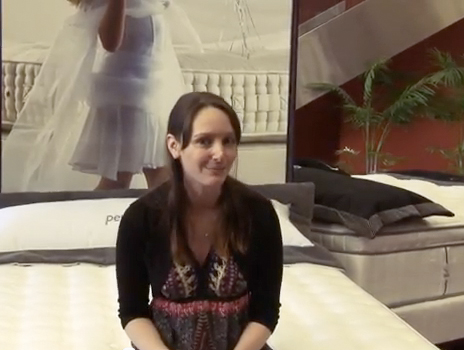
Trouble falling asleep may be linked to drinking coffee or working out too late in the evening, says Emily Barrett, Sleepy’s first-ever Snooze Director.

Eighteen years of sleeping of experience. Check. Ability to fall asleep on a Sleepy’s mattress during daylight hours. Check.

At 24, Emily Barrett is the first person to hold the title of Sleepy’s Snooze Director. The position was created last year in an effort, Barrett speculates, to create a media buzz. But in the wake of nabbing the job, she has transformed the position into an integral role at the mattress retailer’s 4,200-square-foot headquarters in Hicksville, NY, where she helps manage Sleepy’s Facebook and Twitter accounts. Barrett’s friends – recent college graduates who are starting to move out and buy new mattresses – recruit her to tag along as their go-to mattress guru.

Unlike many in social media positions, Barrett isn’t a salesperson or public relations pro. Instead, she touts herself as the “Sleepy’s cheerleader” with the goal of educating consumers on how to improve health based on a good night’s sleep. “[Humans] spend about a third of their lives in bed,” she says. “You need to be willing to invest in your sleep. People tend to want to spend more money on their TVs than their mattresses.”

Editor’s note: the jury is still out on whether singles or couples sleep better at night.

Age: 24
Based in: Hicksville, NY
Graduated from: New York University, degree in media communications
Previous jobs: I graduated in May 2011, and was hired for this position in June 2011.

Describe what you do in one sentence. I work with social media for the Sleepy’s brand; I run the Twitter account, help with its Facebook page, and maintain the Sleepy’s blog.

What qualified you for the Snooze Director position? At my past internships at radio stations, a big part of my job was blogging. I emphasized my personal use of social media and ability to make videos. Because Sleepy’s accepted applications through Facebook and YouTube, as well as through regular recruiting websites, applicants were able to show much more of who they really were.

How did you hear about the job? My aunt sent me a link to the posting on CareerBuilder.com. I was hesitant to apply, since it was just a temporary part-time position, but my aunt pushed me to. In September, I became a full-time employee.

Did you have to test mattresses as part of the interview process? After my first interview with the recruitment department, I was called into the Sleepy’s showroom do an interview for an evening segment on Channel 7 News with two other candidates. They set up a scene and had us jump from bed to bed, which is definitely something I’ve never done during an interview before. [You can watch the segment here. Be prepared for puns like “dream job” and “thinking out of the box spring.”]

Hours you sleep on a regular basis: At least eight or nine. I’m a really good sleeper – that might be another reason I got the job. [Laughs.] Even in college, I usually never got fewer than six hours of sleep and never pulled an all-nighter.

Any tips for those who have trouble falling asleep? White noise really helps me, as does my air conditioning – it’s important to be cool when you’re going to sleep. But at the end of the day, it always comes back your mattress.

Signs you’re ready for a new mattress: If you can see dips in it, or if you can’t remember when you purchased it. If it’s been more than five to seven years, it might be time for a new mattress, since our bodies change within that window of time. I actually just bought my first new mattress a few months ago.

Signs you’re ready for a new pillow: Take the pillow test. Fold your pillow in half and place a light weight on it, like a shoe or book. When you remove the weight, the pillow should flatten out. If it stays folded, that means it won’t hold the weight of your head, and it’s time for a new one.

Best part of your job: Interacting with other departments. Since everyone at the company sees my name and title on the Sleepy’s blog, they often reach out to me. I’m kind of the friendly face at Sleepy’s – the Sleepy’s cheerleader, if you will.

Most challenging part of your job: Along the same lines, lots of people are always reaching out to me with new projects, and it’s tough to stay on top of all of them. I’m a one-person team, so I can’t really delegate anything. At a certain point, I’ll know when to say “no” to new projects.

One gadget you can’t live without: Probably my cell phone – it’s the only alarm clock I have. I turn it on vibrate and place it upside-down on top of a pillow on my floor when I go to sleep, so I don’t hear it if I get a message in the middle of the night. Then, the sound kicks in for the alarm in the morning. I can’t remember the last time I used an actual alarm clock.

Photo: dogkidz.com

Are you an advocate of naps? Personally, I don’t take naps, but I advocate for them (unless you’re an insomniac). I’m a big fan of offices that allow naptime; it single-handedly increases productivity tenfold.

Some workplaces, like The Huffington Post, encourage employees to use their nap pods. I’m in awe of that.

Are you a coffee drinker? I love coffee, but I stick to one cup in the morning. This job really made me cut back from college, when I drank multiple cups every day. Cutting out your afternoon coffee can really help you fall asleep at night. I even tried an experiment in which I completely stopped drinking coffee for one week. It made me realize I didn’t need coffee for energy, and I felt that I was sleeping more deeply.

Perks of the job: Sleepy’s sent me to the Kingsdown factory in North Carolina, one of the last mattress manufacturers in the United States, where I got to see the whole process of making a mattress. It kind of looked like making a sandwich, but with metal, foam, and automatic sewing machines. Another perk is being able to help my friends and family when they complain about getting a bad night’s sleep.

Annual salary: Between $30,000 and $40,000.

LAUNCHING YOUR CAREER>>
Take a chance on crazy jobs. I applied to the Snooze Director position on a whim, and now, I’m well-respected within the company. Be persistent and confident, and let your personality shine.

More from No Joe Schmo: meet the Oscar Mayer Hotdogger, who is another recent college graduate.