The Woman Revolutionizing Airbrush Tanning

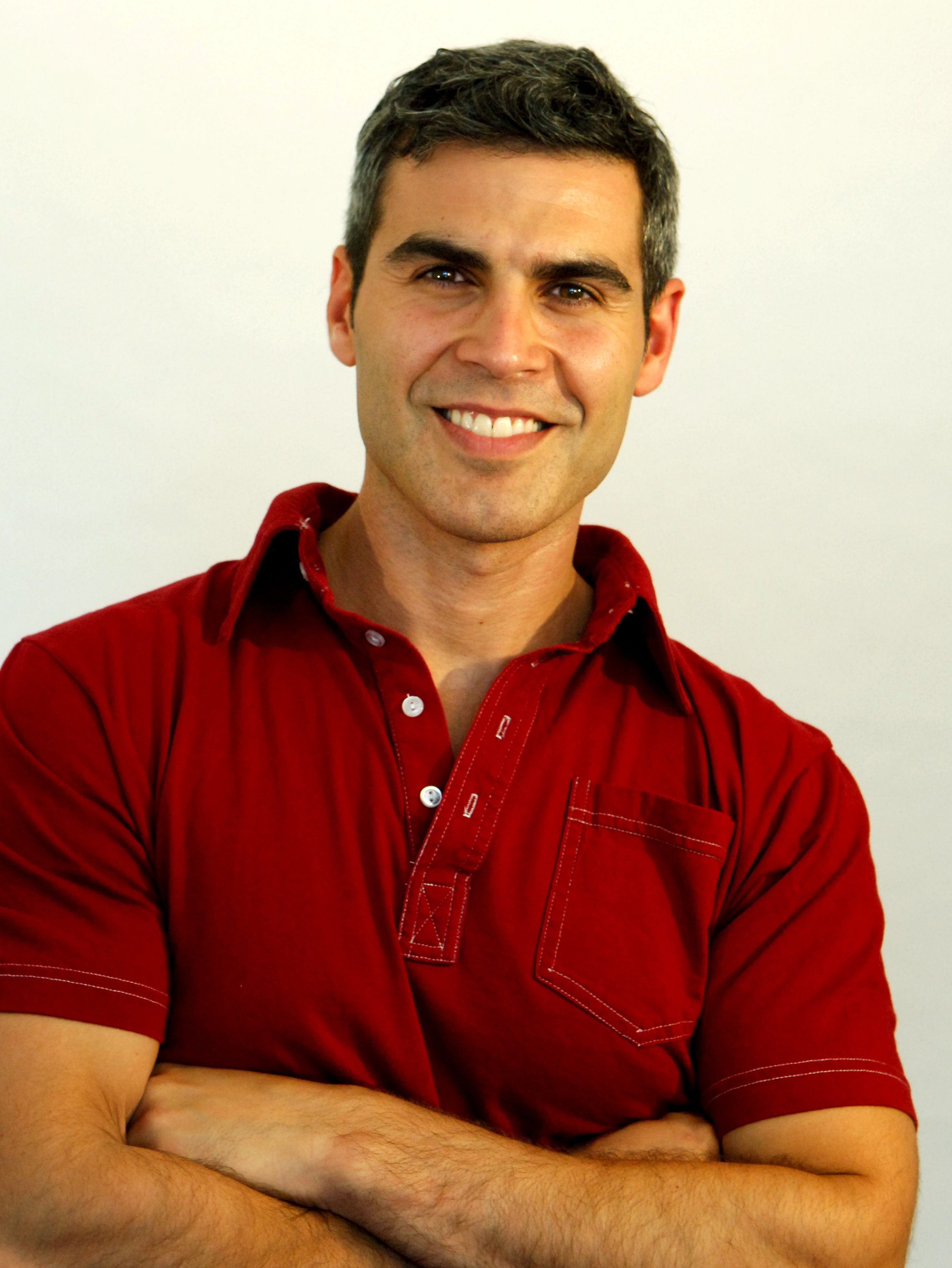
Tamar Vezirian contours and sculpts her clients’ bodies with a spray gun. Photo: Yvonne Lynch

“No showering until tomorrow morning,” Tamar Vezirian instructs. “And no bikram yoga. The tan comes off more quickly if you sweat through your pores.” The woman nods obediently, handing over her credit card.

Half an hour later, another trim, blond woman opens the door, more warily than the previous customer. It’s her first time at an airbrush tanning salon. “If you don’t want tan lines, take off your underwear,” Vezirian says matter-of-factly.

Last year, Vezirian, a self-described “tanning drill sergeant,” opened Gotham Glow, an airbrush tanning salon in the heart of New York City’s Flatiron District. After nine years in the industry, she realized she couldn’t maintain a client base of 10,000 from her cramped one-bedroom apartment. To her neighbors’ annoyance, clients were lining up outside her door or inadvertently ringing their doorbells. Vezirian was repeatedly telling her subletter not to come in because naked women were drying their tans.

Now, with a roster of some 30,000, including names like Mariah Carey and Paula Abdul, Vezirian is trying to reverse the bad rap often assigned to the airbrush tanning industry.

Click here for the chance to win one in-studio tanning session at Gotham Glow through No Joe Schmo.

Age: 33
In the business for: 9 years
Graduated from: I only went to high school, and then acting school in San Francisco. So I went to the school of hard knocks.
Previous jobs: Makeup artist for 17 years; standup comedian; waitress

Your “in” to the tanning industry: I found a job on Craigslist working for an airbrush tanning salon, which, at the time, was the first airbrush tanning salon in New York City. I came from a makeup background, so I was good with the spray gun and making people feel comfortable naked. Making people comfortable is 90 percent of the job.

What instigated you to start your own business? I started taking on clients as a side hustle while doing comedy shows. But it got big; for the last six years, I’ve had 115-hour workweeks. I finally opened my own salon about a year ago, but before then, I tanned out of my apartment, which I subletted from the guy who played Cookie Monster on Sesame Street. It was pretty ghetto.

I’ve never gotten a spray tan. Can you walk me through the process? Exfoliate beforehand, and make sure you don’t have any moisturizer on when you come in. The whole process takes about 10 minutes, including drying time. You stand naked, and I go through poses like an aerobics workout. I’m like a drill sergeant: Start with your back toward me, arms all the way up, bend all the way down! Let me have your hands! Suck your cheeks in, turn to the side, bend all the way down! People start laughing in the middle of [my instructions], but I’m just in the zone. Then you dry under a fan for a few minutes.

Post-tanning rules: As the day progresses, you get darker and darker. You can shower after eight hours, and then all the surface stuff comes of. You’re left with a nice, even tan for five to 10 days.

Above: the waiting area at Gotham Glow. Vezirian still makes house calls to special clients, to which she totes a pop-up tanning tent. Photo: C. Bay Milin

How do you put people at ease about stripping down? I’m very gifted that way. I guess I have an I don’t really give a sh*t attitude. Women with breast cancer who have had mastectomies, who haven’t even shown their husbands, get naked in front of me. Even Catholic girls who have a lot of guilt feel totally comfortable. My whole life has been filled with naked women, actually; I was once a makeup artist at a strip club.

Do most go fully nude? Yeah, or just underwear. Women wear thongs, men wear boxers or briefs. I tell women who are breastfeeding to wear strapless bras.

You tan some very wealthy, powerful women. That’s an interesting juxtaposition: they stand vulnerable while you’re in control. People can get very bitchy and demanding when they feel vulnerable. After many years, I have learned to put them in their place and say, “I’m not going to bother tanning you if this is how you’re going to talk to me.” Usually, that does the trick.

Do male clients ask for spray-on abs? I do some light contouring underneath the belly or on triceps, but I won’t just put two strips down your abs. That’s ridiculous. You have to come in with a little definition; I can’t make a severely overweight person have a six-pack.

Best part of your job: I love running my own business. I have ADHD and need to keep going all the time, and this is the perfect fast-paced environment.

Most challenging part of your job: Other people working for me and making sure they’re up to par. I have three girls who work for me, but I’m looking for more. To me, a great personality and honesty are more important than tanning experience.

What would people be surprised to learn about your job? Very fit women with amazing bodies are more shy of getting naked than overweight women. Overweight women are much more confident and have no shame.

Your celebrity clients: I recently tanned Mariah [Carey] before she went to sing for princes somewhere. I’ve done Paula Abdul, Courtney Love, and a lot of reality show people.

Photo: cinemablend.com

Do you get starstruck? No. I care more about seeing Larry David from Curb Your Enthusiasm than Madonna.

Most memorable tanning stories: One client threw me her stiletto Christian Louboutin shoe and a $100 bill to chase a cockroach around her apartment and kill it. I was like, Eh, I’ll do it for 100 bucks. Gotta pay the rent. Another time, a prominent New York doctor started dancing in my tanning tent, but there wasn’t any music playing. I had to kind of follow her body with the tanning gun.

Ingredients in your tanning solution: It’s all-natural and homemade using sugar cane, beets, aloe, vitamins A and E, hemp, and grape seed extract. Airbrush tanning has a stigma of being tacky and orange, but I specialize in light, natural, sun-kissed looks.

Do you self-tan? Yes. I have it on right now. But it’s like working at a restaurant; you’re always in it. So the last thing I want to do is spray-tan before going home.

The tanning mom story got a ton of media attention. What was your reaction? The media always focuses on stories like the tanning mom and puts a negative spin on the tanning industry. But I tan so many people who can’t go in the sun: people with melanoma, with lupus, who went through chemotherapy. Instead, they come to me, and that’s a good thing.

Cost per session: $75 for an in-studio tan; $50 for half-body tan. House call are $150 to $200, depending on location; I service Manhattan, Brooklyn, Queens, and Staten Island. I also do parties and on-site photo shoots.

Guilty pleasure: Pork belly and duck. I’m a meat-and-potatoes kind of girl.
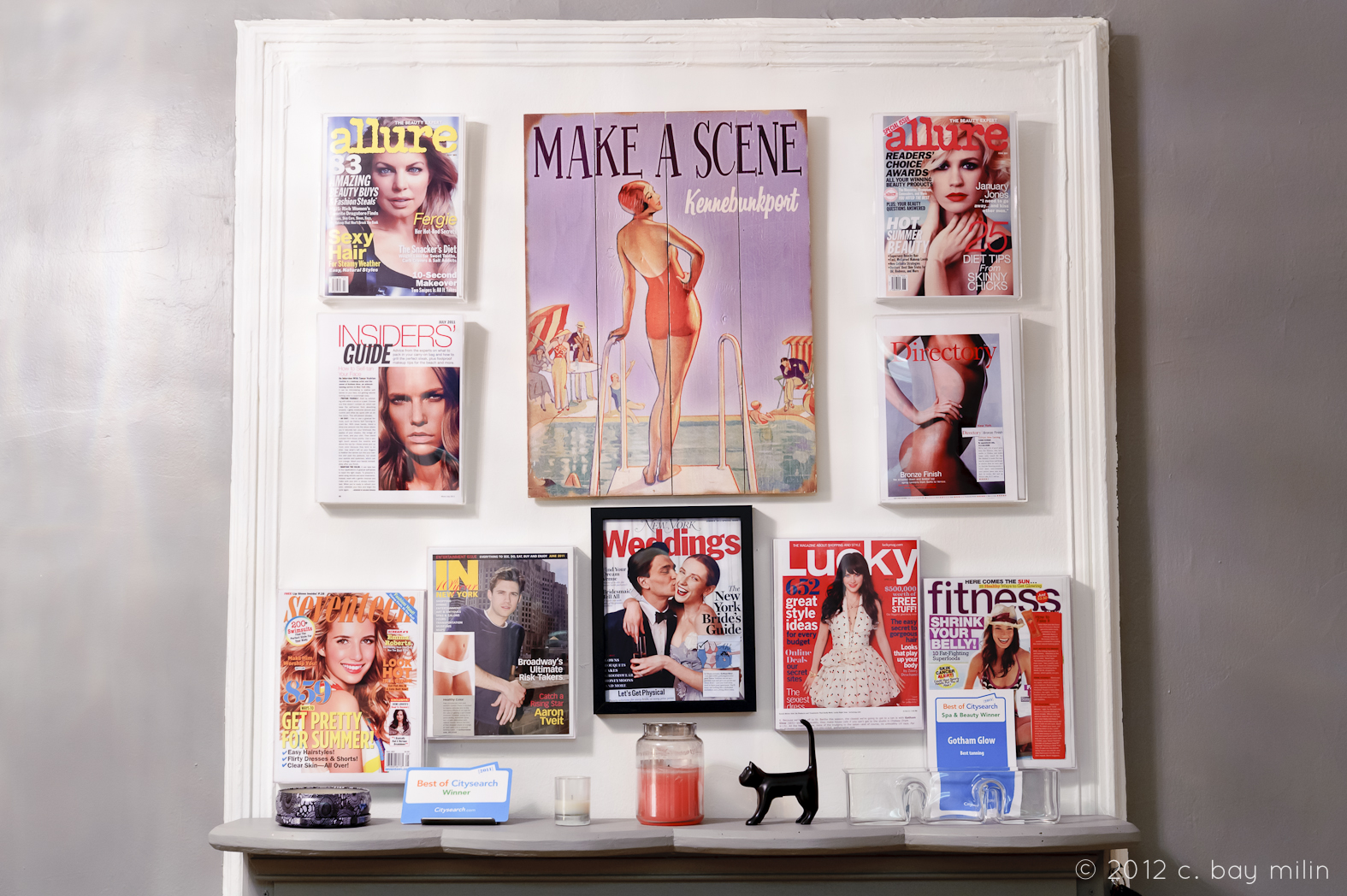
The wall above the front desk at Gotham Glow. A large part of Vezirian’s growing client base comes from Yelp, she says, where people find others with similar tanning fears. Photo: C. Bay Milin

Your required reading: Business books, like The Tipping Point and The E-Myth. I love reading about other business owners and how they succeeded.

LAUNCHING YOUR CAREER>>
1. Work for a tanning salon as a receptionist or booking coordinator. You’ll learn how to talk to clients and the do’s and don’ts of the business.

2. Spray all different types of people: really skinny, really overweight, darker and lighter skin tones. The more people you tan, the better you’ll get at it.

3. Learn to feel comfortable in front of naked people. Clients will be able to tell if you’re nervous, and then they will get nervous. Confidence can take years of experience. Above all else, give great customer service.

Enter below for the chance to win one in-studio tanning session at Gotham Glow. Entry period closes on Sunday, August 19 at 11:59 p.m. ET.

[Return to top]

← Back

Thank you for your response. ✨

Odd Jobs at the Olympics

Photo: Reuters/Jorge Silva

There are plenty of odd things about the Olympics, from the Industrial Revolution bit during the Opening Ceremonies to the crazy faces cameras capture of divers mid-catapult.

But some of the weirdest aspects may occur off the court and out of the pool. The New Yorker chronicles some of the No Joe Schmos who are the axles and gears of the Olympic Games. One of my favorites: the people who drive the remote-controlled mini-Mini Coopers that retrieve tossed javelins, discuses, shot puts, and hammers. Oh, and the men and women sitting in folding chairs during the field events and scribbling down violations on pads of paper. I like to imagine they’re actually doodling things like Mrs. Ryan Lochte.

Click here for the full article on NewYorker.com.

(h/t Kara Landsman)

No Joe Schmo’s Summer Roundup

Photo: justincaseyouwerewondering.com

Worried that you missed out on a few No Joe Schmos this summer that may be changing the world? We’ve done the legwork for you: check out these four must-read No Joe Schmos. Fun fact: the top No Joe Schmo-viewing countries, after the United States, are, in order: Canada, the United Kingdom, Australia, and India.

The SNL Cue Cards Guy | When he started out 20 years ago, Wally Feresten was almost fired for sloppy handwriting.

The Sommelier Wants to Sip Bourdeaux With Winston Churchill | Chris Cree is one of only 297 Masters of Wine in the world.

Foodie Friday: The Miniature Food Artist Israeli artist Shay Aaron began creating miniaturized food sculptures at 1:12 scale that look almost completely edible, and used the hobby to curb his appetite.

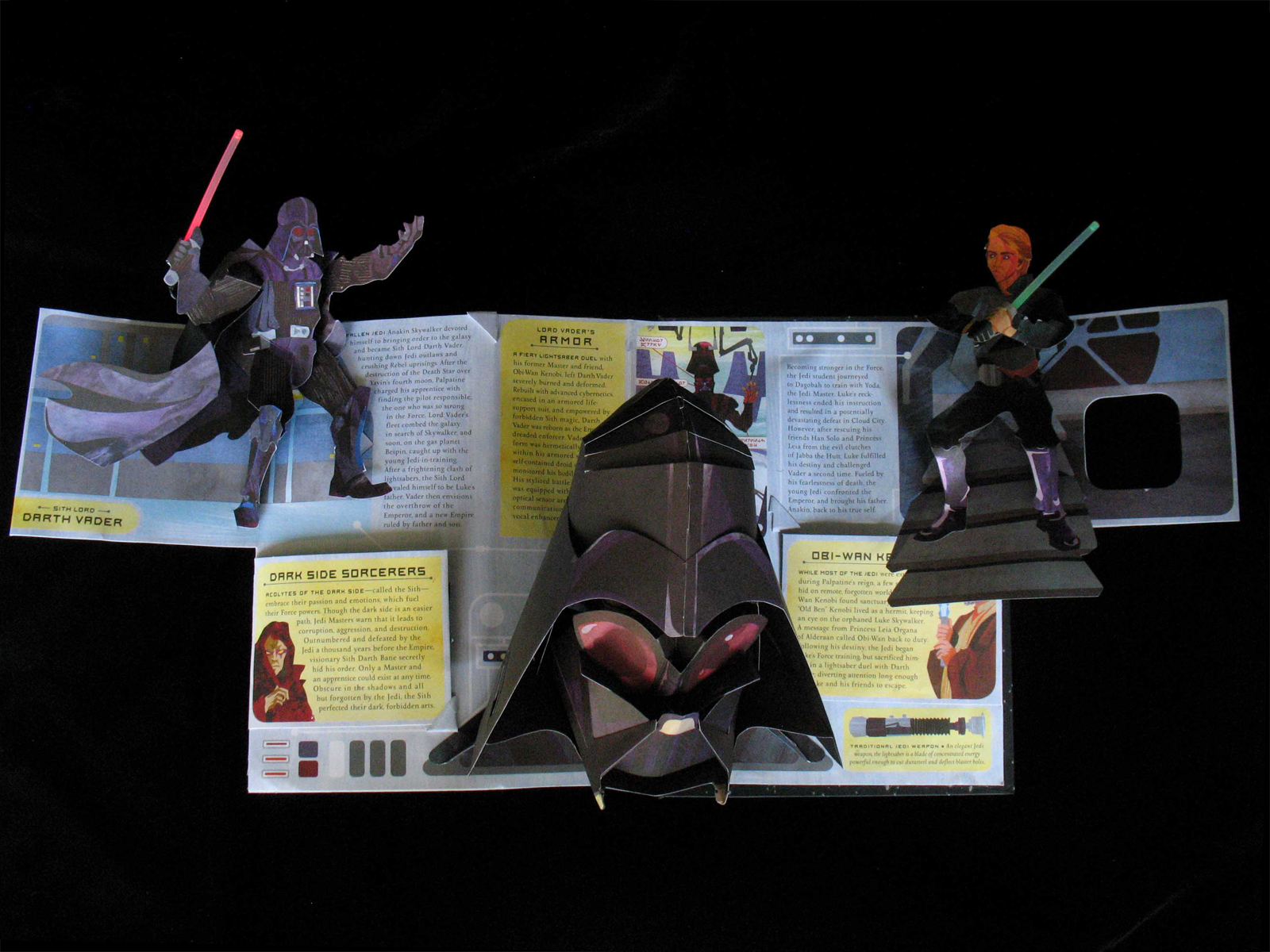
The Pop-Up Paper Engineer | Matthew Reinhart is the author and illustrator of elaborate pop-up books like Star Wars: Pop-Up Guide to the Galaxy.

Like what you see? “Like” the No Joe Schmo Facebook page for exclusive videos, photos, and scoops on upcoming features. If you have suggestions for future No Joe Schmos, comment on the “Suggest a No Joe Schmo” tab or tweet using #NoJoeSchmo.

Next up: Justin Bieber and Carly Rae Jepsen! Kidding. (Maybe.)

The Pop-Up Paper Engineer

“I always try to push myself in new directions with the engineering,” Reinhart says. “I try not to use similar mechanisms throughout my  books.”

In a small, messy studio in Chelsea, Matthew Reinhart sits at his desk, cutting paper for children’s pop-up books and listening to Howard Stern. Star Wars memorabilia and cutesy anime posters adorn the walls. Interns – along with one full-time staffer – flit in and out.

Reinhart, the author and illustrator of elaborate, awe-inspiring pop-up books like Star Wars: Pop-Up Guide to the Galaxy, typically spends about six to eight months conceiving a storyline and cutting out hundreds of pieces for one of his books, some of which are as thin as a piece of thread or as small as a speck of pepper. His newest project – a book involving large transforming robots that he is deliberately vague about – is slated to take even longer.

Many hail his work as sophisticated engineering, but Reinhart remains is bashful. “I’m just this guy who sits in a studio and cuts up paper,” he says. “I’m an art student, not a math student.”

Yet his dedication to art was not always so clearly defined. Below, the author-slash-engineer discusses how gouging out eyes from corpses at New York City morgues made him realize the importance of pursuing a career you love.

Age: 40
Graduated from: Clemson University, biology major; Pratt Institute, industrial design major
In the business for: 13 years
Based in: New York, New York

You studied biology as an undergraduate. Did you always have a hidden passion for art? I always took an interest in making things, but my parents didn’t want me to be a starving artist. They wanted me to be a doctor. So I majored in biology at Clemson, and if I ever had an elective, I took an art course. My notebooks in biology class were out of control – I drew massive ink sketches in the margins.

When did it click that you should study art instead? I got into medical school, but decided to first take a year off and live in New York. I started working at the Eye-Bank for Sight Restoration, through which I went to morgues and took out people’s eyeballs, sometimes in the middle of the night. By the time I was 22, I had been to every morgue in the New York City area. I saw a lot of dead people – a lot of whom were really young. That made me realize that life is short, and I have to do something I love.

So death inspired you to take advantage of life. [Laughs.] I went to my parents and told them I wanted to pursue art, and they were totally behind me.

Why pop-up books? I met [acclaimed children’s book author] Robert Sabuda doing volunteer work together for a local community center. When I graduated from Pratt, I began working with him on a book, and then we began co-authoring books. It grew bigger, and I started my own projects.

At the end of Star Wars, pieces of an Anakin Skywalker pop-up fold away as the light saber turns from blue to red. The pop-up fully transforms into Darth Vader.

What would people be surprised to learn about your job? It’s a lot less technical than people think. I’m an art student, not a math student. I don’t sit here with my trigonometry calculator and figure out the sine or cosine; I cut paper and see if it works.

Which comes first: pop-ups or words? Words are almost always first. Once we agree on a manuscript – which is like writing a term paper only three pages long – we outline what will go on each page. Then, I create the rough pop-ups, cutting and folding paper, which takes two or three months. Next is the cut-paper collage and placement in the digital file. One book might have 200 to 300 separate pieces.

Time span of creation, from start to finish: About six to eight months, but Star Wars took a little longer.

Tools used: 110-lb. cardstock; scissors; white artist’s tape; double-stick tape; white glue (similar to Elmer’s); scanners; and X-Acto blades. I use tweezers to pick up the really small pieces.

Do you use computers for design, or just implementation? Some people make pop-ups totally on the computer, but we don’t. You don’t know how all the pieces are going to fit together unless you’re holding them in front of you.

Last year, eBooks passed print in adult fiction for the first time. Pop-ups can’t exactly be digitized. Do you perceive that as a disadvantage? It’s a really weird time, and there’s a lot of nervousness in the publishing industry. Some of my work has slowed down, but I think kids will always play with [physical] books, especially picture books.

Do you use an eReader? My iPad is easier when I’m traveling, and I can get a lot of different comic book titles on it without worrying about collecting them. But if I find a really beautiful book about graffiti, I want the actual book.

This slideshow requires JavaScript.

Best part of your job: Working with amazingly creative people, like DC Comics. And I get to wear shorts to work if it’s hot.

Most challenging part of your job: Deadlines are the worst. The changing economy makes it hard to create something spectacular and also cost-appropriate.

Do you have certain ideas for pop-ups that are simply too expensive to be produced en masse? Yeah, there are certain elements. But I get to put light sabers in books, which is pretty cool.

Were you an avid reader as a kid? It’s funny – throughout my entire childhood, I didn’t really have any pop-up books. I wasn’t a big reader. I remember faking a report for A Wrinkle in Time using the liner notes on the book’s inside flap. I wasn’t even smart enough to use CliffsNotes! So now, I think about how I can pull in young readers who aren’t so interested in reading – the young versions of me.

In the New York Times, David Pogue wrote that calling your Star Wars book a pop-up book was like calling the Great Wall of China a partition. That was one of the most amazing things to have ever been written about me. I truly love this work, and sure, there are times when I’ve neglected my social life or personal life for it. But it’s very much a part of me.

One book character you’re dying to meet: The Cat in the Hat or Horton would be pretty cool. Optimus Prime would also be pretty kickass.

Your required reading: I did a book with Maurice Sendak – rest in peace – I love his work. The artwork of Mercer Mayer and Peter Spier is fantastic, too.


LAUNCHING YOUR CAREER>>
1. Paper engineering is a competitive field right now, especially with the emphasis on digital media. Be persistent and look around at what exists – then make sure you’re doing something completely different.

2. Acknowledge that you won’t be on top in the beginning. You’ll spend a lot of time working under someone else, paying your dues and being patient. Don’t assume, I made this book, so it should be published. [Success] doesn’t always come quickly.

3. Invest in a copy of The Elements of Pop-Up by David A. Carter and James Diaz.

Follow Matthew’s work on his blog and learn how to create your own Darth Vader pop-ups on his website.

For more crafty No Joe Schmos, check out the miniature food artist, the roller coaster engineer, and the textile jeweler.

The Airport Canine Ambassador

“I don’t know of any other airport in the U.S. that does this,” Liz Miller says. “People just flock to [Casey] on the concourse.” Photo: Miami-Dade Aviation Department
Casey, who is almost four years old, soothes red-faced wailing children. She gives harried businesspeople a moment of calm as they scramble to catch connecting flights. She shimmies and wriggles on the floor, delighting most within her line of sight.

Casey is the 69-pound golden retriever-in-residence at Miami International Airport. As the airport’s official “K-9 ambassador,” she and her owner, Liz Miller, volunteer for two hours on Mondays and Thursdays, helping passengers feel at ease and spreading goodwill on the concourse. It’s one of the airport’s unique ways of providing a rich customer service experience.

Beneath a silky sheath of golden hair and you-can’t-stay-mad-at-me eyes, Casey engages with passengers on an emotional level. “Airports can be so sterile and annoying,” Miller says. “You don’t expect to see a beautiful dog walk up to you. I think people are really touched and moved by that, and it chills them out a little bit.”

But Casey isn’t the only one working her magic. Miller, a former consultant and human resources director, is Casey’s human sidekick at Miami International (MIA), which spans 7 million square feet and services the most international flights in the United States.

Age: 58
Graduated from: Bachelor’s from University of Rhode Island; MBA from University of Miami; PHR [professional in human resources] certification
Based in: Miami, Florida
In the position for: About one year
Work hours: Mondays and Thursdays, noon to 2 p.m. EST; open to special requests
Previous jobs: Corporate lender; national and small business consultant; CFO and director of human resources for a private school in southern Florida

How did your skill set – HR and consulting – segue into volunteering with a golden retriever? Two years ago, I left my position as director of human resources and opened a specialty dessert sauces company, which had been my dream for quite a while. That left more time to focus on volunteer work, and volunteering at the airport was one of my first choices.

What inspired you to bring Casey into that equation? Casey is our family dog, our fifth golden retriever. She went through obedience training and is a certified therapy dog. I took her to do therapy dog work at a local children’s hospital, where I saw her love of humans and how much she delighted kids. I thought that she’d be a natural doing the same kind of work with passengers at MIA. With about 105,000 passengers coming through the concourses daily – and lots of stressed travelers – the opportunity to make a positive impact there was huge. I thought Casey could do it.

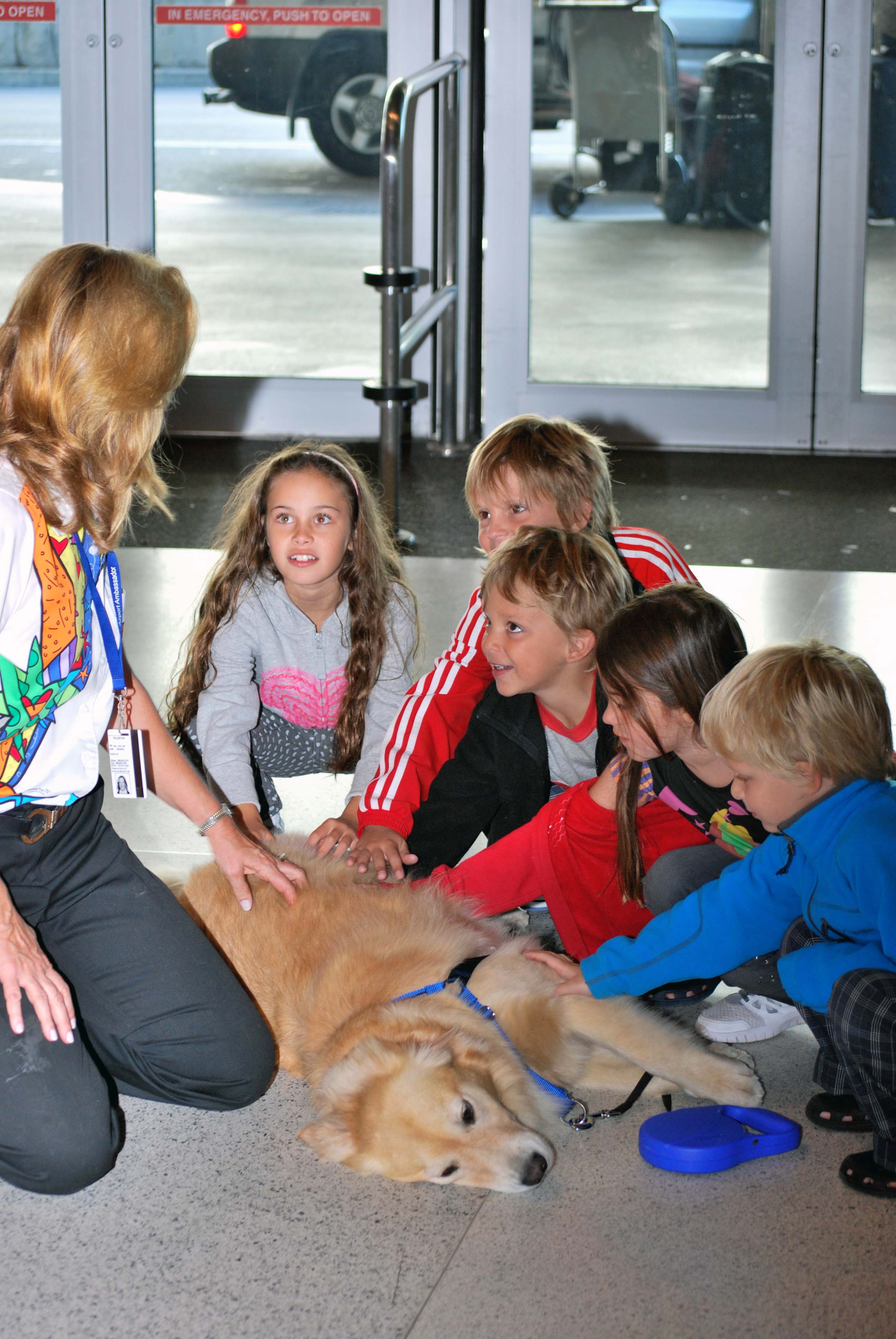
Casey the K-9 Ambassador spreading the love. Photo: Miami-Dade Aviation Department

Do you typically approach passengers, or let them come to you? Both. People approach Casey and pet her, and sometimes end up on the floor with her in a lovefest. Other times, I watch people’s body language – they might brighten up when they see Casey, but don’t come over. So I’ll walk over and ask if they want to meet her. Usually, a child’s screaming and crying will stop when we approach.

Does Casey wear a uniform on the job? Yes: a cobalt blue vest with the words “pet me” on the back, and an official MIA security badge, just like mine. Casey even has her own business cards; a paid MIA employee responds to everyone who writes in. They sign off with Casey’s paw print.

You volunteer with Casey twice a week, but mentioned that you’re “open to special requests.” Like what? Sometimes, airlines ask us to see off a large group passengers at a certain gate. Other times, Casey will get an email from a family, asking if she can come in and greet them as they arrive, or before they depart. In February, we got to the airport at 8 a.m. to see off a family with five kids going on a ski trip. Casey started wriggling on her back, and all the kids got on the ground and mimicked her. We still get messages from that family.

One occasion you truly made a difference: I heard screaming at the international arrival gate. The source was a 2-year-old girl standing on her seat, kicking at her mother, who was trying to placate her. I knelt down next to her with Casey, and she immediately stopped. It was like manna from heaven. I quickly realized the little girl and her mother spoke Creole, not English, but the universal message of touch and calm and safety came across. When we got up to leave, I could see the other passengers saying thank you, thank you, thank you with their eyes. Another time, Casey pulled me toward a young boy who was traveling with his parents. She pressed her head against him, and he bent down to kiss her head. It was beautiful.

But not every traveler loves dogs. I’m really sensitive to that. I don’t approach little children unless their parents have given me eye contact, so I know the parent is receptive. I would never approach it if the parent was reticent.

Has Casey ever bitten a passenger? You think I would tell you if she did? (Laughs.) But no, thank God. Once, I misunderstood someone’s look, and went over to introduce Casey, but he put his paper up. I got his drift.

Do you work overtime during the summertime and holidays, when travel stress is at all-time highs? If we work more than two hours at a time, Casey will push against my knee. If I resist, she’ll pull on the leash and get angry with me – she needs a break. After those two hours, she falls right asleep.

Dogs: a baby’s best friend? Photo: Miami-Dade Aviation Department

Best part of your job: The visual thank-yous – like huge smiles from passengers – and the verbal ones. And the awe, the surprise, from passengers. Casey’s presence has a ripple effect: when I look up, I’ll see people standing and watching us 10 yards away, smiling and talking to each other.

Most challenging part of your job: For every two hours spent in the airport, I spend about five to six hours preparing or coming down from it. It’s a lot of energy being constantly “on”; it’s like a full day’s work.

What kind of preparation? Keeping Casey’s coat clean and groomed. It’s absolutely beautiful, and the softest thing ever. Then there’s getting myself prepped, and getting to the airport takes about 45 minutes. But it’s worth it.

What would people be surprised to learn about your job? A therapy dog’s tolerance level is about one and a half hours. Casey’s is two hours, but she’s doing a lot of walking and getting touched a million times – and doesn’t necessarily know where the hands are coming from. Part of my job is making sure she’s safe.

Any other pets at home? My sons. (Laughs.) No, not right now.

Where does Casey spend her off days? At Totally Dog Day Camp, a five-acre rural area a little south of [Miami]. Twice a week, a small school bus picks her up at 7:30 a.m., and she has her own seat – all the dogs do. The windows stay half-open so the dogs can hang out and bark and love life all the way to the camp. They’re let loose to run, play, and go on hikes around the property, which has a huge bone-shaped swimming pool. I pick her up from the bus around 5:30 p.m.

LAUNCHING YOUR CAREER>>
1. Be very comfortable working and engaging with a dog for a number of hours per day. Build a loving rapport through obedience training.

2. Put yourself out there and initiate contact with strangers. You need an ease with the public. This is a vulnerable position, and you must be able to read people’s body language to see whether they will be receptive to your approach.

3. Enjoy finding out about other people, and be a good listener. The dog breaks the ice, but the handler is the one who must engage in conversation and coax people out of their shells. It’s teamwork. If at any time I see a passenger looking really distressed or confused, I deal with that immediately and help solve his or her problem.

Casey’s business cards: no bones about it.

Check out Casey’s personal site, or email her at casey@miami-airport.com. Learn more about the MIA Volunteer Ambassador Program, where about 80 volunteers help to welcome visitors to the Greater Miami area.

For more animal-loving No Joe Schmos, check out the pet detective and the pooper scooper.