The Elvis Impersonator

Schulz performing at Turner Field before a Braves game. Photo credit: Flickr.com/Richard Roberson

Harold “Elvis” Schulz wears a red-and-white shirt, blue jeans, and white boots when he’s Country Western Elvis. He wears a G.I. Blues uniform when he’s Army Elvis. He wears a black velvet shirt, gold vest, and white patent leather shoes when he’s Return to Tupelo Elvis.

For over a decade, Schulz and his trio, Young Elvis and the Blue Suedes, have been performing strictly 50s tunes for thousands of adoring fans at nursing homes, corporate events, and weddings around the world.

Schulz’s natural resemblance to The King is striking. For shows, he simply applies Suave Mega Hold hairspray and some red chapstick, and he’s ready to go. Even Elvis’ own stepbrothers tell him he looks like Elvis’ ghost.

Title: Celebrity look-alike and performer
Age: It’s a trade secret – somewhere between 30 and 35
Graduated from: University of Georgia, B.B.A. in marketing
In the industry for
: 11 years
Salary: $200 to $250/hour for nursing homes; $350 for 30-minute private parties; up to $2,000 for 3-hour conventions and corporate events
Previous jobs:
Regional and national salesman at various companies, including Siemens

Biggest crowd: 10,000 people in Kansas City for New Year’s Eve in 2008.
Average crowd: Anywhere from 40 to 5,000.
Total number of shows: In the thousands. In my busiest month, I worked 19 shows.
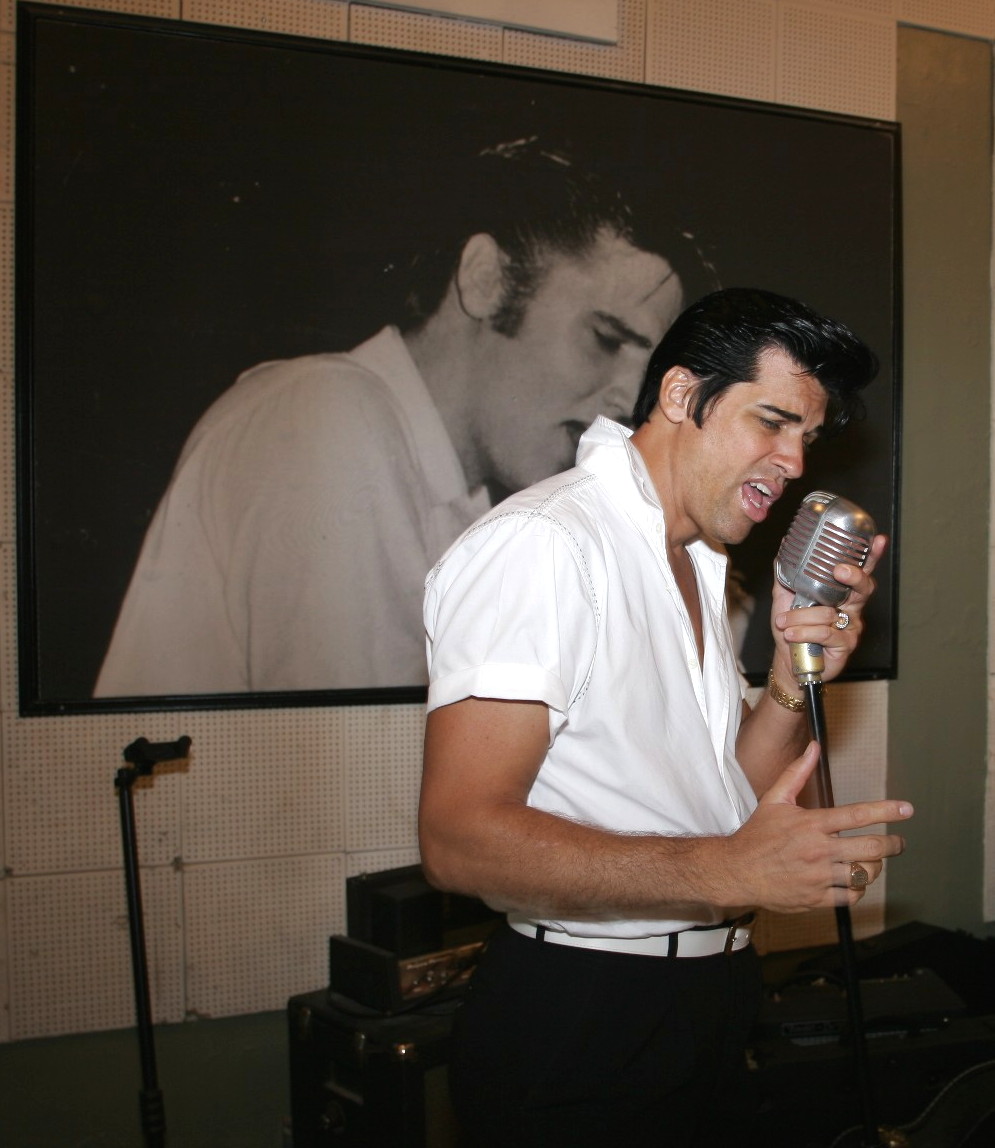
Schulz performing in Memphis.

How you got the job: My ex-wife was garnishing wages from my corporate job, so I only had about $400/month to live on. To make some extra money, I started singing karaoke at different venues for fun. I entered a contest and happened to sing Elvis, and the DJ called me afterward. He asked if I had ever thought about being an Elvis impersonator, and my first thought was, I’m not a fat guy, and I’m not putting on a white jumpsuit.

What changed your mind? He told me I could make $500/hour performing, which perked my ears up. I started practicing, and made $850 for 45 minutes during my first gig. After I was laid off from my corporate job, I decided to go into showbiz full-time.

You call yourself “young Elvis.” What are the restrictions? I’m strictly a 50s Elvis – not that fat guy in a white jumpsuit. I perform mostly blues – you know, “Heartbreak Hotel” and “Don’t Be Cruel.”

How do you resemble Elvis? My hair lifts high like his, and we’re the same height and weight. I also practice all his mannerisms, like singing to the microphone and the little inflections in his voice.

That must take a ton of practice. In the beginning, I spent thousands of hours in front of the mirror. And I’m always practicing my voice – usually in my car, since I drive around a lot. [Begins belting out “You Don’t Know Me.”]

Schulz with Elvis' stepbrothers, Rick Stanley (L) and Billy Stanley (R).

What makes your show unique? All our instruments – including our microphones – are vintage, meaning they’re worth about $145,000. My group is officially endorsed by Rick and Billy Stanley, Elvis’ stepbrothers, and Billy once told me that it freaks him out how much I look like Elvis.

How many guys do you work with? A trio, just like the original Elvis trio: a drummer, guitarist, and bassist. We also do some Frank Sinatra and Dean Martin shows.

And you do all the singing? Yep, and I play some acoustic guitar, just like Elvis did. I’m pretty much a one-man shop: I manage the marketing, bookings, advertisements, video editing, production, web design, and sales. My business background helps with all of that.

Where do you perform? Lots of nursing homes, retirement homes, and events like the Special Olympics. But to pay the bills, I’ll do larger venues, like performing arts centers, corporate events, the occasional casino, and private parties – weddings, anniversaries, and birthday parties.

Do you travel across the United States? All over the world, actually. If they’re paying, we’re playing.

Something people don’t know about your job: Elvis crosses all cultural and socioeconomic borders. We perform for kids to teens to people in their 90s. Playing for older clients is cool, because we’re bringing music back to life that they grew up with.
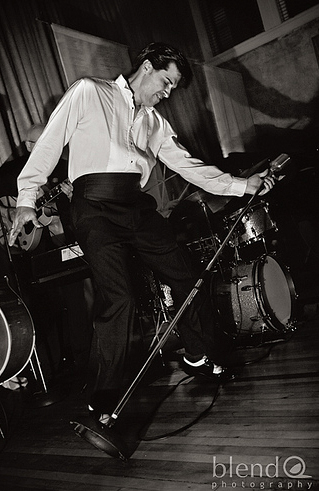
Channeling Elvis' style, Schulz sings to the microphone "like it's his woman."

Do you refer to yourself as “The King”? No, never ever, ever. When I’m on stage, I’m on, but when I’m off, I’m off.

You seem like a pretty normal guy, but there must be some crazies out there who think they’re actually Elvis. Last year, I went to Elvis Week in Memphis for the first time. Some of the people there made Trekkies look normal.

Did you grow up listening to Elvis? Elvis, Frank Sinatra, Dean Martin, Nat King Cole – all the classics.

Is your house decorated with memorabilia? I’ve never bought that kind of stuff, but people always give it to me – 45s, books, framed photos. My living room is decorated very classy, with some 45s and some black-and-white photos from Jailhouse Rock.

How do you pump up the crowds? Elvis was always a practical joker, so I’ll do lots of comedy and banter on stage to keep things fresh. I also spend about half the show off the stage, walking around the room and singing to ladies.

Funniest memory from a show: Once, I heard a woman whisper to her husband, “That guy must have had plastic surgery.” So I snuck up behind her and said into my mic, “Nope, no plastic surgery!” She screamed.

Routine before a show: I’ll apply a little mascara to my eyebrows, some red chapstick to my lips, and occasionally some self-tanner to bring out my eyes. Some of the Elvis impersonators I’ve seen wear so much makeup that they look like French prostitutes.

You mentioned an ex-wife earlier. Was she an Elvis fan? She hated it. In the beginning, she pretended to like it, but we couldn’t eat dinner without people asking to take a photo with me. I didn’t mind it.

Schulz with a group of adoring fans after a show.

So you have lots of fans? Once, during a dinner in Florida, a group of eight girls came up to me to take photos. Their boyfriends were sitting at the next table, giving us dirty looks. I was like, Hey man, they came over to us. Get mad at them.

Favorite Elvis number: I have about 10 favorites, mostly ballads, including “Love Me Tender,” “Can’t Help Falling in Love,” and “All Shook Up.”

LAUNCHING YOUR CAREER>>
1. While it’s important to seek the advice of industry experts, think outside of the box. Everyone told me to build a fan base, but I didn’t want to. I like working with new people at each show, so I always go after different venues and fresh audiences.

2. Find a niche in the market. All Elvis impersonators were doing the jumpsuit thing, so I opted to do young Elvis. Also, market your services as selling an experience. I sell the entire 1956 style, feel, energy, and vintage instruments– not just a guy who looks like Elvis.

3. It helps to have a business background. Otherwise, you’re at the mercy of your manager. Just look at Billy Joel’s $90 million lawsuit against his ex-brother-in-law and former manager; the guy didn’t know anything about his own books.

Check out more videos of Young Elvis and the Blue Suedes! Unless stated otherwise, all photos courtesy of bluesuedeent.com.
Saving the Rainforest in $8 Rubber Rain Boots

Jenny Litz doesn

For the past 15 months, Jenny Litz woke up each morning and checked for tarantula bites on her skin, cockroaches in her shoes, and poisonous snakes on the ground.

In the coastal rainforest region of Ecuador, where Jenny worked as a field research assistant, such things are commonplace. After interning abroad in Ecuador in college, she knew she belonged in the hot, rainy environment, which was a full 21 hours away from her home in Seattle by plane, bus, open-air truck, and horse.

She fell in love with the rainforest community and its barbecued cuy (more commonly known as guinea pig), so she returned to Ecuador to educate kids about deforestation and to study bird population patterns. “The rainforest is something everyone loves deep down and has a passion for,” Jenny says. “But people may not realize it until they see it.”

Age: 25
Graduated from: Western Washington University, degree in biology
Salary: Lived on a stipend of $200 per month (after rent: $60 per month)
Previous jobs: Lifeguard; worked at a plant nursery; substitute teacher

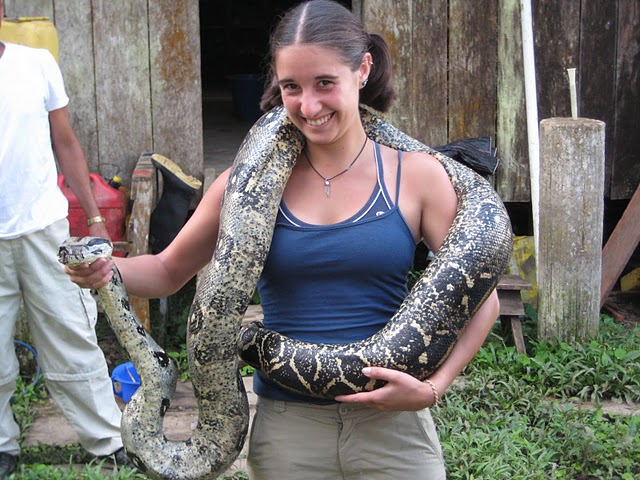
Jenny holding an umbrellabird, with a radio on its back to study its home range.

Ties to the rainforest: Since I was a little kid, I always loved the idea of the rainforest. In college, I realized the sad reality: the rainforest was being cut down at a ridiculous rate. Trucks take down huge tree trunks 24 hours a day. It’s very personal for me – I fell in love with this place, and don’t want to it disappear.

Why Ecuador? My junior year in college, I interned there for three months in part because I was minoring in Spanish. I worked with scientists from UCLA in a biological research station studying plants, which made me realize I didn’t want to study plants. I wanted to work with birds.

So you moved back after graduation? I reconnected with the scientists from the Center for Tropical Research at the UCLA Institute of the Environment and Sustainability. I volunteered in Ecuador on a tourist visa for three months and taught kids in rural rainforest communities about ways to coexist with their environment; their families were cutting down trees to make money, and the children were killing birds with slingshots.

Don’t the inhabitants want to preserve the rainforest? You’d think so. But they thought selling the trees was the most profitable use of their land.

Jenny with a group of children in the rainforest community, where she taught environmental education.

What was most striking about their way of life? [The people I worked with] lived in shacks with tin roofs, and their only source of running water was the river. But despite their poverty, these people shared everything. If they had one mattress for their entire family of 12, they gave it to you and slept on floor.

What happened after your three-month visa was up? I came back to the United States and acquired a two-year visa to work as a field research assistant in the Chocó region of Ecuador with a group from Tulane University.

Did you work with kids again? I studied migratory birds and their population patterns, which is where my true interest was. I spent half my days in the rainforest and half in the capital city of Quito.

The dirt road is four hours walking or on horseback.

Distance between the Chocó rainforest and Seattle: It’s a 10-hour plane ride to Quito, then a five-hour bus ride to the outskirts of the jungle. Then I got on an open-air truck squeezed with 40 people, chickens, and huge sacks of rice. After two hours on a bumpy dirt road, we arrived at the last place a car could get to, and from there took a horse or walked for four hours, wearing knee-high rubber boots that cost $8 in town.

That’s 21 hours total. If you do it all at once. I usually spent the night in Quito.

Ecuadorian delicacies: The guinea pig, called cuy, was delicious. I also ate rabbit once, which was dark, juicy, and cooked over a barbecue. Street vendors also sold tons of crazy different fruits, like fresh passion fruit.

El Mercado, the market in Ecuador, sold lots of fresh, cheap, and delicious fruits.

Anything you didn’t try? The skull soup, which was served with sheep’s head in it. You’re supposed to eat its brains.

Job responsibilities as field research assistant: Waking up at 4 a.m., hiking to the study site, and opening mist nets for the birds to fly into. We often caught four to 10 birds every half hour, and would then measure, examine, and release them.

Examine them for what? We attached a small metal bracelet to each bird’s foot to identify the species if we caught if again years later. We also took a tiny blood sample and removed two tail feathers from each bird, which served as DNA samples. The samples and data were taken to labs at Tulane for comparative studies on life spans and growth.

How many bird species did you encounter? There are 1,640 species of birds in Ecuador. In the area we worked in, there were 350. Our nets were only nine feet tall, so they didn’t catch birds in the canopy, like parrots.

Favorite bird: The endangered umbrellabird was emblematic of our project; almost nobody had ever studied it before this project. The feathers hanging from its chin looked like a long beard.

Measuring a toucan

Best part of the job: Being so close to the animals. I held toucans in my hands and felt the wind from bats’ wings just inches from my face.

Worst part of the job: Waking up at 4 a.m. every day and hiking in rainy, hot, and muddy conditions. The lifestyle in general is pretty hard.

Besides for the rain boots, what’s your jungle attire? High nylon soccer socks, convertible zip-off pants, and light, breathable tops. I always carried a backpack with a 1.5-liter water bottle and bugspray to avoid mosquitoes carrying Leishmaniasis parasites, which make holes in your skin.

What changed between your first and second trips to Ecuador? I eventually got used to the tarantulas in my room, the cockroaches in my shoes, and the poisonous snakes everywhere. I’d often see small gravesites on roadsides where someone had been bitten and killed on the spot by a snake.

Did you have reverse culture shock coming back to America? I was blown away. Everyone has a smartphone, and there are these weird squares you scan [QR codes].

What did you miss about America? My family, obviously. And Cool Ranch Doritos – Ecuador sold other types, but not Cool Ranch.

What are your current plans? I’ve been substitute teaching since I returned in May, and now I’m applying to grad school to study conservation ecology. I want to focus on tropical environments and complete my thesis in South America.

Greatest setback: I applied for a Fulbright grant in Ecuador and came back as an alternate. Getting funding is so complicated – my research depends on grants.

Have you ever felt in danger as a woman in the rainforest? Rainforest communities are very patriarchal societies. People there assumed [my boyfriend] Luis and I were married, and asked why I didn’t already have 10 kids. Women definitely don’t have equal rights, but I never felt in danger.

Photo credit: toursinperu.blogspot.com

LAUNCHING YOUR CAREER>>
1. Study a foreign language, then travel or intern abroad in your area of designated fieldwork. It changes your way of looking at the world.

2. Research people who are involved in your field of interest. Contact whoever is heading up a cool new project and ask about volunteer positions; don’t be afraid to make a cold call.

3. Look at and subscribe to online publications like The Wilson Journal of Ornithology.

Visit Jenny’s blog at jennylitz.tumblr.com and check out more exclusive rainforest photos on the No Joe Schmo Facebook page! Unless otherwise noted, all photos courtesy of Jenny Litz and Luis Carrasco.


Did you study abroad in college and want to return there post-graduation? If so, where? Comment below!

The Artificial Limb Maker

David Sisson working on a plaster cast for a leg. Photo credit: Patrick Sisson

In 1974, as a high school junior in a “blue-collar ghetto neighborhood,” David Sisson delivered pizza. But on the side, he designed and fabricated artificial limbs. They were carved from a block of wood, and he made adjustments with sandpaper and a chisel.

Since then, prosthetics has taken huge strides. After receiving his college degree – he was the first in his family to do so – David Sisson founded the Sisson Mobility Restoration Center, Inc. in Madison, Wisc. There, he implements personal, customized treatment for amputees, war veterans and victims of physical abuse. He records their information using no measurements: only his hands and plaster. In his 37 years of treating more than 10,000 amputees, he’s learned a thing or two about the process.

Age: 53
Graduated from: City Colleges of Chicago, Associate’s degree in prosthetics (included clinical training at Northwestern University)
Dream job in college: Trust-funder
In the industry for: 37 years
Cost per device: Below-knee prostheses average from $8,000 to $10,000
Previous jobs: Lifeguard; pizza delivery boy; worked at the Rehabilitation Institute of Chicago

How he got the job: I was working as a pizza delivery boy, and one night, I was delivering this girl’s weekly Friday night pizza pie. She opened the door, and a there was a huge guy holding a 45-caliber gun in the room. I said, That’s it, I quit. My high school had posted an opening for a prosthetic technician, and the pay was better than my rate as a pizza delivery boy, so I applied. I started sanding wooden legs in shop class.

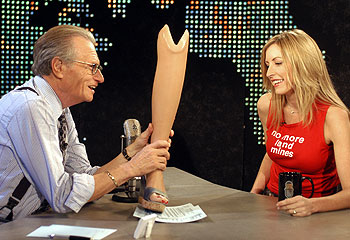
Heather Mills, Paul McCartney's ex-wife, took off her prosthetic leg during an interview on Larry King Live in 2002. Photo credit: freerepublic.com

Why did you start your own center? I’m a terrible employee. I was raising a family in Madison, Wisc., so I tried to buy the business I was working at. They wouldn’t let me, so I started my own business.

Do you mostly order devices from a catalog? I’m old school, so we make about 98% of what we use. If you’re missing it, I make it – externally, that is. But a majority of prostheses are below the knee, due to the diabetes epidemic.

Are diabetes-related injuries increasing?  Yes, and patients are getting younger. Most of diabetes patients used to be over age 60, and now it’s more like age 40.

What’s the process of creating an artificial limb? It’s more art than science. After someone loses a limb, it takes about a month to heal from the surgery. Then, we squeeze out any built-up fluid and take a cast of the stump for accuracy. Finally, we sculpt a plaster cast and make sockets depending on the person’s age and activity level.

Most important part: The quality of the socket [which connects the prosthesis to the stump]. If it’s not comfortable to wear – if it hurts to walk – you’re not going to use it.

Harrison Ford with Sisson's prosthetic arm in The Fugitive. Photo credit: movieforums.com

Coolest moment of your career: I was in the film The Fugitive alongside Harrison Ford and Tommy Lee Jones for about two seconds. I created the prosthesis for the one-armed man.

People don’t realize: There are many more amputees in this world than you’d expect. Many always wear long pants, so you can’t tell.

Do you have any special techniques? I don’t take any measurements – I just use my hands and plaster impressions. I’ve seen 10,000 amputees in my 37 years, and can record lots of information by feeling soft tissue and bone structure with my hands.

What materials are used for the artificial limb? Heat foam with aluminum and titanium fittings. Sockets are made of fiberglass, carbon fiber, and other materials. We attach limbs with suction instead of leather straps, which is how it used be.

Once the limb is replaced, can a patient return to everyday life? It takes anywhere from six to eight weeks for the soft tissue to remodel itself and heal internally. It can also take that long for patients to get used to the stresses and strains, so physical therapy can be very beneficial.

Are the limbs water-resistant? Most are not, although we can specially design them to be. Some people develop a closet full of limbs over the years, so they’ll use an old foot or leg to go in the water and then throw it out.

What if you don’t have a closet full of limbs? Tie a garbage bag around your thigh – or wherever the stump is – to keep out the water during a shower or bath.

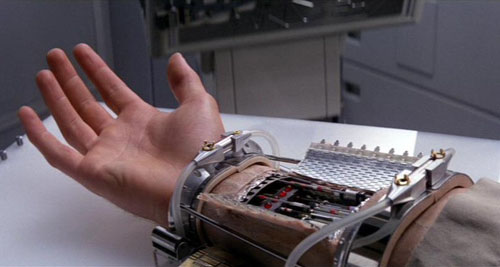
Luke Skywalker's legacy lives on today. Photo credit: scifi-review.net

How has modern technology advanced your work? Patients are running marathons and going back into active combat wearing prostheses. Luke Skywalker’s replacement hand in 1977 had fingers that moved independently, and we thought that would never happen. Now, we create hands with five motorized fingers.

Hardest part of the job: Every amputee is different, and people have lists of expectations. They can get very hung up on cosmetics and appearances.

Are you more protective of your kids because of the injuries you witness on a daily basis? No. My older son broke his arm twice in one summer, and I was in the emergency room with him, but was kind of jaded. I’ve seen people ripped in half, people missing halves of bodies from electrical burns. So I wasn’t too overwrought over a broken arm.

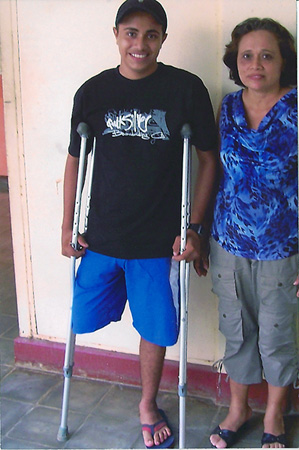
A boy in Nicaragua who lost his leg in 2007. Photo credit: htc-il.org

You also work with amputees in third-world countries. A group called Healing the Children provides medical care to children in need. When the group traveled to Nicaragua, they brought back some cases they couldn’t take care of. I made several prostheses for boys who had suffered machete injuries.

That must be incredibly rewarding. Yes, but it’s essentially a bait-and-switch for young kids. You can give them a new leg, but if they need minor repair, they don’t have the three cents for a bus ride into town, much less the two cents for a new rivet. There needs to be an infrastructure where someone is on-site, in the matrix of society in these third-world countries.

Something people don’t know about you: I grew up a blue-collar ghetto neighborhood, and am the first in my family to receive a college degree. Also, I’m left-handed.

Have you used your skills outside of working with patients? [Using my hands] also comes in handy with making costumes. I helped make props and set pieces for my son’s school performance of Aida and a local theater group’s performance of A Christmas Carol.

Best lesson learned? You can decide a prosthetic limb is just one more challenge in your life. Or you can do the best you can with what you’ve got.

David Sisson creating a prosthetic hand (note: not Luke Skywalker's). Photo credit: Patrick Sisson

LAUNCHING YOUR CAREER>>
Want a future in artificial limbs? Dave Sisson gives you a leg up.

1. Visit a local limb shop and ask the prosthetist if you can shadow him or her for a few days. Some parts of our job are kind of gross, so you need to make sure it suits your sensibilities.

2. The American Board for Certification in Orthotics, Prosthetics and Pedorthics offers many resources, including the curriculum for individual certification and continuing education courses.

3. What I do is very abnormal, so part of the process with new amputees is developing a language with each patient so he or she can describe how they’re feeling. You must be able to communicate with folks.

Click here to listen to patients’ testimonials from the Sisson Mobility Restoration Center.

Have you or a loved one ever lost a limb? How long did it take to readjust? Comment below!

The Urban Honey Beekeeper

Photo credit: Matthew Sandager Photography

Think of them as your new pets. Your best friends. Your companions. You know, the kind of companions that might sting you – and then fly away, leaving their guts and stingers behind.

Go ahead, scoff. But Noah Wilson-Rich, the founder of Best Bees Company, transports tens of thousands of honey bees to hives across the greater Boston and Cape Cod areas. He considers them his pets. In fact, he’s received so many bee stings over the past five years that he barely notices them anymore.

Noah’s organic beekeeping service is the only of its kind. He develops and installs honey bee hives in gardens and on rooftops in urban habitats and revisits them every two weeks. The proceeds from thankful hive-owners contribute to Noah’s development of vaccines to help bees better survive the winters and avoid diseases.

Bees weren’t always Noah’s best friends. As a kid, he was terrified of bugs. Below, he explains his connection with them – as well as the science behind the “disappearing bees” phenomenon. Plus: you’ll never guess what wallet item he uses to remove stingers!

No, this isn't Noah. Just a fellow bee-lover. Photo credit: Reuters/Eliana Aponte

Age: 29
Working with bees since: 2006
Graduated from: Northeastern University, Bachelor’s degree in biology; Tufts University, Ph.D. in biology
Previous jobs: Clinical researcher, phlebotomist [someone who draws blood], and nurse’s assistant at Children’s Hospital Boston

Job description in one sentence: I deliver, install, and maintain honey bee hives for gardeners and property owners and the greater Boston and Cape Cod areas to raise money for my research to improve honey bee health.

Where did you learn about bees? I helped manage honey bee hives at the veterinary school at Tufts. I’m also a 2007 graduate of the Bee School at the Essex County Beekeepers Association in Topsifield, Mass.

I have a mental image of students dressed in black and yellow, buzzing around the classroom. I actually thought it was only gonna be me and a couple of weirdos in the class. But there were 80 people enrolled – all regular, everyday people who just wanted a little piece of nature in their lives.

What sparked your interest in honey bees? Initially, because of my background in medicine, I was interested in learning how bees could resist diseases. There’s an innate connection between humans and honey bees that’s existed for thousands of years.

Coolest thing people don’t know about your job? Watching honey bees is extremely relaxing. Hive owners just sit with a cup of coffee, watching the bees bring in pollen and nectar. It defies the common Omigod, bees! I’m so nervous! mentality.

You’ve never been scared of them? The beekeeper suit is like an invincibility cloak – it gives me confidence. But I still get stung regularly, which is never fun.

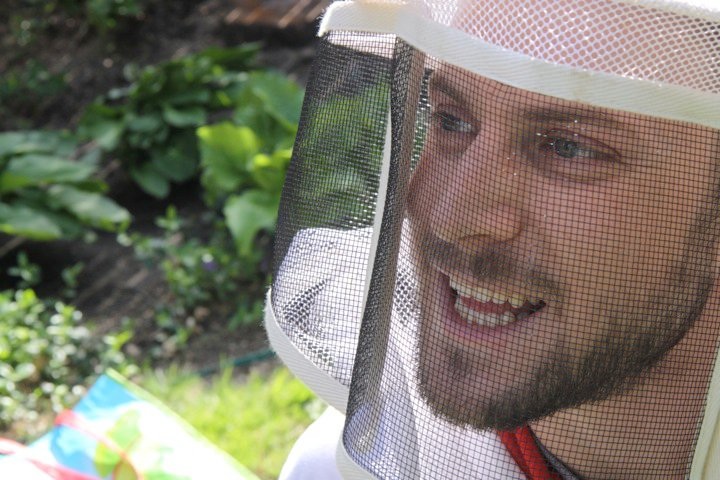
Noah wearing his beekeeper suit. Photo credit: Izzy Berdan

What does the suit look like? It’s a white onesie jumpsuit with full arms and legs, and at the neck there’s a zipper attached to a veil. The veil is mesh that surrounds my head and has a hole at the top made of harder mesh. It sits like a safari hat.

Why you should care about honey bees: Ecologically, they help plants reproduce by transferring pollen, which contributes to the fruits and veggies that humans consume. Economically, the estimated value of all the crops they pollinate around the world is about $15 billion annually. If honey bees are less available, costs of produce pollinated by honey bees will rise. We’ve already seen that with almond products.

Number of honey bees in each hive: Tens of thousands.
Number of bumblebees in each hive: About 100.

Tell me about the “disappearing bees” phenomenon. Just around 2006, when I started working with bees, news started popping up that they were dying from colony collapse disorder. Basically, that means thousands of older foraging bees were just vanishing from their hives – there were no dead bodies to examine what killed them. The younger and baby bees were still there, the queen bee was still laying eggs, and the hive looked healthy, with plenty of pollen and nectar.

Note: Beekeper suits do not actually resemble Lady Gaga's beekeeper hat. Photo credit: idolator.com

Why is that so bad? Without [the older foraging bees], younger bees are forced to collect pollen before their immune systems are fully developed. So those younger bees would bring back disease agents and bacteria to their hives – or so we think.

How do you explain the disappearing? Researchers are still furiously figuring it out. Three leading hypotheses are pesticides, poor nutrition, and disease. The strongest argument is for disease: when fungi and viruses infect the hive, it collapses.

Is there a way to help? Oral supplements and bee yogurt filled with probiotics can help strengthen their immune systems. Immune boosters are added to a mixture of water and pollen, forming a peanut butter-like consistency. The goop is shaped into paddies and placed into hives for consumption.

Hardest part of the job: Although I patented a vaccination for these diseases, it’s been impossible to get funding from grants. Best Bees Company is a way to raise money for my research.

Are your hive installation services in high demand? Right now, I’m managing 32 hives. I check on the hives once every two to three weeks, so I’m constantly traveling from Gloucester through urban Boston down to Cape Cod.

Charge for a honey bee hive: $975 for the first year, which is all-inclusive; $750 to $850 for each subsequent year, depending on location. We’ll replace the bees at no additional cost if they don’t make it through the winter.

I’m assuming these aren’t killer bees, then. They’re totally non-aggressive Italian bees. If you’re not a flower, they won’t care about you. Killer bees are from tropical habitats like Africa. Aggressive traits in honey bees were favored over time in tropical habitats because of selection pressure from predators.

Honey bees improve the quality and quantity of garden crops. Photo credit: gmo-journal.com

Benefits of a honey bee hive: The honey is delicious – just take out the frame from inside the hive, which will be covered in honey and capped with wax. Remove the wax, let the honey drip into a pan, and dip a spoon in. No processing is required since we don’t use any chemicals.

Little-known way to help a bee sting: Dribble vinegar onto a paper towel, and press it to onto the sting.

Little-known way to remove a stinger: The stinger still pumps venom after a bee sting, so the faster you can remove it, the better. Slide out the stinger with a credit card; your fingers can push the venom in with an accidental pinch.

Biggest pet peeve: Slow drivers. I have tens of thousands of bees in my car, people.

LAUNCHING YOUR CAREER>>
Noah Wilson-Rich gives the buzz on sustainable beekeeping practices.

1. Take a beekeeping course. You’ll not only learn how to become a beekeeper, but also become part of a community and a greater network. For example, the Barnstable Academy in Cape Cod offers classes on how to breed local queen bees instead of importing them.

2. Join your local beekeepers association. Unless you want to do research, you don’t necessarily need a background in science or biology. In fact, most of the people in the New York City Beekeepers Association are lawyers.

3. Remember, this isn’t a cheap hobby.

Visit BestBees.com to learn more about the Boston screening of “Vanishing of the Bees,” a documentary film about honey bees, their importance, and their baffling disappearance, on June 23.

The Guys That Clean Eight-Story IMAX Screens

Michael Quaranto can’t count the number of times he’s heard, “Wait, you do what for a living?” He sighs. Most people just don’t understand why he’d give up his job as an airline pilot to clean nacho cheese and silly string from movie screens after-hours.

In 2004, Quaranto – along with his best friend and fellow pilot, Andrew Brown – founded 1570 Cinema Services as a way to rake in extra cash. But business boomed, so Quaranto quit his job to clean screens full-time. Now, the two work on more than 1,000 screens per year across the world – from North Carolina to Australia to South America.

Title: Partner and co-founder, 1570 Cinema Services
Age: 34
Salary: If we hired someone full-time, we’d pay them between $40,000 and $50,000/year.
In the industry for: 19 years
Screens he cleans in one night: 15 to 20. The average person could probably only clean five or six in a night.
Based out of: Chicago, with another small office in Houston, TX
Graduated from: Baylor University, degree in business marketing
Dream job in college: Airline pilot
Previous jobs: Clown’s assistant; every department in the grocery store; bicycle mechanic; waiter; busboy; Starbucks barista; airline pilot

Job description in one sentence: We service flat screens, domes, and [standard-sized] 35mm screens in theater chains, museums, and science centers worldwide.

How he got the job: When I was 15, I worked cleaning movie screens for my friend’s father, who had the world’s only screen-cleaning company. I continued to do that part-time when I was an airline pilot, and we kept getting requests to clean IMAX screens. My friend’s father said nobody knew how to do that. I realized there was a gap in the screen-cleaning market, so I started a business [cleaning large-format screens] with Andrew.

Something people don’t know about you: It’s hard for people to understand why we’d give up a job flying planes to work at removing gummy bears from movie screens. It’s like being a janitor on a vertical surface.

Well, why did you switch careers? I love owning my own business and having a niche market. It allows for a ton of flexibility and freedom.

How do you reach the high screens? The traditional theater chain screens are only about 30 feet tall, so we use aluminum extension poles from the ground. We put custom-made towels over the cleaning heads on the poles to dust the screen. Then, we spray on a sudsy cleaning solution from a pressurized bottle and rinse it. If we’re working between shows, we’ll dry the screens with a microfiber material.

What about cleaning huge IMAX screens? We use a machine because the extension poles can’t reach that high; most are seven or eight stories. Pulleys connect cleaning heads, which are made of wax-infused lamb’s wool, to an electric motor that moves the heads up and down.

Does that hurt your upper body? Andrew and I are not very muscular – we’re two tall skinny guys. It does wreck your shoulders. Driving home the next day, it’s hard to touch the top half of the steering wheel.

How long does it take to clean one screen? An IMAX screen takes 8 hours. We’ll go in at midnight or 2 a.m., work through the night, and finish in the morning. You have to get on a different schedule.

What do you charge? Varies by size. Regular movie screen, local, $90; IMAX screen, local, $5,000; additional airline costs depending on location.

Grossest things you’ve cleaned off? Spit wads, lugies, silly string, and anything you can find at a concession stand – like gummy bears and nacho cheese.

Best career advice: Remain positive and stay away from people who say you can’t do it. A lot of people said we couldn’t clean IMAX screens, but we knew it could be done, so we pursued finding a process.

LAUNCHING YOUR CAREER>>
Looking to start a business in a niche market? Michael Quaranto offers three tips.

1. If you’re looking to start a new business, keep your full-time job. Don’t completely quit without knowing whether your product will sell. Then, once you figure out a business model, patent the process. For us, that took about two years.

2. Attend conventions and join associations related to your target market. That way, you can find out what other people with similar businesses are doing to stay fresh. For example, we occasionally attend conventions for the Giant Screen Cinema Association.

3. Seek out the decision-makers at companies. Recently, I sent direct mailers to about 100 people, including before/after images of our screens. Even if we only get four responses, that will pay for itself. I took the time to hand-write the envelopes and make the notes personal.

Would you quit your desk job to clean movie screens, even if it meant having 100% flexibility and control over your schedule? Comment below!