Saving the Rainforest in $8 Rubber Rain Boots

Jenny Litz doesn

For the past 15 months, Jenny Litz woke up each morning and checked for tarantula bites on her skin, cockroaches in her shoes, and poisonous snakes on the ground.

In the coastal rainforest region of Ecuador, where Jenny worked as a field research assistant, such things are commonplace. After interning abroad in Ecuador in college, she knew she belonged in the hot, rainy environment, which was a full 21 hours away from her home in Seattle by plane, bus, open-air truck, and horse.

She fell in love with the rainforest community and its barbecued cuy (more commonly known as guinea pig), so she returned to Ecuador to educate kids about deforestation and to study bird population patterns. “The rainforest is something everyone loves deep down and has a passion for,” Jenny says. “But people may not realize it until they see it.”

Age: 25
Graduated from: Western Washington University, degree in biology
Salary: Lived on a stipend of $200 per month (after rent: $60 per month)
Previous jobs: Lifeguard; worked at a plant nursery; substitute teacher

Jenny holding an umbrellabird, with a radio on its back to study its home range.

Ties to the rainforest: Since I was a little kid, I always loved the idea of the rainforest. In college, I realized the sad reality: the rainforest was being cut down at a ridiculous rate. Trucks take down huge tree trunks 24 hours a day. It’s very personal for me – I fell in love with this place, and don’t want to it disappear.

Why Ecuador? My junior year in college, I interned there for three months in part because I was minoring in Spanish. I worked with scientists from UCLA in a biological research station studying plants, which made me realize I didn’t want to study plants. I wanted to work with birds.

So you moved back after graduation? I reconnected with the scientists from the Center for Tropical Research at the UCLA Institute of the Environment and Sustainability. I volunteered in Ecuador on a tourist visa for three months and taught kids in rural rainforest communities about ways to coexist with their environment; their families were cutting down trees to make money, and the children were killing birds with slingshots.

Don’t the inhabitants want to preserve the rainforest? You’d think so. But they thought selling the trees was the most profitable use of their land.

Jenny with a group of children in the rainforest community, where she taught environmental education.

What was most striking about their way of life? [The people I worked with] lived in shacks with tin roofs, and their only source of running water was the river. But despite their poverty, these people shared everything. If they had one mattress for their entire family of 12, they gave it to you and slept on floor.

What happened after your three-month visa was up? I came back to the United States and acquired a two-year visa to work as a field research assistant in the Chocó region of Ecuador with a group from Tulane University.

Did you work with kids again? I studied migratory birds and their population patterns, which is where my true interest was. I spent half my days in the rainforest and half in the capital city of Quito.

The dirt road is four hours walking or on horseback.

Distance between the Chocó rainforest and Seattle: It’s a 10-hour plane ride to Quito, then a five-hour bus ride to the outskirts of the jungle. Then I got on an open-air truck squeezed with 40 people, chickens, and huge sacks of rice. After two hours on a bumpy dirt road, we arrived at the last place a car could get to, and from there took a horse or walked for four hours, wearing knee-high rubber boots that cost $8 in town.

That’s 21 hours total. If you do it all at once. I usually spent the night in Quito.

Ecuadorian delicacies: The guinea pig, called cuy, was delicious. I also ate rabbit once, which was dark, juicy, and cooked over a barbecue. Street vendors also sold tons of crazy different fruits, like fresh passion fruit.
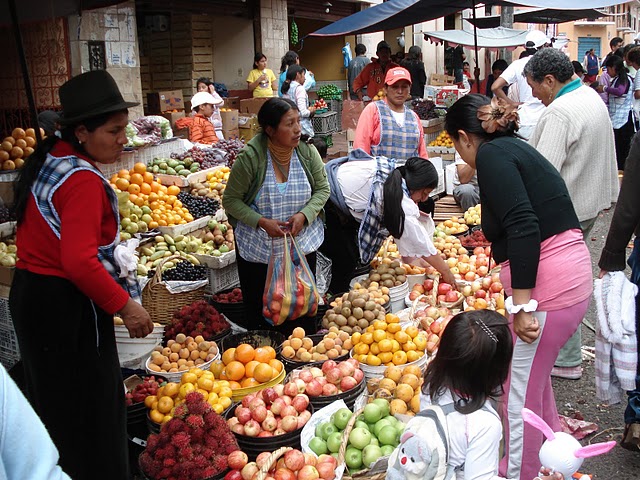
El Mercado, the market in Ecuador, sold lots of fresh, cheap, and delicious fruits.

Anything you didn’t try? The skull soup, which was served with sheep’s head in it. You’re supposed to eat its brains.

Job responsibilities as field research assistant: Waking up at 4 a.m., hiking to the study site, and opening mist nets for the birds to fly into. We often caught four to 10 birds every half hour, and would then measure, examine, and release them.

Examine them for what? We attached a small metal bracelet to each bird’s foot to identify the species if we caught if again years later. We also took a tiny blood sample and removed two tail feathers from each bird, which served as DNA samples. The samples and data were taken to labs at Tulane for comparative studies on life spans and growth.

How many bird species did you encounter? There are 1,640 species of birds in Ecuador. In the area we worked in, there were 350. Our nets were only nine feet tall, so they didn’t catch birds in the canopy, like parrots.

Favorite bird: The endangered umbrellabird was emblematic of our project; almost nobody had ever studied it before this project. The feathers hanging from its chin looked like a long beard.

Measuring a toucan

Best part of the job: Being so close to the animals. I held toucans in my hands and felt the wind from bats’ wings just inches from my face.

Worst part of the job: Waking up at 4 a.m. every day and hiking in rainy, hot, and muddy conditions. The lifestyle in general is pretty hard.

Besides for the rain boots, what’s your jungle attire? High nylon soccer socks, convertible zip-off pants, and light, breathable tops. I always carried a backpack with a 1.5-liter water bottle and bugspray to avoid mosquitoes carrying Leishmaniasis parasites, which make holes in your skin.

What changed between your first and second trips to Ecuador? I eventually got used to the tarantulas in my room, the cockroaches in my shoes, and the poisonous snakes everywhere. I’d often see small gravesites on roadsides where someone had been bitten and killed on the spot by a snake.

Did you have reverse culture shock coming back to America? I was blown away. Everyone has a smartphone, and there are these weird squares you scan [QR codes].

What did you miss about America? My family, obviously. And Cool Ranch Doritos – Ecuador sold other types, but not Cool Ranch.

What are your current plans? I’ve been substitute teaching since I returned in May, and now I’m applying to grad school to study conservation ecology. I want to focus on tropical environments and complete my thesis in South America.

Greatest setback: I applied for a Fulbright grant in Ecuador and came back as an alternate. Getting funding is so complicated – my research depends on grants.

Have you ever felt in danger as a woman in the rainforest? Rainforest communities are very patriarchal societies. People there assumed [my boyfriend] Luis and I were married, and asked why I didn’t already have 10 kids. Women definitely don’t have equal rights, but I never felt in danger.

Photo credit: toursinperu.blogspot.com

LAUNCHING YOUR CAREER>>
1. Study a foreign language, then travel or intern abroad in your area of designated fieldwork. It changes your way of looking at the world.

2. Research people who are involved in your field of interest. Contact whoever is heading up a cool new project and ask about volunteer positions; don’t be afraid to make a cold call.

3. Look at and subscribe to online publications like The Wilson Journal of Ornithology.

Visit Jenny’s blog at jennylitz.tumblr.com and check out more exclusive rainforest photos on the No Joe Schmo Facebook page! Unless otherwise noted, all photos courtesy of Jenny Litz and Luis Carrasco.


Did you study abroad in college and want to return there post-graduation? If so, where? Comment below!

The Urban Honey Beekeeper

Photo credit: Matthew Sandager Photography

Think of them as your new pets. Your best friends. Your companions. You know, the kind of companions that might sting you – and then fly away, leaving their guts and stingers behind.

Go ahead, scoff. But Noah Wilson-Rich, the founder of Best Bees Company, transports tens of thousands of honey bees to hives across the greater Boston and Cape Cod areas. He considers them his pets. In fact, he’s received so many bee stings over the past five years that he barely notices them anymore.

Noah’s organic beekeeping service is the only of its kind. He develops and installs honey bee hives in gardens and on rooftops in urban habitats and revisits them every two weeks. The proceeds from thankful hive-owners contribute to Noah’s development of vaccines to help bees better survive the winters and avoid diseases.

Bees weren’t always Noah’s best friends. As a kid, he was terrified of bugs. Below, he explains his connection with them – as well as the science behind the “disappearing bees” phenomenon. Plus: you’ll never guess what wallet item he uses to remove stingers!

No, this isn't Noah. Just a fellow bee-lover. Photo credit: Reuters/Eliana Aponte

Age: 29
Working with bees since: 2006
Graduated from: Northeastern University, Bachelor’s degree in biology; Tufts University, Ph.D. in biology
Previous jobs: Clinical researcher, phlebotomist [someone who draws blood], and nurse’s assistant at Children’s Hospital Boston

Job description in one sentence: I deliver, install, and maintain honey bee hives for gardeners and property owners and the greater Boston and Cape Cod areas to raise money for my research to improve honey bee health.

Where did you learn about bees? I helped manage honey bee hives at the veterinary school at Tufts. I’m also a 2007 graduate of the Bee School at the Essex County Beekeepers Association in Topsifield, Mass.

I have a mental image of students dressed in black and yellow, buzzing around the classroom. I actually thought it was only gonna be me and a couple of weirdos in the class. But there were 80 people enrolled – all regular, everyday people who just wanted a little piece of nature in their lives.

What sparked your interest in honey bees? Initially, because of my background in medicine, I was interested in learning how bees could resist diseases. There’s an innate connection between humans and honey bees that’s existed for thousands of years.

Coolest thing people don’t know about your job? Watching honey bees is extremely relaxing. Hive owners just sit with a cup of coffee, watching the bees bring in pollen and nectar. It defies the common Omigod, bees! I’m so nervous! mentality.

You’ve never been scared of them? The beekeeper suit is like an invincibility cloak – it gives me confidence. But I still get stung regularly, which is never fun.

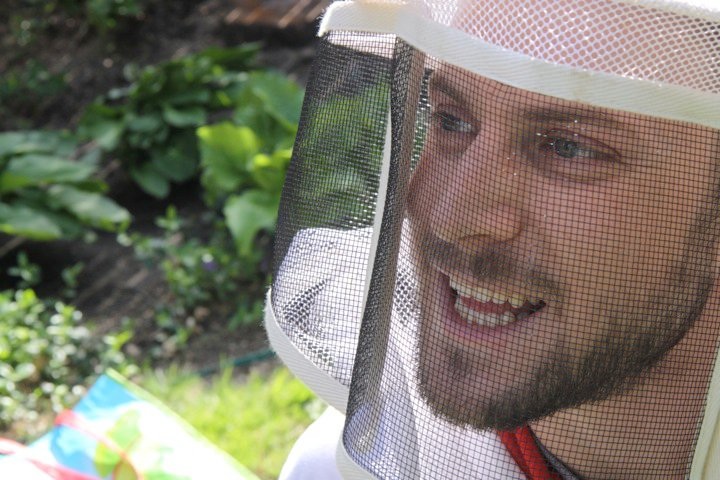
Noah wearing his beekeeper suit. Photo credit: Izzy Berdan

What does the suit look like? It’s a white onesie jumpsuit with full arms and legs, and at the neck there’s a zipper attached to a veil. The veil is mesh that surrounds my head and has a hole at the top made of harder mesh. It sits like a safari hat.

Why you should care about honey bees: Ecologically, they help plants reproduce by transferring pollen, which contributes to the fruits and veggies that humans consume. Economically, the estimated value of all the crops they pollinate around the world is about $15 billion annually. If honey bees are less available, costs of produce pollinated by honey bees will rise. We’ve already seen that with almond products.

Number of honey bees in each hive: Tens of thousands.
Number of bumblebees in each hive: About 100.

Tell me about the “disappearing bees” phenomenon. Just around 2006, when I started working with bees, news started popping up that they were dying from colony collapse disorder. Basically, that means thousands of older foraging bees were just vanishing from their hives – there were no dead bodies to examine what killed them. The younger and baby bees were still there, the queen bee was still laying eggs, and the hive looked healthy, with plenty of pollen and nectar.

Note: Beekeper suits do not actually resemble Lady Gaga's beekeeper hat. Photo credit: idolator.com

Why is that so bad? Without [the older foraging bees], younger bees are forced to collect pollen before their immune systems are fully developed. So those younger bees would bring back disease agents and bacteria to their hives – or so we think.

How do you explain the disappearing? Researchers are still furiously figuring it out. Three leading hypotheses are pesticides, poor nutrition, and disease. The strongest argument is for disease: when fungi and viruses infect the hive, it collapses.

Is there a way to help? Oral supplements and bee yogurt filled with probiotics can help strengthen their immune systems. Immune boosters are added to a mixture of water and pollen, forming a peanut butter-like consistency. The goop is shaped into paddies and placed into hives for consumption.

Hardest part of the job: Although I patented a vaccination for these diseases, it’s been impossible to get funding from grants. Best Bees Company is a way to raise money for my research.

Are your hive installation services in high demand? Right now, I’m managing 32 hives. I check on the hives once every two to three weeks, so I’m constantly traveling from Gloucester through urban Boston down to Cape Cod.

Charge for a honey bee hive: $975 for the first year, which is all-inclusive; $750 to $850 for each subsequent year, depending on location. We’ll replace the bees at no additional cost if they don’t make it through the winter.

I’m assuming these aren’t killer bees, then. They’re totally non-aggressive Italian bees. If you’re not a flower, they won’t care about you. Killer bees are from tropical habitats like Africa. Aggressive traits in honey bees were favored over time in tropical habitats because of selection pressure from predators.

Honey bees improve the quality and quantity of garden crops. Photo credit: gmo-journal.com

Benefits of a honey bee hive: The honey is delicious – just take out the frame from inside the hive, which will be covered in honey and capped with wax. Remove the wax, let the honey drip into a pan, and dip a spoon in. No processing is required since we don’t use any chemicals.

Little-known way to help a bee sting: Dribble vinegar onto a paper towel, and press it to onto the sting.

Little-known way to remove a stinger: The stinger still pumps venom after a bee sting, so the faster you can remove it, the better. Slide out the stinger with a credit card; your fingers can push the venom in with an accidental pinch.

Biggest pet peeve: Slow drivers. I have tens of thousands of bees in my car, people.

LAUNCHING YOUR CAREER>>
Noah Wilson-Rich gives the buzz on sustainable beekeeping practices.

1. Take a beekeeping course. You’ll not only learn how to become a beekeeper, but also become part of a community and a greater network. For example, the Barnstable Academy in Cape Cod offers classes on how to breed local queen bees instead of importing them.

2. Join your local beekeepers association. Unless you want to do research, you don’t necessarily need a background in science or biology. In fact, most of the people in the New York City Beekeepers Association are lawyers.

3. Remember, this isn’t a cheap hobby.

Visit BestBees.com to learn more about the Boston screening of “Vanishing of the Bees,” a documentary film about honey bees, their importance, and their baffling disappearance, on June 23.

The Rain, Wind, and Snow Man

Photo credit: 123rf.com

The Day After Tomorrow, 2012 – yeah, we’ve heard it all before. The world is ending and global warming may kill us. But how much of the noise can we really believe?

Jon Gottschalck, 39, provides local and regional forecasts at the National Oceanic and Atmospheric Administration, more commonly known as NOAA. Their National Weather Service weather service is the official voice of the U.S. government for issuing warnings during life threatening weather situations (think Snowpocalypse ’10).

The former NASA researcher has been pafmatssionate about weather since the age of 6, when he loved frolicking in the snow. Indeed, weather now consumes Gottschalck’s life – he often gets blamed (jokingly, he insists) at dinner parties for incorrect predictions. But the public doesn’t realize how far weather predictions have come in the past 30 years, he says. Read on for his explanation – and if the world is really ending.

Title: Head of Forecast Operations, Climate Prediction Center, NOAA [National Oceanic and Atmospheric Administration]
Age: 39
Salary: $115,000/year
Based out of: Camp Spring, MD
Graduated from: Penn State, Bachelor’s and Master’s degrees in science
Previous jobs: Senior research association at University of Miami; research staff member at NASA’s Goddard Space Flight Center

Job description in a sentence (or two): I manage 10 to 15 forecasters, and ensure that all operational forecasts are accurate and timely. I’m also responsible for interjecting any new ideas into operational forecasts.

Snow days: a kid's best friend. Photo credit: kidsblogs.nationalgeographic.com

Have you always been fascinated by the weather? I always knew I wanted to be a meteorologist. Since I was 6 years old, I always loved snow. That expanded from wanting to get a day off from school to my interest in extreme weather, like tornadoes, hurricanes, and heat waves. I wanted to learn more about it, so I made a decision to choose science as my major. Even now, after all these years, I still like it quite a bit.

During parties, do your conversations always fall back to weather? I can never get away from it – people are always asking me about the weather. Especially when things don’t work out, they blame us. [Laughs.]

What has worried you lately about trends in extreme weather? The past year or two of increased extreme weather has definitely raised eyebrows. Is it a bubble that will go back to a normal level soon, or a general increase to be expected over the next 30 years? That hasn’t been answered yet. We’re worried about it, but that work takes time.

Would you say you’re more worried than the general public? Frenzy develops among meteorologists with extreme weather. We congregate around computers and maps, generating our own vortex, getting very excited over it.

So walk me through your day. My days are never the same. But first thing in the morning, I make sure all the resources to make forecasts are available – like data sets and graphics. Then, I draft up forecast maps to make sure they’re accurate. You know, that they’re the right date, in the right locations, no obvious glitches. I know exactly what they should look like.

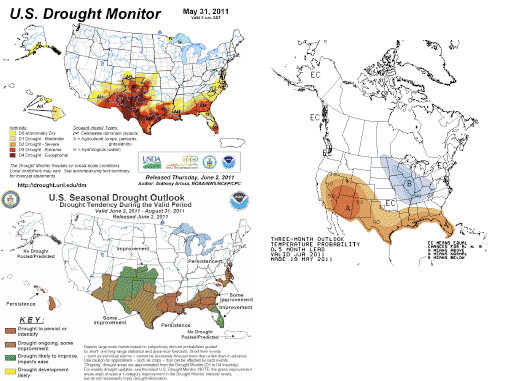
Map monitoring droughts throughout the U.S., drafted by Gottschalck.

Then what’s usually on your afternoon agenda? Often, I’m involved in meetings and coordinating new research projects. I also work on my own set of research projects to help move forecast skills forward.

What types of research projects are you working on right now? I’m looking at how changes in the deep tropics – such as El Niño and La Niña – can have an impact on where we live [in the Northeast]. El Niño is characterized by unusually warm temperatures, and La Niña by unusually cool temperatures in the equatorial Pacific. We’re trying to learn as much as we can from tropical rainfall patterns to improve weather forecasts in the two, three, and four-week future.

Who have you always wanted to meet? Max Mayfield, the director of the National Hurricane Center during Hurricane Katrina.

How do you explain all the crazy weather lately, from tsunamis to hurricanes? There have been lots of media requests for us to explain what’s going on in relation to the climate. It’s difficult to say, because very often, these things [extreme weather events] just happen. It’s the normal variability in the atmosphere. There’s no clear metric bullet why this is happening, but it’s not necessarily related to climate change.

What did you think of the movie The Day After Tomorrow? It’s not realistic, and way over the top, even in our changing climate world.

Does your job deal with long-term climate change, like global warming? There are two types of climate change: long-term projections, like 100 years, and short-term climate projections, which is what we focus on. So we don’t really deal with global warming – we’ll send people to the Geophysical Fluid Dynamics Laboratory to deal with those questions.

What did you do at NASA? I studied interactions between land and the atmosphere, and how that impacts climate.

Do you wear your pajamas inside out in hopes of snow days? We joke that when weather forecast models predict a big snowstorm a week or more ahead of time, [the snowstorm is] never going to happen. When the models don’t predict snow – that’s when there’s hope.

Something people don’t know about your job: The public doesn’t have a handle on how far weather forecasting has come over the past 30 to 40 years. Although predictions certainly fail at times, they’re relatively accurate, but the public is quick to criticize. When I was a child, forecasts wouldn’t go out more than four days in advance. Now, we issue detailed ones for a week and beyond. But no forecasts are foolproof, even 24-hour ones.

Something people don’t know about you: I’m a lot calmer at work than I am at home. I have three kids.

Ron Burgundy and Jon Gottschalck have very, um, different approaches to covering the weather. Photo credit: dreamworks.com

LAUNCHING YOUR CAREER>>
Want a career in weather? Jon Gottschalck tells you what you need to know.

1. Measure your interest in math and physics; those two subjects are the basis of meteorology. I’m talking about hardcore science, not just pretty radar pictures or maps. You also need a very good background in weather and climate, which can range from understanding synoptic meteorology (day-to-day weather) to understanding El Niño. One way to acquire this background is by interning or volunteering at a local weather center.

2. Hone your computer skills on a Windows-type PC. It’s essential to know computer programming techniques and languages to process, filter, and display weather data.

3. Subscribe to and read various weather and meteorology journals. Subscription costs can rack up, but you learn a lot about science, where the jobs are, and different mini-disciplines within meteorology – from climate to oceans to space weather. Weatherwise Magazine is a good introductory publication that includes a wide range of topics, and isn’t written it total scientific jargon.

What have you always wanted to know about climate? Comment below, and your questions will be relayed to Jon!

You can follow NOAA on Twitter at @usnoaagov.

Not Quite Ace Ventura: The Pet Detective

Kat (center) with two dog trainers from Italy who flew to Seattle to take her training course.

Cop-turned-pet detective Kat Albrecht risked losing all respect from her peers when she decided to become a pet detective. In 2001, she founded a national nonprofit organization to search for missing pets and ultimately trained over 125 pet detectives from across the United States, Canada, Japan, Mexico, Ireland, and Italy.

But remaining passionate with her work isn’t always easy. Kat reveals the secrets to her commitment – and her thoughts on Jim Carrey’s portrayal of the job in Ace Ventura: Pet Detective.

Title: Founder, Missing Pet Partnership
Age: 50
Based in: Seattle, WA
Job description in one sentence: I help minister hope to grieving and broken-hearted pet owners who have lost their pets.
In the industry for: 13 years
Previous jobs: 9-1-1 dispatcher; police officer; K-9 trainer for police bloodhounds and cadaver dogs in Santa Cruz, Calif. I’m also working on a romance mystery for teens, which features a 17-year-old girl using her bloodhound to score points with a guy she has a crush on.

Why she chose nonprofit work: I want my work to exist beyond just myself, long after I’m gone.

How a roadblock sparked the job: Back in 1996, my bloodhound, AJ, escaped in the woods. I couldn’t find him, panicked, and called the sheriff’s department. They told me that they only look for missing people, and that I was on my own. I called a friend whose golden retriever had been used to track missing people, and he tracked down AJ in 20 minutes. That changed my life. A little while later, I was injured in the line of duty and had to medically retire from police work, so I attempted to form my passion for animals into a nonprofit organization.

How did you expand the concept? Using my skills and experience in crime scene work and lost person behavior, I launched the first-ever pet detective academy to train others to help people search for lost pets. Training dogs takes a lot of time, skill, and effort, so we’ve shifted direction with the economic recession to focus on developing a base of volunteer search-and-rescue teams. We’ve partnered with local animal shelters in the Seattle area to train their volunteers, and would like to blueprint that plan at shelters across the country.

Kat training a search dog to find lost cats. There's a cat inside that black mesh bag!

Was there a time you almost gave up? My first efforts failed, which was discouraging. I knew I was risking my reputation, risking looking like an idiot, risking getting scorned by my peers. That did happen.

What turned you around? One day, in 1998, I was driving down the road and saw a lost dog poster on a telephone pole that read, “please help us.” I started crying, and knew I’d never be able to forgive myself if I were to give up on the chance to make a difference in peoples’ lives.

How did you remain optimistic after initial failure? When you pioneer anything new, you end up making sacrifices. I made a decision and commitment that I wouldn’t give up, which has crossed over into other areas of my life, like losing weight. There are times when I may not be happy, but I’m committed.

What’s your biggest pet peeve? Drivers that tailgate. When I used to be a cop, I could do something about it, but now I’m so frustrated that I can’t. I can’t believe I got paid money [as a police officer] to drive fast, point guns at people, and frisk men.

Most important career advice? If you ever have a chance to be paid for your passion, then you’ve arrived. Lane Frost, a champion bull rider who died during a final bull-riding competition, once said: “Don’t be afraid to go after what you want to do, and what you want to be. But don’t be afraid to be willing to pay the price.”

Is your job anything like its portrayal in Ace Ventura: Pet Detective? I love Jim Carrey, but the movie is nothing like what we do. We’re helping people that are afraid and consumed with grief and fear, and often they don’t have happy endings.


LAUNCHING YOUR CAREER>>
Love pets and nonprofit work? Kat Albrecht offers insight into the business.

Neon posters and tagged cars are equipment Kat uses to help recover lost pets.

1. Don’t necessarily make a living around pet detective work – use it as a volunteer opportunity. It’s important to give back to the community, but make sure you have enough time to devote.

2. Stapling signs onto telephone poles isn’t the right way to go about finding pets. Check out these recovery tips, such as intersection alerts – standing near intersections with bright neon signs with the information and a number to call. That way, people who are driving will see them.

3. When a dog disappears, it’s not abducted; it goes somewhere. So it’s a matter of getting the word out there. Now more than ever, we’re trying to spread information through social media marketing. There are tons of opportunities for web-savvy teens to start their volunteer efforts that way.

You can follow Kat on Twitter at @KatAlbrecht and find the Missing Pet Partnership on Facebook. All photos are courtesy of Kat Albrecht.