The Man Behind the Macy’s Thanksgiving Day Parade

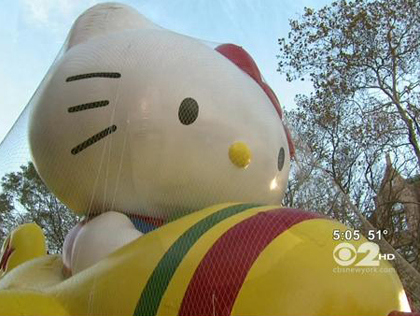
The Hello Kitty balloon is one of three new character balloons and six new floats this year. Photo: CBS 2

As Kermit, Hello Kitty, and Carly Rae Jepsen meander down 6th Avenue in New York City, thousands of onlookers ooh and aah. The annual Macy’s Thanksgiving Day Parade — celebrating its 86th anniversary this year — is as much a Turkey Day tradition as the turkey itself. For most Americans, the spectacle is all over in a few hours.

But for scores of designers and volunteers behind the scenes, the parade has meant months of plans and preparation. Yahoo! News recently interviewed John Piper, the creative director of Macy’s Studio, a “nondescript New Jersey warehouse about 30 minutes outside of New York City” where the float magic happens. He lives 364 days for one.

In the interview, the 30-year parade veteran discusses the worldwide helium shortage, challenges brought on by Superstorm Sandy, and fitting ballons through the Lincoln Tunnel (certain balloons must be disassembled). Watch it on Yahoo! News here.

See also: The Woman Behind the Macy’s Thanksgiving Day Parade, h/t @shelleytibbetts

The Naked Cowboy Reads Nietzsche

“Everyone in the world knows me, and if they don’t, they will. It’ll be Buddha, Jesus, Naked Cowboy,” Burck says matter-of-factly. Photo: facebook.com/nkdcowboy

In a dimly-lit Times Square parking lot, Robert Burck, a fair-haired man with bulging biceps and tired eyes, lounges in the driver’s seat of his pristine Cadillac Escalade. There, he remains incognito, clad in cargo shorts and a black t-shirt. Most don’t recognize him without his signature underwear and guitar strapped across his chest.

Burck — more commonly known as the Naked Cowboy — has always been one for showy displays of attention. Each morning, he drives the 20 minute commute from his motel in Secaucus, NJ, to the Icon parking lot in Times Square. By noon, he’s working the crowds, serenading tourists and posing in photos for thousands of passers-by wearing nothing but a hat, cowboy boots, briefs, and a strategically placed guitar.

Particularly prone to exaggeration and contradiction, Burck expresses an impatience for people and their faulty cameras; minutes later, he proclaims himself a “social genius.” After reading Tony Robbins’ Unlimited Power, he says, he grew obsessed with writing self-affirmations and personal goals. He reveals a stack of college-ruled papers, perhaps several hundred sheets thick, held together by a large binder clip. The papers are clearly worn: the edges fray and the dark circles and underlines on each page bleed together.

This summer, Burck’s manager sent a cease-and-desist letter to the Naked Indian, who recently started showing up in Times Square. Burck believes he is stealing his act.

The 41-year-old climbs out of his Escalade, takes off his t-shirt and shorts, and slithers into a pair of tighty-whities. They’re a boys’ size 12. “No undies when I’m not working,” he explains. A few swipes of deodorant and a quick guitar tune-up later, he swaggers out of the parking lot into more familiar territory, strumming a tune: I have tons of fun, just shaking my buns, all day long, out here in the sun. Within minutes, a crowd surges around him. Two girls giggle and point: “Oh my God, it’s that guy.” Another couple, struggling with a subway map: “This is so New York.”

Age: 41
Based in:
New York, NY; Secaucus, NJ
Grew up in: Cincinnati, Ohio
Graduated from: University of Cincinnati, Bachelor’s degree; Xavier University, incomplete Master’s degree
Previous jobs: Stripper; waiter at T.G.I. Friday’s; male model
Years in the business: About 13

Where did your identity as the Naked Cowboy originate? In 1998, I was in Venice Beach, California, shooting for Playgirl magazine. I took out my guitar, and the photographer suggested playing in my underwear. I made over $100 that day from tips. I did the same thing a few days later in Cincinnati, got arrested, and made the news. The next morning, I left town in my beat-up BMW and did the same thing driving across the country, getting arrested along the way. I finally landed in New York, and I’ve gotten better at not getting arrested.

How does one get better at not getting arrested? Don’t push the envelope, don’t be a jerk. For two years, before landing in Times Square, I would call the media and the police on myself.

Weather conditions that keep you inside: I don’t go out if it’s pouring rain, because people won’t interact with me. I stand outside during 90% of the winter and wear a full-length mink coat to warm up in between rounds. I don’t get sick; being sick is a state of mind.

A small opening in the top of the guitar collects cash. Burck also glued on a small mirror.

Source of income: I charge $1 for up to 100 photos with me, but most people stop at two. I probably make about $100 an hour, especially in the evenings. Then there’s the money from my three music albums [including an X-rated country album], my endorsement deal with Blue Island oysters, my merchandise, and the Naked Cowboy Bar and Grill that’s opening soon.

Ratio of adults to kids who approach you: Yesterday, I picked up at least 80 people off the ground, 60% of which were old people and grandmas. They’re not scared, because I’m strong as sh*t.

Your driving force: Reading and studying. I read six to seven hours a day, and have for 24 years. I read psychology, philosophy, Spanish. I want to be the smartest motherf*cker on the face of this Earth.

Currently reading: The Art of Seduction, for probably the third or fourth time. I’ve read Robert Greene’s The 48 Laws of Power at least six or seven times. And Emerson’s essays, which are sitting at my hotel – I’ve read those about 100 times.

Your hotel? For the last 13 years, I’ve lived in the Royal Motel in Secaucus, New Jersey, right outside the city. It’s only $50 per night. My mailing address is still my mother’s in Cincinnati.

Burck keeps two pairs of boots in the trunk of his car at all times. He wears each pair for two or three weeks before selling them on his website.

Where do you keep your belongings? I have a suitcase in the backseat with all my underwear, my guitar, my boots, my hat, and a few other things. My hotel room has a spare guitar, my mink coat, and a suit and tie from my high school graduation. That’s all I need.

Brand of underwear: Fruit of the Loom, which is what my mother bought me when I first started. They come in packs of six, but I always keep a seventh just in case. I wear two pairs at a time: one painted with Naked Cowboy, and one unpainted. When they get old or stained, I sell them for $50 on NakedCowboy.com.

They look really tiny. They’re a size 12, which is meant for boys who are about 114 pounds. I weigh 200-something. I haven’t missed a day at the gym since I was 17 years old.

Do you stay this tan year-round? In the winter, I supplement a little bit. Right now, even with all the sun, I have a lighter spot on my leg where my guitar sits.

How do you unwind after a long day? I go to my hotel, have a glass of wine, and write in my journal for a few hours about how great I am, how my expectations are always fulfilled, how I’m a child prodigy.

Can you read me something you wrote recently? I am the most incredibly polished, spontaneous, talented, hilarious performer of all times. [I am] the most fabulously built, ripped, and determined body and mind ever created. […] [I am] an American icon, true badass, no-fear cowboy. The only Naked Cowboy.

That seems a bit arrogant. People don’t understand humility. It’s not about downplaying yourself.

Are you religious? I’m God Almighty. The God you worship is the God you are capable of becoming, in the words of Joseph Campbell. Do you know him? J.C., Jesus Christ.

Guitar go-tos: Mostly just sh*ts and giggles, except when I play full songs and pretend I don’t see people. My guitar is just an unlikely vehicle to get people’s attention. People even tell me I can’t sing very well.

Burck meticulously documents his meals, reading logs, and schedule into black marble notebooks. To date, he estimates he has filled about 400 journals over the past 13 years.

What would people be surprised to learn about your job? Standing in Times Square is hard work. If people come up to me with the wrong attitude, I double their wrong attitude, and they scurry off in fear. I don’t waste time with people who are wasting my time.

Best part of your job: Freedom.

Most challenging part of your job: Nobody’s camera is ready. Nobody knows how to shoot a picture. After a few hours, I’m kind of like, I’m never coming here again. When it’s raining, it feels like it’s never going to shine again.

Are you dating anyone? I have a girlfriend who I see once every few days. She works at the Cranberry Café, where I’ve eaten lunch every single day for the past 10 years. When my last relationship ended, I ended up with her, because she was the only girl I knew.

Do you walk naked into the café? I’ve been in many places naked, but I don’t do that anymore. I have a key to the executive bathroom here in the Icon parking lot, where I’ve parked for free for 10 years. These guys are the best.

You mention that you’re the only Naked Cowboy, but now it’s a franchise. That happened about two years ago. There are four Naked Cowboys, myself included, and four Naked Cowgirls, all part of Naked Cowboy Enterprises at different spots throughout Times Square. They just came out of the woodwork and approached me about it. The black Naked Cowboy was selling comedy tickets in Times Square.

You ran for mayor in 2009 and announced a run for the 2012 presidency as a Tea Party candidate. Those both fizzled. Any future plans to run for office? When they knock on my door and beg me to run because I’m the best man for the job.

Dream job as a kid: I wanted to be the most celebrated entertainer of all time. I did whatever I could to have all eyes on me. Everyone was always telling me what I couldn’t do.

The tattoo on Burck’s right arm depicts a devil, and the one his left depicts Jesus. “It shows I can be as evil or as good as I want,” he says.

Like getting that tattoo on your arm? When I was 16, I was on house arrest, so I got this tattoo of the devil’s head. It was the coolest picture I could get for $60. Later, I got Jesus on my other arm to balance it out.

How do you spend your time when you’re not reading or in Times Square? That’s really it. I can be the life of any party, but why spend all that enthusiasm on a few people in a room when I can spend it on thousands of people walking through Times Square?

Does your family visit you here? I send them envelopes filled with money every week. I stamp each dollar with my Naked Cowboy stamper and sign each dollar coin.

Do you want kids? Nope, not for as long as I live. And I don’t plan on dying. Ever.

Visit the No Joe Schmo Facebook page for more behind the scenes with the Naked Cowboy (and to find out how he signs his text messages).

Follow the Naked Cowboy on Twitter at @TheNakedCowboy and on his Facebook page. All photos courtesy of Megan Hess unless otherwise specified.

The Pop-Up Paper Engineer

“I always try to push myself in new directions with the engineering,” Reinhart says. “I try not to use similar mechanisms throughout my  books.”

In a small, messy studio in Chelsea, Matthew Reinhart sits at his desk, cutting paper for children’s pop-up books and listening to Howard Stern. Star Wars memorabilia and cutesy anime posters adorn the walls. Interns – along with one full-time staffer – flit in and out.

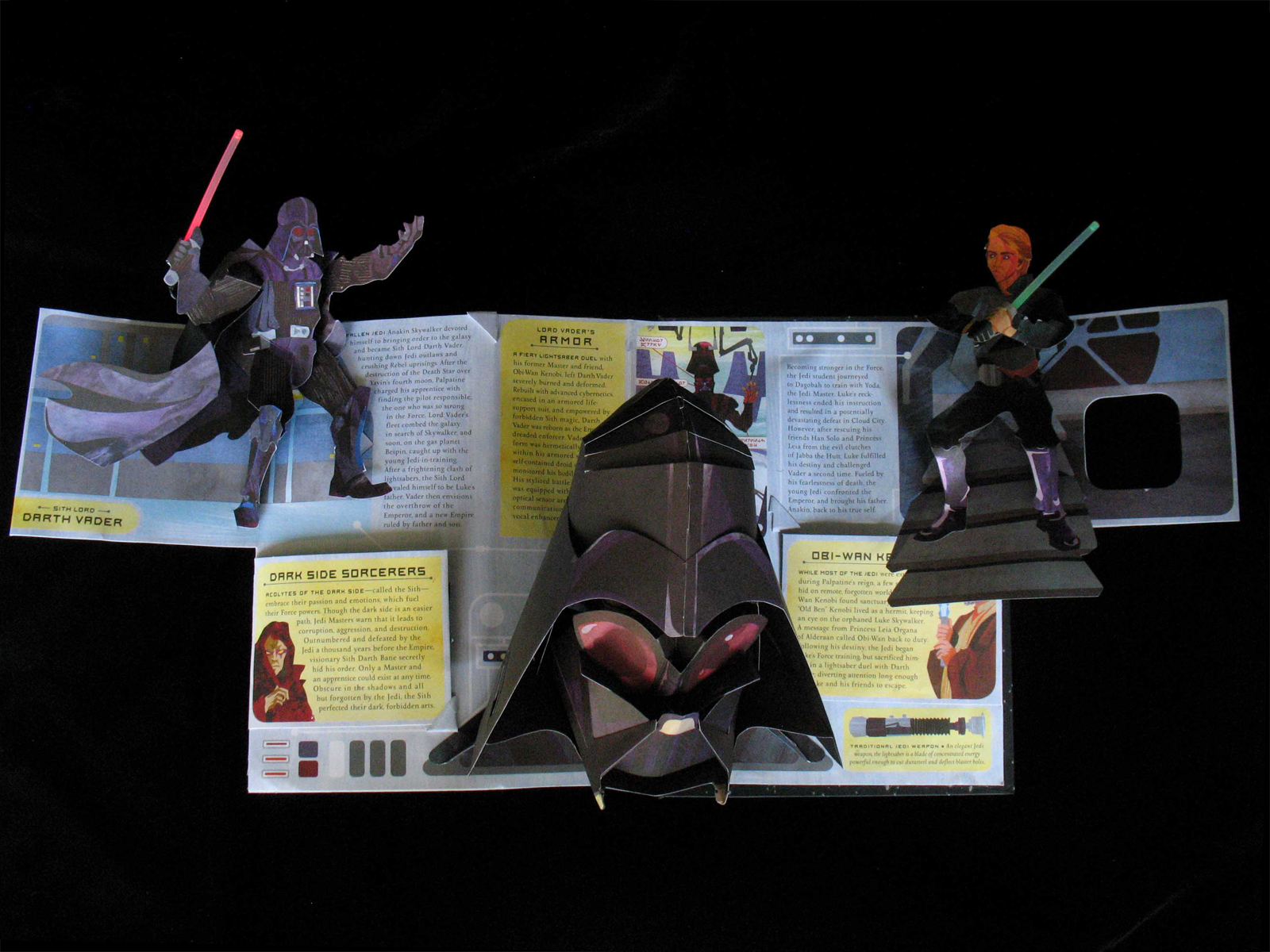
Reinhart, the author and illustrator of elaborate, awe-inspiring pop-up books like Star Wars: Pop-Up Guide to the Galaxy, typically spends about six to eight months conceiving a storyline and cutting out hundreds of pieces for one of his books, some of which are as thin as a piece of thread or as small as a speck of pepper. His newest project – a book involving large transforming robots that he is deliberately vague about – is slated to take even longer.

Many hail his work as sophisticated engineering, but Reinhart remains is bashful. “I’m just this guy who sits in a studio and cuts up paper,” he says. “I’m an art student, not a math student.”

Yet his dedication to art was not always so clearly defined. Below, the author-slash-engineer discusses how gouging out eyes from corpses at New York City morgues made him realize the importance of pursuing a career you love.

Age: 40
Graduated from: Clemson University, biology major; Pratt Institute, industrial design major
In the business for: 13 years
Based in: New York, New York

You studied biology as an undergraduate. Did you always have a hidden passion for art? I always took an interest in making things, but my parents didn’t want me to be a starving artist. They wanted me to be a doctor. So I majored in biology at Clemson, and if I ever had an elective, I took an art course. My notebooks in biology class were out of control – I drew massive ink sketches in the margins.

When did it click that you should study art instead? I got into medical school, but decided to first take a year off and live in New York. I started working at the Eye-Bank for Sight Restoration, through which I went to morgues and took out people’s eyeballs, sometimes in the middle of the night. By the time I was 22, I had been to every morgue in the New York City area. I saw a lot of dead people – a lot of whom were really young. That made me realize that life is short, and I have to do something I love.

So death inspired you to take advantage of life. [Laughs.] I went to my parents and told them I wanted to pursue art, and they were totally behind me.

Why pop-up books? I met [acclaimed children’s book author] Robert Sabuda doing volunteer work together for a local community center. When I graduated from Pratt, I began working with him on a book, and then we began co-authoring books. It grew bigger, and I started my own projects.

At the end of Star Wars, pieces of an Anakin Skywalker pop-up fold away as the light saber turns from blue to red. The pop-up fully transforms into Darth Vader.

What would people be surprised to learn about your job? It’s a lot less technical than people think. I’m an art student, not a math student. I don’t sit here with my trigonometry calculator and figure out the sine or cosine; I cut paper and see if it works.

Which comes first: pop-ups or words? Words are almost always first. Once we agree on a manuscript – which is like writing a term paper only three pages long – we outline what will go on each page. Then, I create the rough pop-ups, cutting and folding paper, which takes two or three months. Next is the cut-paper collage and placement in the digital file. One book might have 200 to 300 separate pieces.

Time span of creation, from start to finish: About six to eight months, but Star Wars took a little longer.

Tools used: 110-lb. cardstock; scissors; white artist’s tape; double-stick tape; white glue (similar to Elmer’s); scanners; and X-Acto blades. I use tweezers to pick up the really small pieces.

Do you use computers for design, or just implementation? Some people make pop-ups totally on the computer, but we don’t. You don’t know how all the pieces are going to fit together unless you’re holding them in front of you.

Last year, eBooks passed print in adult fiction for the first time. Pop-ups can’t exactly be digitized. Do you perceive that as a disadvantage? It’s a really weird time, and there’s a lot of nervousness in the publishing industry. Some of my work has slowed down, but I think kids will always play with [physical] books, especially picture books.

Do you use an eReader? My iPad is easier when I’m traveling, and I can get a lot of different comic book titles on it without worrying about collecting them. But if I find a really beautiful book about graffiti, I want the actual book.

This slideshow requires JavaScript.

Best part of your job: Working with amazingly creative people, like DC Comics. And I get to wear shorts to work if it’s hot.

Most challenging part of your job: Deadlines are the worst. The changing economy makes it hard to create something spectacular and also cost-appropriate.

Do you have certain ideas for pop-ups that are simply too expensive to be produced en masse? Yeah, there are certain elements. But I get to put light sabers in books, which is pretty cool.

Were you an avid reader as a kid? It’s funny – throughout my entire childhood, I didn’t really have any pop-up books. I wasn’t a big reader. I remember faking a report for A Wrinkle in Time using the liner notes on the book’s inside flap. I wasn’t even smart enough to use CliffsNotes! So now, I think about how I can pull in young readers who aren’t so interested in reading – the young versions of me.

In the New York Times, David Pogue wrote that calling your Star Wars book a pop-up book was like calling the Great Wall of China a partition. That was one of the most amazing things to have ever been written about me. I truly love this work, and sure, there are times when I’ve neglected my social life or personal life for it. But it’s very much a part of me.

One book character you’re dying to meet: The Cat in the Hat or Horton would be pretty cool. Optimus Prime would also be pretty kickass.

Your required reading: I did a book with Maurice Sendak – rest in peace – I love his work. The artwork of Mercer Mayer and Peter Spier is fantastic, too.


LAUNCHING YOUR CAREER>>
1. Paper engineering is a competitive field right now, especially with the emphasis on digital media. Be persistent and look around at what exists – then make sure you’re doing something completely different.

2. Acknowledge that you won’t be on top in the beginning. You’ll spend a lot of time working under someone else, paying your dues and being patient. Don’t assume, I made this book, so it should be published. [Success] doesn’t always come quickly.

3. Invest in a copy of The Elements of Pop-Up by David A. Carter and James Diaz.

Follow Matthew’s work on his blog and learn how to create your own Darth Vader pop-ups on his website.

For more crafty No Joe Schmos, check out the miniature food artist, the roller coaster engineer, and the textile jeweler.

The SNL Cue Cards Guy

“When you’ve been holding up 22″ x 40″ cards for 22 years, you develop muscles,” says Wally Feresten. “But with that muscle comes ache.” Photo: steph-was-here.tumblr.com

Wally Feresten rolls over in bed around noon on Sunday, struggling to open his eyes. He’s had a long night; he didn’t get home until 5 a.m., and his entire upper body aches. He’ll have the next few days to recuperate, but on Thursday, it’s back to Studio 8H at 30 Rockefeller Plaza, where he’s responsible for making sure all the actors and celebrities know exactly what to say come 11:30 p.m. EST on Saturday night.

Feresten started working as a cue cards guy on NBC’s Saturday Night Live more than 20 years ago, when he was almost fired for sloppy handwriting. But now he runs the show with precision and a sense of calm that is unusual for a job that requires rewriting cue cards for sketches just minutes before they air. Over the years, he has written episodes for a variety of sitcoms; but most of his writing still involves printing large letters exactly the right space apart on swaths of recycled cardstock, which he orders in batches of 10,000 and stashes beneath the bleachers in Studio 8H.

Sometimes, Feresten feels uncomfortable telling people what he does for a living. He explains that his company, NYC Q-Cards, handles all the cue card work on SNL and Late Night with Conan O’Brien, plus many other award shows, live specials, and commercials. Then he politely inquires about the professions of his new acquaintances. Oh, I’m an accountant, they’ll say. I can’t compete with that.

Age: 46
Graduated from: Syracuse University; studied television/radio/film and writing
In the business for: 22 years
Based in: New York City

Previous jobs: After graduation, I lived in Los Angeles for three years, writing scripts. I didn’t have much luck, so I moved to New York, where my brother had just started writing for the Late Show with David Letterman. He helped me get a job writing cue cards there.

Was handwriting a major factor in the hiring process? Actually, my handwriting was horrible. I had to do about half an hour of duping during my interview, which is the process of copying text from card to card. But [the job is] also a lot about getting along with everyone – you have to work long hours under stressful conditions. They liked my personality, and as for handwriting, said they’d seen worse.

Did your handwriting improve? During my first six weeks at SNL, my trainer Tony Mendez wouldn’t use any of my cards because they didn’t hold up to his standards. He was looking for an excuse to fire me. During one show, he threw me into a line of fire. For the first card, I had to stand on a ladder; for the second, lie on my stomach; for the third, get on my knees. I did it perfectly, which pretty much saved my job. Within three years, I was running the show at SNL.

Do you move around for a majority of the show? If the actors in a sketch are looking directly into the camera – say, for a press conference with Kofi Annan and President Obama – I’ll stand in place. For other sketches, I’m constantly adjusting my height so the actors can always see the cards. It’s like a choreographed dance.

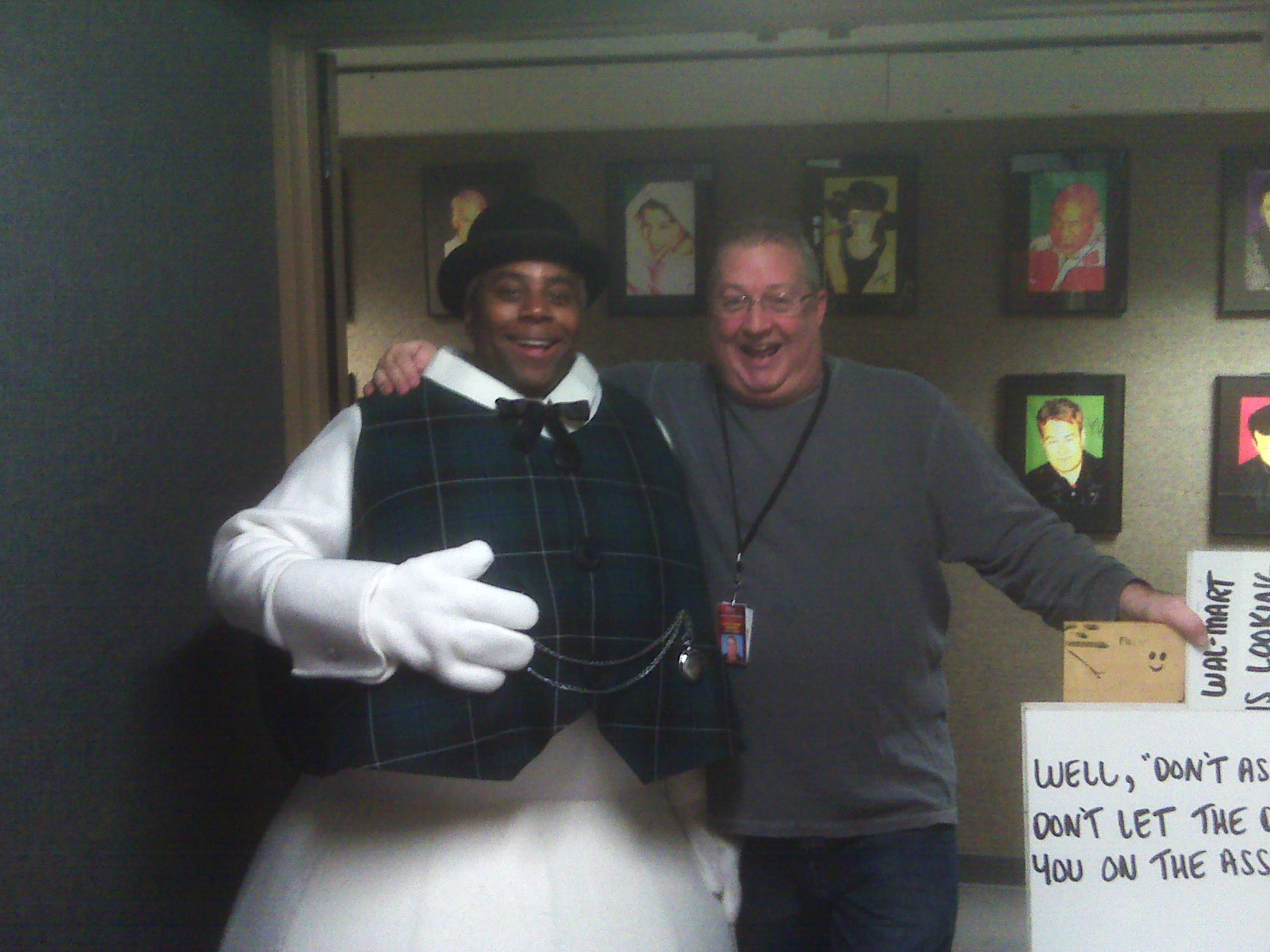
Wally Feresten (R) with Keenan Thompson on the set of SNL.

Are you right-handed or left-handed? Right-handed, as most cue card people are. If you are left-handed, your left hand would typically smudge the printing on the card. But you have to be good with both arms. You’re holding one card steadily in the palm of one hand, and balancing the other 7 to 20 cards in your other palm. I’m pretty sore at the end of the day.

Do you have noticeable muscle strain? Over the past eight years, I’ve gone to physical therapy for tendonitis in my left elbow, right elbow, left shoulder, and right shoulder. But I’m feeling pretty good now, knock on wood.

The New Yorker called preparing and holding cue cards a “dying art,” and that was more than 10 years ago. I’m surprised the industry hasn’t digitized. Timing rules everything. If a computer goes down or gets unplugged during a live show, it’s a disaster. Producers won’t allow that.

To what extent do actors improvise during SNL? They can only improvise during rehearsal, not during the actual show. [Improvising] doesn’t make sense, anyway, since writers are rewriting up to the last minute.

Define “the last minute.” We’ll do rewrites until anywhere from 12 a.m. to 12:15 a.m., sometimes rewriting a sketch just a few minutes before it starts. [Editors’ note: SNL airs from 11:30 p.m. to 1 a.m. EST].

That sounds very high-stress. How do you cope with the pressure? I love the adrenaline rush, and I don’t panic. I think that’s why they picked me to do the job 19 years ago.

You undoubtedly have front-row access to some of the most important moments in TV history. An especially memorable one was holding cards for Mayor Giuliani two weeks after September 11, with firemen standing behind me, when we were the first comedy show to come back on the air. It’s also pretty fun seeing pairs meet for the first time in the dressing rooms to discuss their monologues: Sarah Palin and Tina Fey, Jesse Eisenberg and Mark Zuckerberg.

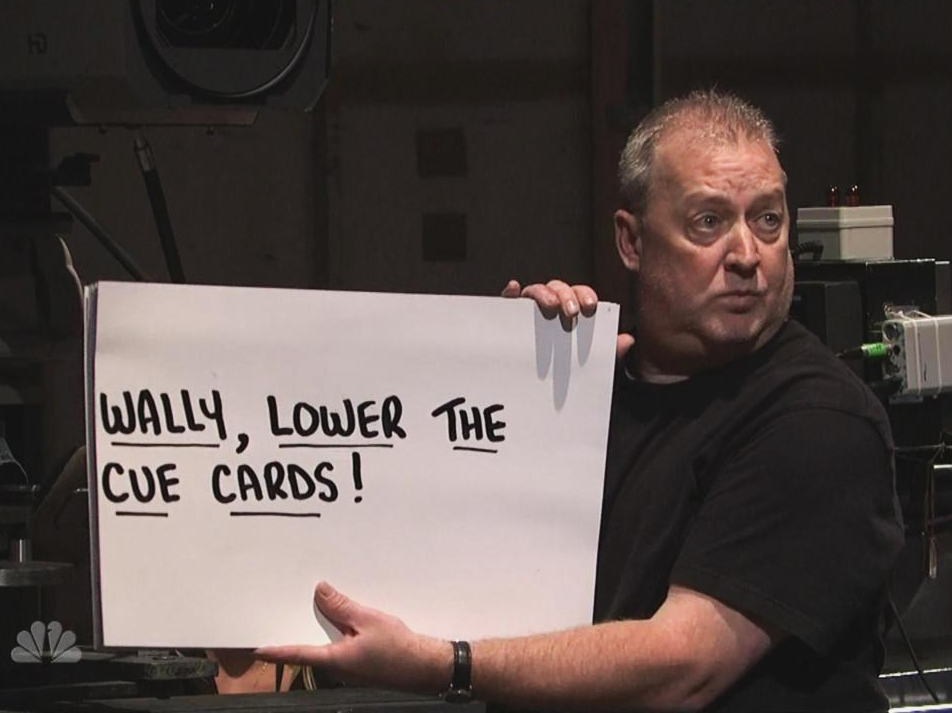
I love the Mother’s Day episode when Will Ferrell hosted. He told you to lower the cards so he could talk to his mom on stage “unscripted.” Was that scripted? Yes. Adam McKay, who used to work for SNL and now writes and directs with Will Ferrell, wrote that. I get my best reviews for that performance.


Writing utensils: M99 markers, which are big, thick, silver pens that we unscrew and fill up with ink. The fumes are really bad for you, so we try not to inhale too much.

Best part of your job: Making friends with cast members and working with our celebrity hosts. After Paul Rudd hosted for the first time, I sent him his monologue cards, and he told me he has them hanging around his house. I’ll do that for young actors who haven’t hosted before and are really excited about it.

Most challenging part of your job: Getting through the day on Friday, when we start rehearsal at 1 p.m. and aren’t done until midnight or 1 a.m. It can be tough to stay focused, especially when it takes two hours to block one sketch.

Walk me through your week. I don’t work Sundays through Wednesdays. Thursdays are light days; we rehearse three or four sketches and are out by 5 p.m. They don’t want to scare the host too much. Fridays are long and hard. Saturdays we rehearse all day, do two shows, and then party.

Do you usually attend the SNL after-parties? Yes. You get such an adrenaline rush from the live shows, that even when I just go home, I can’t fall asleep until 5 a.m. Lots of alcohol helps you relax. Then, on Sundays, I’m a mess. I get home really late, which is tough on my wife and two sons, who are 12 and 10. They let me sleep until noon.

Feresten’s company, NYC Q-Cards, also works on the set of Late Night with Jimmy Fallon. Photo: sheknows.com

Do you foresee a future in comedy for your kids? I wrote some stand-up for my older son, who performed on Late Night with Jimmy Fallon, and he totally killed.

What would people be surprised to learn about your job? The number of people who still ask whether SNL is a live show.

Best reaction to telling a stranger about your line of work: It kind of halts the conversation. Sometimes, I’ll go through my spiel about meeting celebrities, and the other guy will be like, Oh, I’m an accountant.

Most important lesson learned: The rewrite process is the most important part of writing comedy. That’s sometimes the hardest thing for a writer, since you might not want to mess with your work.

Do you consider yourself a funny guy? I do. [Laughs.] Growing up, we listened to a lot of George Carlin albums, and I always want to be a comedian.

Any summer plans while SNL is on hiatus? [NYC Q-Cards] is doing three shows at the same time: Ink Master, a tattoo reality show on Spike TV; Project Runway on Lifetime; and Late Night with Jimmy Fallon on NBC.

Salary per show: For most New York shows, I normally charge $500 for an eight-hour day. SNL is a different beast, though. And the cards cost about $1,700 for a 10,000-card order.

I read that your legal name is Chris Feresten. What’s that about? My brother nicknamed me Wally when we were kids, and it kind of stuck.


LAUNCHING YOUR CAREER>>
Practice your printing – that’s copying from script to cue cards. Meet people doing cue card work and have them show you how to hold the cards; you need someone with connections to vouch for you.

Meet more No Joe Schmos who wield pens as swords: the fountain pen doctor, the tattoo artist, and the CollegeHumor.com editor.

CEO Files: The CouchSurfer

"CouchSurfing attracts anyone who is interested in having authentic connections," CouchSurfing CEO Dan Hoffer says.

Couches can speak volumes about one’s style and personality. A leather reclining sofa may suggest luxury and low-maintenance, while a brightly colored sectional may suggest versatility.

In his time, Dan Hoffer has come to know hundreds of people through their couches. Eight years ago, he co-founded CouchSurfing.com, an online network that connects travelers across the globe, allowing them to “bypass the typical hotel experience by staying at the home of a local and learning about their culture.” Once threatened by a database crash that nearly shut down the site for good, CouchSurfing now boasts millions of members in over 230 countries and territories around the world.

Age: 34
Graduated from: Undergraduate studies at Harvard University; MBA from Columbia University
Based in: San Francisco, Calif.
Has held the position for: Co-founded CouchSurfing eight years ago and served as chairman of the board; starting working full-time as its CEO almost two years ago
Previous jobs: Entrepreneur in residence at a venture capital firm; executive at Semantic Technologies, a large software company

What do you do at work all day? As the CEO, I spend most of my days in meetings. I meet with everyone in the company at least once a month, and get involved in certain projects involving project strategy, communication strategy, and fundraising. CEOs need to be generalists.

Inside the CouchSurfing headquarters in San Francisco.

Something people would be surprised to learn about your job: In a leadership position, everyone watches what you do very carefully. I’ve seen people make judgments about visitors to the office based on how warmly I greeted the person.

How often do you CouchSurf? A few times a year. I’ve been to Japan, Korea, Sweden, France, Senegal, Mexico, Puerto Rico…the list goes on.

Is your own couch available to CouchSurfers? Yes, I do hosts on occasion.

Dangers of the process: Cultural misunderstanding is the biggest one, where you don’t get along on a social level with the person you meet. There’s no vetting beforehand to match people socially, but you can look at profiles and photos to get a good sense of people.

Without vetting, how do CouchSurfers know they’re staying in a safe place? It’s like online dating. You can go meet a stranger that you met on the Internet, and you don’t know if they’re going to be a nice person or an axe murderer. With CouchSurfing, you look at profiles and references left by others. We have a vouching system and an identity verification system.

Coolest part of the process: The people and the sense of community. CouchSurfing enables you to find people to meet and activities to join.

Hoffer hosts a presentation at the company's headquarters.

Biggest setback: In 2006, we had a big database crash that threatened to destroy CouchSurfing. We were planning to shut it down, but the community rallied. Thousands of volunteers wrote to us, offering to help restore the website. With their help, we did.

Best part of your job: Supporting our community of millions of members so they can experience life-changing moments. I asked one 26-year-old German CouchSurfer about her best CouchSurfing experience, and she talked about climbing a 150-foot crane in London. She had been staying with someone whose hobby was climbing skyscrapers.

Most challenging part of your job: Balancing conflicting agendas. [The CouchSurfing community] doesn’t want to pay anything, but at the same time, they want an amazing website. To build an amazing website, you need to hire amazing people who cost money.

Target audience: We tend to have more participants in their 20s and 30s, but we also have people in their 70s.

Minimum age to sign up for CouchSurfing: 18.

Best advice for recent graduates: Learning how to think in any particular discipline is invaluable. While at Harvard, I took a semester off to work on a ranch in Texas for a former Marine Corps sergeant. I learned a lot about leadership by hauling hay and building fences for him.

Okay, so it's not quite a couch...

Like what? At the time, I never guessed there would be any professional career applications. But in reality, there have been quite a few, like how to lead effectively, how to listen, and how to deal with different skill levels.

Most memorable traveling experience: I trekked through the jungle in Borneo and hiked through the Virgin Rainforest.

Your indispensable gadget while traveling: Chromebooks.

What’s always in your backpack? A water bottle and flashlight.

If you had all the money and resources in the world, what business would you start? I would focus on African refugee relief.

LAUNCHING YOUR CAREER>>
Focus on learning from the people you respect the most – not necessarily in fields that seem professionally oriented. Pursue a career where you can excel.

Follow CouchSurfing on Twitter at @CouchSurfing. Photo, top: Meredith Hoffer. Rest of photos: Jim Stone, CouchSurfing.com.

PLUS: For more high-powered No Joe Schmos, check out the CEO of Chicago’s Lincoln Park Zoo and the founder/CEO of Home4Dance